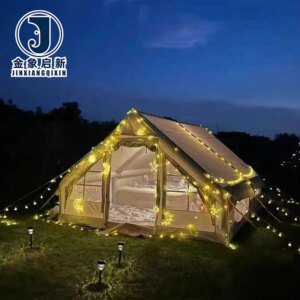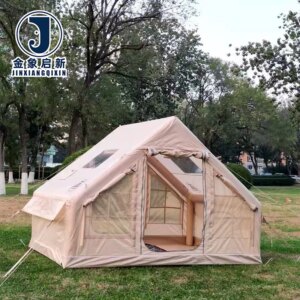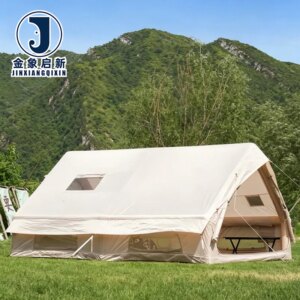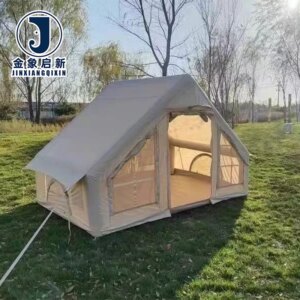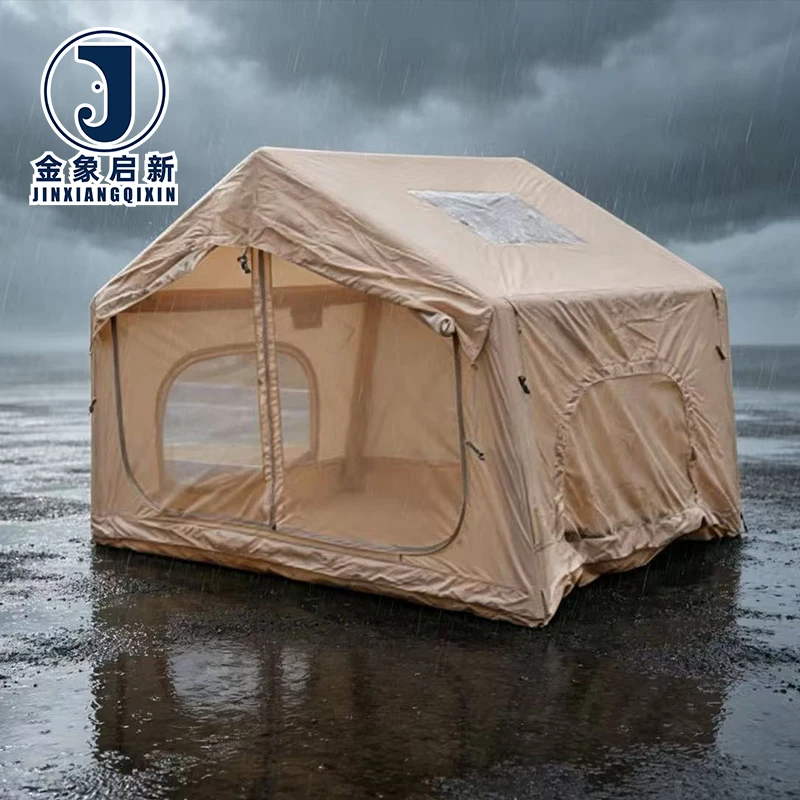
Near 30-Year Coated Fabric Focus — Process control over coating weight and adhesion refined across three decades of PVC production, applied directly to inflatable tent fabric performance.
Technical Specifications
| Parameter | Value |
|---|---|
| Product Type | Inflatable Camping Tent |
| Core Material | Waterproof UV-Resistant PVC Fabric |
| Key Performance | Waterproof, UV-Resistant, Quick Auto Opening |
| Product Forms | Inflatable Camping Tent |
| UV Treatment | Available in UV-resistant grades — confirm the UV test standard required for your market (test basis not stated in source) |
| Waterproof Rating | Available in waterproof grades — confirm the waterproof rating required for your application (grade not stated in source) |
| Customization Service | OEM & ODM with sample customization and pattern printing |
| Quality Control | Full-process inspection with dedicated QA & QC staff |
| Production Capacity | 3 full production lines, 36 sets of professional equipment |
| R&D Capability | 10 technicians supporting material selection and sample development |
| Certifications | ISO 9001, ISO 14001, ISO 45001, CE |
Application Suitability
| Application | Exposure & Requirement |
|---|---|
| Outdoor event shelters | Sustained sun exposure, wind loading on inflated structure, frequent assembly and disassembly requiring fabric flexibility |
| Temporary storage at construction sites | Dust and debris impact, UV degradation over extended placement, protection of equipment and materials from rainfall |
| Mobile field stations for engineering projects | Rapid deployment demands, repeated inflation and deflation cycles, transport abrasion during relocation |
| Commercial logistics outdoor shelters | High visibility requirements, weather resistance through seasonal changes, structural integrity under continuous inflation pressure |
Why Verified Fabric Performance Matters More Than Tent Specifications Alone
Inflatable camping tent structures live or die by the coated fabric envelope, not the air pump.
Fleet operators and construction contractors have experienced shelters that look adequate on the quotation sheet but degrade under real exposure conditions. The PVC coating weight determines how the material handles continuous internal pressure against wind gusts. UV treatment without a documented test basis means you cannot predict when the fabric surface will begin to chalk or lose tensile integrity. When an inflatable camping tent fails in the field, it is almost always the fabric that gives way first — at a seam, at a stress point, or across a UV-weakened panel [NEED_CITE: common failure modes in inflatable shelter fabrics under continuous pressure loading].
Deployment Speed That Matches Fleet and Site Operational Tempo
Transport fleet managers cannot afford shelter setup procedures that consume half a shift. The quick auto opening mechanism on this inflatable camping tent reduces deployment to a matter of minutes rather than hours, meaning your crew spends time on the actual job instead of wrestling with pole-and-canvas assemblies. For mobile field stations that relocate as the project moves, rapid deflation and packing are equally important — the PVC fabric retains flexibility across typical outdoor temperature ranges, folding without crease damage that could compromise the coating layer.
PVC Coated Fabric Behaviour Under Continuous Inflation Load
An inflatable structure places constant outward pressure on every square metre of its envelope. The PVC coated fabric used in this inflatable camping tent must resist this sustained stress without creep deformation at the welded seams. Heat-welded joints on PVC coated fabric create a bond that, when properly executed, approaches the base fabric strength — but execution quality varies significantly between manufacturers [NEED_CITE: weld strength testing methodology for PVC coated fabrics]. The 10-technician R&D team works with heat welding parameters specific to the coating formulation used, ensuring seam integrity matches the panel material.
Understanding Material Properties That Determine Shelter Lifespan
The PVC coated fabric performance depends on the interaction between base fabric denier, weave density, and coating weight applied during manufacturing. A heavier coating does not automatically mean better performance if the base fabric lacks sufficient tensile capacity to carry the load. Waterproof performance in PVC coated fabrics comes from the coating layer fully encapsulating the weave — any gap in coverage becomes a water ingress point under sustained rain exposure. UV resistance depends on additives integrated into the PVC compound during the coating process, and the effectiveness of these additives can only be confirmed through standardized accelerated weathering tests [NEED_CITE: UV resistance testing standards for PVC coated textile materials]. The coating method — whether knife-over-roll, dip, or calender — affects how deeply the PVC penetrates the base fabric weave, which in turn influences peel strength between coating and substrate.
What Happens When Fabric Specifications Are Assumed Rather Than Confirmed
An inflatable shelter operating under continuous internal pressure will reveal material weaknesses faster than a static cover. If the UV treatment level was specified generically rather than verified against a test standard, surface degradation can appear within a single season of direct sun exposure, leading to chalking and eventual loss of waterproof integrity. Batch-to-batch inconsistency in coating weight means one tent from an order may perform differently from another — a serious issue when shelters are deployed as a matched set at a commercial event or project site. Welded seams that were set at incorrect temperature or pressure for the specific coating formulation will fail at the joint while the surrounding fabric remains intact, creating a repair scenario that is difficult to resolve in the field [NEED_CITE: heat weld failure patterns in PVC coated inflatable structures].
Procurement Backed by Documented Process Control
The 9,180 square metre facility operates 3 full production lines with 36 sets of processing equipment, meaning capacity exists to handle bulk inflatable camping tent orders without compressing production timelines. A 10-person R&D team develops customized samples within days rather than weeks, allowing you to confirm material hand, colour, and welding response before committing to volume. Full-process quality inspection with dedicated QA and QC staff means each production stage is checked — not just a final visual pass before packing. OEM and ODM services include pattern printing and sizing adjustments specific to your deployment requirements. ISO 9001, ISO 14001, ISO 45001, and CE documentation is available to support compliance requirements in your target market.
Documentation & Verification
- Material specification sheet stating PVC coating formulation and base fabric construction
- Batch quality inspection report generated before dispatch from the production facility
- UV and waterproof treatment test documentation available upon request with standard references
- ISO 9001, ISO 14001, ISO 45001, and CE compliance certificates provided with shipment
- Pre-shipment inspection record covering dimensional accuracy and visual quality checks
- Customization parameter descriptions documenting OEM pattern printing and sizing specifications
Fabrication, Handling & Storage
- Heat weld temperature and dwell time must match the specific PVC coating formulation to prevent seam delamination under inflation pressure
- Store PVC coated fabric rolls or folded tent assemblies in shaded, ventilated areas to prevent UV exposure before deployment
- Avoid sharp fold creases during packing that can crack the PVC coating layer and create water ingress paths
- Clean surfaces with mild detergent only — solvent-based cleaners will dissolve the PVC plasticizer and compromise flexibility
- Inspect welded seams at high-stress connection points before each inflation cycle for early signs of peel separation
- Inflate to recommended operating pressure only — over-pressurization accelerates coating creep at panel edges
Requesting a Quotation That Matches Your Actual Requirements
Provide your deployment environment details including typical wind loads, expected duration of continuous inflation, and sun exposure intensity for the operating region. Specify whether you need standard sizing or custom dimensions with particular pattern printing or branding requirements. Indicate the compliance standards your market requires — whether UV test reports, fire classification documentation, or material safety certifications. State your projected order volume and whether you need samples developed for field testing before committing to full production.
Frequently Asked Questions
Q: How is waterproof performance verified before shipment?
A: Each production batch undergoes inspection by dedicated QA and QC staff before dispatch. The inspection includes visual checks of the PVC coating continuity across all panels and welded seams. Waterproof rating test documentation can be provided upon request — specify the test standard your application requires when placing the inquiry so the appropriate verification is prepared alongside the batch inspection report.
Q: What UV-resistant treatment test basis applies to this inflatable tent fabric?
A: UV-resistant additives are integrated into the PVC compound during the coating process. The specific test standard used to verify UV performance depends on your market requirements. Request the UV treatment test documentation when submitting your inquiry, and specify which accelerated weathering standard — such as ISO or ASTM protocols — your procurement specification calls for so the correct report is included with your shipment.
Q: What does the OEM and ODM customization process include?
A: OEM and ODM services cover sizing adjustments, pattern printing, and material parameter modifications. The 10-technician R&D team develops customized samples for your confirmation before mass production begins. Provide your dimensional requirements, colour references, and any branding specifications with your inquiry. Sample development allows you to verify fabric hand, colour accuracy, and welding response before volume commitment.
Q: How do I obtain batch inspection reports and material certificates?
A: Batch quality inspection reports are generated as part of the full-process quality inspection system and are available with each shipment. Material specification sheets, ISO 9001, ISO 14001, ISO 45001, and CE compliance documentation are provided as standard. Request these documents explicitly when confirming your order to ensure they are included in the dispatch documentation package alongside the packing list.