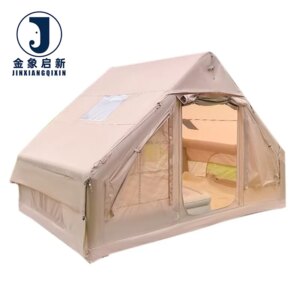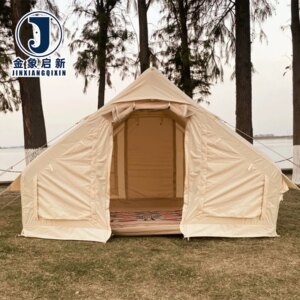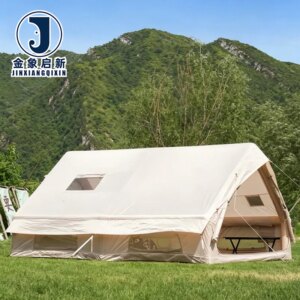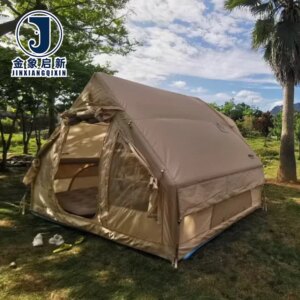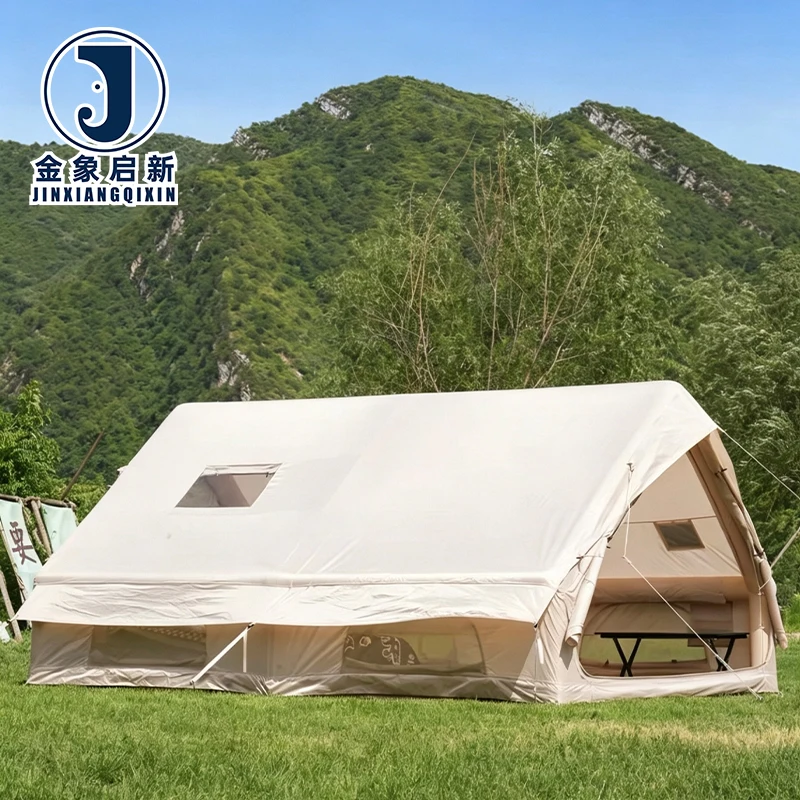
Consistent Roll-to-Roll Quality — every production batch of inflatable tent fabric undergoes full-process inspection with 100% pre-shipment verification, eliminating the colour variation and coating-weight drift that plague multi-roll orders.
Technical Specifications
| Parameter | Value |
|---|---|
| Product Type | Inflatable Tent Fabric |
| Core Material | PVC Tarpaulin |
| Construction | Single-layer PVC coated fabric |
| Key Performance | Waterproof, tear-resistant |
| Fire Retardant | Available in flame retardant grades — confirm the grade required for your market |
| UV Resistance | Available with UV-resistant treatment — request test basis before order confirmation |
| Anti-static | Available with anti-static treatment — confirm standard required for your application |
| Design Application | Four-season inflatable tent structures, 8–10 person capacity configurations |
| Customization | OEM & ODM, sample customization, pattern printing, structural adjustments |
| Standards | ISO 9001, ISO 14001, ISO 45001, CE |
Application Suitability
| Application | Exposure & Requirement |
|---|---|
| Commercial family camping tent production | Repeated inflation cycles, ground abrasion, prolonged sun and rain exposure, consumer-grade handling |
| Professional outdoor adventure shelters | Harsh weather across seasons, rapid deployment demands, transport abrasion during field logistics |
| Event and festival temporary structures | Crowd-density safety compliance, wind-load flexing, multi-day continuous inflation, branding visibility |
| Team accommodation and expedition base camps | Extended field deployment, temperature fluctuation, high humidity and soil contact at base perimeter |
| Rental fleet inflatable shelters | High-frequency pack-and-unpack cycles, varied operator skill levels, cleaning chemical exposure between uses |
What "Flame Retardant" Really Means for Inflatable Tent Fabric Sourcing
A flame retardant claim without a named grade is a liability, not a feature.
When you source Inflatable Tent Fabric for commercial tent manufacturing, the fire safety requirement at the event venue or campsite jurisdiction will reference a specific test standard — DIN 4102, NFPA 701, or a local building-code classification. A supplier stating "flame retardant" without identifying which grade the material achieves leaves you exposed at the compliance check. I have seen entire tent inventories held at customs or rejected at venue inspection because the fabric documentation did not match the fire classification the local authority required [NEED_CITE: fire classification standards for temporary membrane structures]. The responsible approach is to confirm the exact grade your target market demands and verify the test report matches your production batch before the order ships.
Coating Weight Control Across the Full Roll Length
When manufacturing inflatable tents from PVC tarpaulin, the coating weight must remain uniform from the first metre to the last. Variation in coating thickness directly affects how the fabric behaves during hot-air welding — a lighter section will overheat and weaken at the seam while a heavier section may not bond fully. Our production process controls coating application with dedicated QA checks at each stage, so the Inflatable Tent Fabric you receive welds predictably across every panel of your tent design.
Colour Matching from First Roll to Last
Batch colour consistency matters the moment two panels from different rolls sit side by side on a finished tent. For commercial inflatable tent manufacturers producing branded product lines or event shelters, visible colour shift between rolls triggers returns and reputational damage. We maintain colour reference standards across each production run and verify every roll against the approved reference before it leaves the facility [NEED_CITE: colour consistency measurement methods for coated fabrics]. This discipline means your multi-roll Inflatable Tent Fabric order arrives with uniform colour across the entire shipment.
Understanding How PVC Coating Adhesion Affects Welded Seams
The bond between the PVC coating and the base fabric determines whether a welded seam holds or delaminates under inflation pressure. In inflatable tent structures, the seams carry continuous stress from internal air pressure combined with wind-load flexing. Coating adhesion depends on the formulation, the curing temperature profile, and the base fabric preparation before coating. A coating that separates from the yarn structure — known as delamination — typically appears first at welded joints where heat and mechanical stress concentrate. Selecting Inflatable Tent Fabric with verified coating adhesion ensures the seams perform as long as the fabric itself, rather than becoming the first failure point.
Reading GSM Correctly — Why Weight Alone Misleads Buyers
Grams per square metre tells you how much material is in a given area, but it does not independently predict tensile strength, tear resistance, or weld integrity. A heavier GSM achieved by adding filler to the coating compound may actually reduce tear performance compared to a lighter fabric built on a high-denier base yarn with tighter weave density. For inflatable tent applications, the base fabric denier and weave construction work together with the coating weight to determine how the material resists puncture during ground contact, how it handles repeated inflation stress, and how cleanly it welds at seam intersections. Evaluate the complete specification — base yarn, weave density, and coating formulation — rather than quoting on GSM alone.
The Hidden Cost of Specifying Fabric Without Matching the End Use
Choosing Inflatable Tent Fabric based solely on the lowest acceptable GSM or an unverified performance claim leads to predictable failures downstream. A coating weight too light for the tent’s panel size results in excessive flex fatigue at fold lines during packing and transport. Fire retardant treatment without documentation means the tent cannot be legally deployed at regulated venues. Colour drift across a production run forces the manufacturer to sort and match rolls manually, adding labour cost and delaying shipment [NEED_CITE: cost impact of batch inconsistency in coated fabric procurement]. Each of these outcomes traces back to a specification decision made at the sourcing stage — decisions that are straightforward to correct when you align the fabric specification with the actual deployment conditions.
Why Source Inflatable Tent Fabric Through This Production System
Nearly 30 years focused exclusively on coated fabric gives our team process depth that general-purpose suppliers cannot replicate — we understand how PVC formulation choices affect weld behaviour in inflatable tent applications specifically. Three full production lines and 36 sets of professional processing equipment provide the capacity to fulfil bulk roll orders with reliable scheduling. A 10-person R&D team handles material selection, pattern printing, custom sizing, and sample development so you can validate the fabric against your tent design before committing to bulk. Dedicated QA and QC at every production stage, with 100% inspection before shipment, catches coating defects, colour drift, and GSM deviation before they reach your factory. Samples are developed within days for custom requirements, compressing your product development timeline.
Documentation & Verification
- Material specification sheet stating PVC tarpaulin composition, base fabric details, and coating formulation for each roll
- Test reports for UV-resistant and flame retardant grades matched to production batch — request before order confirmation
- Pre-shipment inspection record confirming 100% roll-by-roll verification against stated specifications
- ISO 9001, ISO 14001, ISO 45001, and CE certificates available for regulatory and compliance submissions
- Roll packing list with individual roll identification supporting traceability through your fabrication process
Fabrication, Handling & Storage
- Hot-air welding temperature and speed must be calibrated to the specific PVC coating formulation — request our recommended parameters before production setup
- Store rolls horizontally on padded racking to prevent permanent creasing in the PVC coating layer that transfers to finished tent panels
- Allow fabric to acclimatise to workshop temperature before unrolling and cutting to minimise dimensional shift during panel fabrication
- Use compatible PVC-based repair adhesives for field repair kits supplied with finished inflatable tents
- Plan panel cutting layout to maximise roll-width utilisation and minimise welded seam count in high-stress inflation zones
How to Structure Your Fabric Enquiry
To provide an accurate specification recommendation and sample for your inflatable tent project, share the deployment environment your tents will face — including expected weather exposure, inflation duration, and any fire safety classifications your target market requires. Let us know the roll width and annual volume you need, along with any pattern printing or branded colour requirements. Confirm whether you need raw roll stock for your own fabrication line or if you require pre-cut panels or finished structural components.
Frequently Asked Questions
Q: What flame retardant grade applies to this inflatable tent fabric and how do I verify it?
A: The fabric is available in flame retardant grades, but the applicable test standard depends on your target market — DIN 4102, NFPA 701, or local building codes each define different classifications. Provide your destination market and venue type so we can match the correct grade. We supply a batch-specific test report with your order documentation confirming the achieved classification.
Q: How is UV resistance validated and what outdoor exposure performance should I expect?
A: UV-resistant treatment is available for this PVC tarpaulin, and the test basis varies by formulation. Before confirming your order, request the specific test report applicable to the UV treatment grade selected. The report documents the exposure methodology and results so you can assess suitability against the expected deployment conditions of your inflatable tent product line.
Q: What custom sizing, pattern printing, and minimum order options exist for production runs?
A: We support OEM and ODM customization including custom roll widths, pattern printing, and structural material adjustments. Minimum order quantities depend on the specific colour, width, and print complexity you require. Share your tent panel dimensions and annual volume so we can confirm the most efficient roll configuration and production minimum for your programme.
Q: How do you control colour consistency across multiple rolls in one order?
A: Every production run references an approved colour standard, and each roll is verified against that reference during pre-shipment inspection. This process ensures that panels cut from different rolls within your inflatable tent fabric order show no visible colour variation when assembled side by side on a finished tent structure.
Q: What is the sample development process before I commit to a bulk order?
A: Submit your material specification requirements including coating treatment, colour reference, and any print or sizing needs. Our R&D team develops samples within days for custom requirements. You evaluate the sample under your own welding and fabrication conditions, approve the specification, and only then proceed to bulk production with full documentation support.