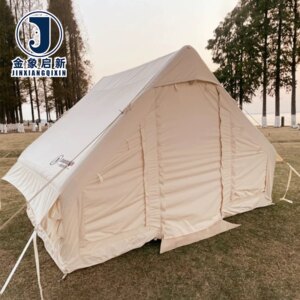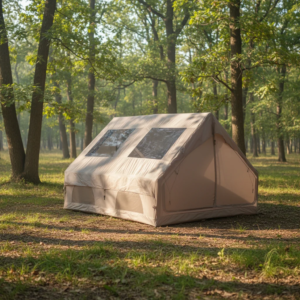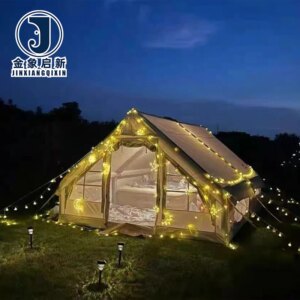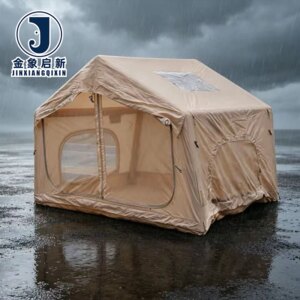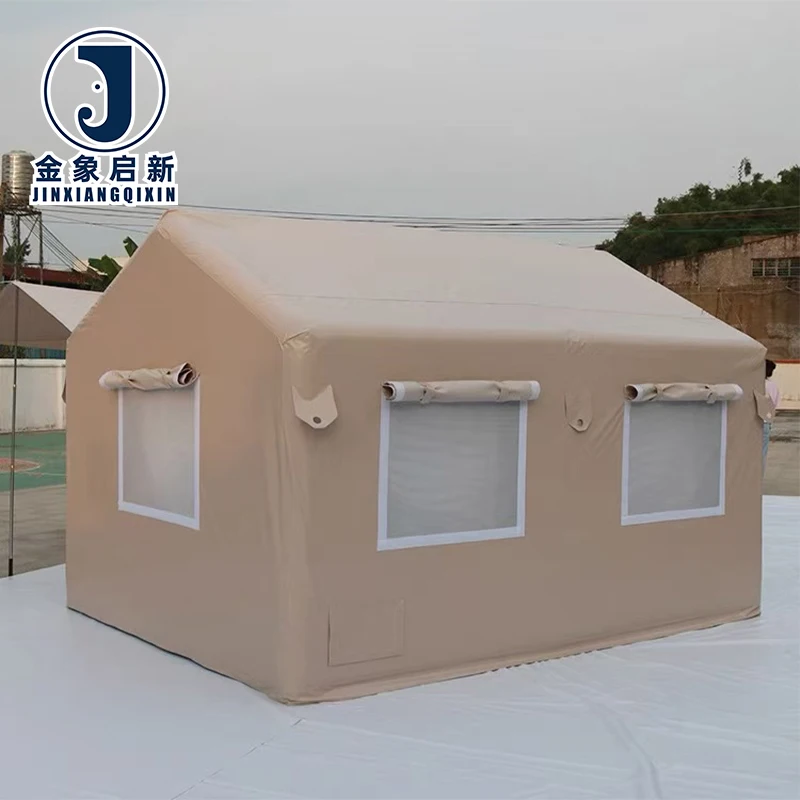
Production Line Versatility — Our facility supports bulk production of inflatable tent structures with reliable on-time delivery through 3 full production lines and dedicated QA staff at every stage.
Technical Specifications
| Parameter | Value |
|---|---|
| Product Type | Inflatable Tent Fabric / Inflatable Structure |
| Core Material | PVC tarpaulin |
| Product Forms | Inflatable structure |
| Key Features | Waterproof, UV-resistant (test basis not stated in source), tear-resistant, fire-retardant (grade not stated in source), anti-static (standard not stated in source) |
| Capacity | 3-4 Person |
| Season Rating | Four-Season |
| Opening Mechanism | Quick Automatic Opening |
| Construction | Single layer |
| Customization | OEM & ODM (sample customization, pattern printing, material selection, product design) |
| Certifications | ISO9001, ISO14001, ISO45001, CE |
Application Suitability
| Application | Exposure & Requirement |
|---|---|
| Logistics yard inspection shelters | Constant deployment and takedown, wind load at anchor points, exposure to vehicle exhaust and fuel handling zones |
| Transport fleet mobile field offices | Remote depot placement, prolonged UV and weather exposure, rapid inflation tied to fleet scheduling |
| Equipment staging covers | Abrasion from loading and unloading, moisture ingress risk, need for fire-retardant compliance near hot work areas |
| Outdoor event management shelters | High foot traffic, rapid setup and takedown cycles, branding and visual consistency requirements |
Why Standard Tent Dimensions Fail at Loading Docks and Logistics Yards
Generic inflatable tent dimensions rarely align with the exact footprint required between truck bays or over staging equipment, leaving coverage gaps that invite wind uplift and water ingress on exposed sites.
A custom-fit inflatable structure eliminates dead space and reduces the surface area vulnerable to wind catch at transport hubs.
I have seen standard-size shelters deployed next to loading docks fail within the first season because the excess material flaps in crosswinds generated by reversing trailers. The seams take the cyclic load and eventually split before the membrane itself shows wear. Field crews end up patching or replacing the unit mid-project, which costs more in downtime than specifying the correct footprint from the outset [NEED_CITE: tensile and tear test methods for coated fabrics per ISO 1421].
Engineered Membrane for Repeated Inflation Cycles
The PVC tarpaulin core material used in this inflatable tent for transport and field operations is selected for its balance of tensile strength and flexibility. Each inflation and deflation cycle introduces bending stress at the air beam fold lines, and the coating must resist micro-cracking through repeated deployment. This is where material selection directly influences service intervals on active logistics sites.
Welded Seam Integrity Under Wind Load
The single-layer construction relies on welded seams to maintain air beam pressure and structural shape. On open staging yards, wind loads transfer through the membrane to these seams at anchor and flex points. If the weld parameters do not match the coating weight and fabric denier, the seam fails before the base fabric reaches its tear limit — a failure mode that is preventable through process-controlled heat welding matched to the specific PVC formulation.
Reading the Material Data Sheet Beyond the Headline Numbers
Specifying an inflatable tent for transport and field operations requires understanding how base fabric denier, weave density, and coating weight interact. A high GSM value alone does not guarantee tear resistance if the base fabric uses a low-denier yarn with loose weave — the coating fills the gaps but cannot compensate for structural weakness in the scrim. Conversely, a tighter weave at a moderate GSM can deliver superior puncture and tear performance because the yarn interlock distributes point loads across a wider area [NEED_CITE: DIN 4102 fire classification for building materials]. The coating method also matters: knife-over-roll application typically yields higher peel strength than lamination, which affects how well the membrane holds at welded seams during inflation pressure cycles. Surface finish — whether glossy or matte — influences both cleanability on dusty construction sites and the adhesion quality of printed branding if fleet livery or event graphics are required.
The Hidden Cost of Underspecifying Weld Parameters
When heat-welding parameters are set for a generic PVC grade rather than the actual coating formulation in production, the resulting seam strength can fall well below the membrane tear resistance. On an inflatable air beam, this means the structure deflates at the weld line under wind load or internal pressure fluctuation — often at the exact point where the beam bends at ground contact. Field repair is difficult because the damaged weld zone must be cleaned, re-heated, and re-sealed under site conditions that rarely match factory standards. Batch-level weld inspection records prevent this class of failure from reaching the deployment site [NEED_CITE: welding parameters and peel strength correlation in coated fabric assemblies].
What Distinguishes This Supply Source
Our production process maintains coating weight consistency across rolls through dedicated QA and QC staff stationed at each of the 36 sets of professional processing equipment. For inflatable tent structures, this means the material feeding into your cutting and welding table performs identically from the first unit to the last in a production run. The 10-technician R&D team handles sample development for custom sizing, allowing you to validate air beam geometry and anchor point layout before committing to bulk production. Every batch ships with a pre-shipment inspection record, so you can verify material grade and seam integrity documentation before the container leaves our Jinan facility.
Documentation & Verification
- Material specification sheet confirming PVC tarpaulin grade and base fabric denier
- Fire-retardant and anti-static test reports aligned to site safety regulations where applicable
- Pre-shipment inspection record covering seam integrity and dimensional accuracy per unit
- Weight verification against stated GSM conducted at batch level before dispatch
- Certificate of origin and customs documentation for export shipments
- Roll packing list detailing unit count, dimensions, and batch reference numbers
Fabrication, Handling & Storage
- Heat-weld air beams using temperature and dwell time matched to the specific PVC coating formulation to prevent seam delamination
- Store rolled membrane stock horizontally on padded racks to avoid permanent crease marks in the single-layer construction
- Deploy in ambient temperatures above the material cold-flex threshold to prevent coating micro-cracking during inflation
- Use PVC-compatible cleaners only; solvent-based products can degrade the coating surface and compromise re-weldability
- Allow full membrane relaxation after unrolling before inflation to reduce initial stress concentration at folded zones
Preparing Your Inquiry
To move forward efficiently, share the deployment environment details including expected wind exposure, ground surface conditions, and whether the site requires fire-retardant or anti-static compliance. Specify the required tent footprint dimensions, target colour or branding print requirements, and whether you need finished units or membrane rolls for in-house fabrication. Sample development is available to confirm fit and finish before production release.
Frequently Asked Questions
Q: Can the tent material and seam specification be matched to our existing inflatable structure fleet?
A: Yes. Provide a sample or specification sheet from your current stock, and our R&D team will match the PVC tarpaulin grade, coating weight, and weld parameters. A confirmation sample is produced for your approval before bulk production begins, ensuring compatibility with your existing inflation systems and repair protocols.
Q: What fire-retardant and anti-static certifications ship with each batch?
A: Test reports for fire-retardant and anti-static grades are available upon request and aligned to the compliance standards required at your deployment site. Confirm the specific grade needed for your market during the inquiry stage so the correct formulation is selected and documented before production.
Q: Do you support custom sizing and branding print for transport company livery?
A: OEM and ODM customization covers custom sizing, pattern printing, and material selection. Provide your dimensional drawings and artwork files, and we develop a printed sample for colour and registration approval before the full production run proceeds.
Q: What is the lead time from sample approval to container-ready dispatch?
A: Lead time depends on order volume and customization complexity. Once the sample is approved, production scheduling is confirmed with a dispatch date. Our 3 full production lines support bulk capacity to maintain reliable delivery timelines for project-critical deployments.
Q: How do you handle colour consistency across multiple units in one order?
A: Colour matching is controlled at the coating stage with batch-level QA checks. All units within a single production run use material from the same coating batch, and a pre-shipment inspection record documents colour consistency verification before dispatch.