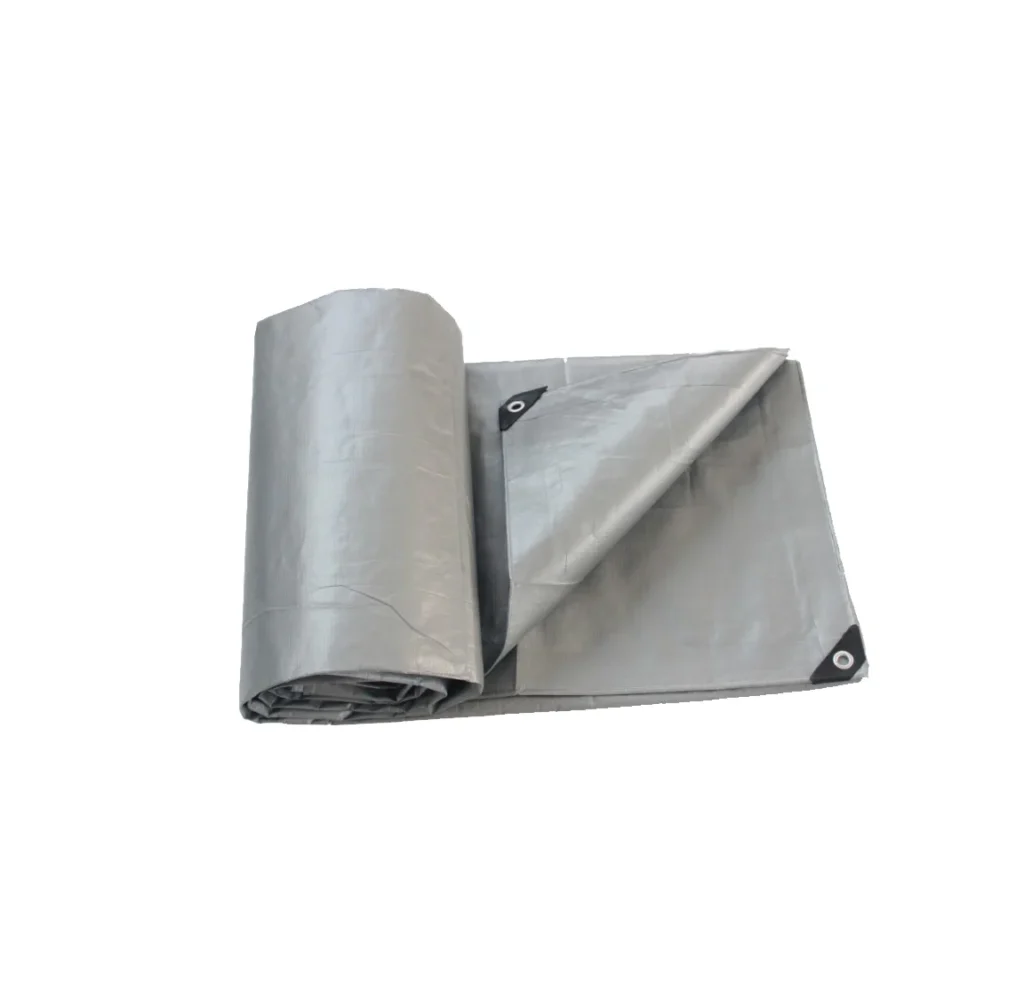
Coating Weight Control — Nearly three decades of process refinement over HDPE weaving and LDPE lamination ensures every roll of PE tarpaulin for truck cover meets the quoted specification without drift.
Technical Specifications
| Parameter | Value |
|---|---|
| Product Type | PE Tarpaulin Roll / Finished PE Tarpaulin |
| Material | HDPE weaving with LDPE lamination on both sides |
| Weight Range | 50 g/m² to 300 g/m² (grade to be confirmed per application) |
| Thickness | 0.2 mm – 0.4 mm (8 mil – 16 mil) |
| Weave Density Options | 6×6, 6×7, 7×7, 7×8, 8×8, 9×9, 8×10, 10×10, 12×12, 14×14, 14×16 |
| Roll Width Options | 6 ft, 8 ft, 10 ft, 12 ft, 2 m, 4 m, 6 m |
| Roll Length Options | 100 yards, 100 meters, or custom |
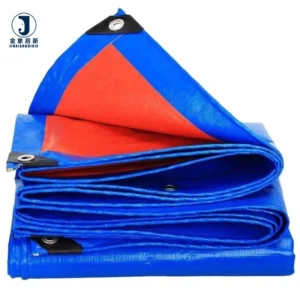
| Edge Reinforcement | PP rope in hem on all four edges (finished tarps) |
| Eyelet Specification | Galvanized, spaced every 3 ft or 1 meter |
| Corner Reinforcement | Reinforced plastic corners (finished tarps) |
| Color Options | Blue, Blue/Orange, Green, Grey, Black, Clear, Grey/Green, Orange, custom |
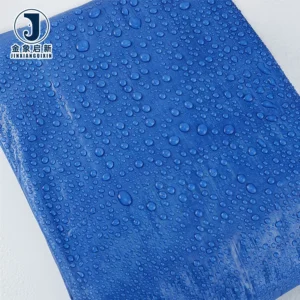
| Surface Treatment | UV treatment available — confirm grade required for your market; waterproof, mildew proof, anti-aging |
| Flame Retardant | Available in flame retardant grades — confirm the grade required for your market |
| Certifications | ISO, CE |
Application Suitability
| Application | Exposure & Requirement |
|---|---|
| Truck and trailer load covers | Highway wind load, rain ingress, tie-down strap tension, constant UV exposure |
| Container and pallet yard storage | Stacked weight, ground moisture, forklift abrasion at contact points |
| Boat and marine covers | Salt spray, prolonged sun exposure, water pooling on horizontal surfaces |
| Construction scaffolding wraps | Wind shear, scaffold tube abrasion, debris impact, weather shielding |
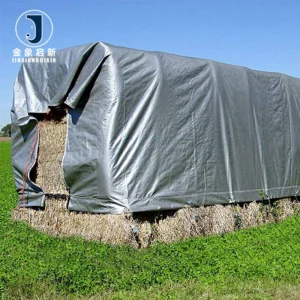
| Agricultural crop and hay covers | Soil contact moisture, UV degradation over growing season, tear risk during deployment |
| Garden furniture and gazebo covers | Frequent handling, folding stress at corners, seasonal UV and rain cycles |
Why Generic-Sized Truck Covers Fail on Specific Trailer Models
A cover cut to a standard rectangle will not account for the side rails, tail lift, and load profile of your actual fleet.
Fleet operators regularly order PE tarpaulin for truck cover applications in common dimensions, only to discover the material rides up at the rear or leaves the front corners exposed once strapped down. The gap between a generic 6×8 m sheet and a trailer that measures 6.1 m with a 0.3 m side rail is where cargo gets wet. [NEED_CITE: cargo damage claims attributed to inadequate load covering during transit] Sourcing covers matched to the specific trailer model eliminates the trial-and-error overlap that leaves edges vulnerable and wastes material on unnecessary overhang.
Matching the Cover to the Trailer Profile
Transport fleets operate diverse trailer configurations — flatbeds, curtain-siders, and refrigerated units each present different securing challenges. A PE tarpaulin for truck cover use needs to be specified not just by length and width but by the securing method: strap pass-throughs, bungee hook points, or full overhang with ground-level tie-down. The PP rope reinforced hem on all four edges and galvanized eyelets at regular intervals provide the anchor structure, but the spacing and placement must correspond to your trailer’s tie-down rail geometry rather than a universal standard.
Load Profile and Overhang Calculation
The cargo itself determines how much fabric is consumed. A flat load of palletised goods sits lower than an irregular load of machinery or timber, and the drape distance from the load peak to the trailer deck adds to the required width. Fleet operators who specify their PE tarpaulin for truck cover use by providing the loaded trailer profile receive covers that drape correctly without excess material flapping in highway wind or insufficient coverage leaving the load shoulders exposed. [NEED_CITE: relationship between tarpaulin drape angle and wind-induced fabric fatigue]
Weave Density and Tensile Behaviour Under Strap Load
The weave density — expressed as mesh count from 6×6 through to 14×16 — directly governs how the fabric behaves when a ratchet strap bears down on it. A 6×6 weave at lower GSM may deform around the strap contact point, concentrating stress on individual HDPE tapes. Higher mesh counts such as 12×12 or 14×14 distribute the strap load across a denser grid, reducing point deformation and the risk of the fabric splitting outward from the eyelet. Selecting the correct mesh count is therefore not a matter of thickness preference but of matching the fabric structure to the tie-down forces your securing system applies.
Reading the Specification Sheet Beyond the Headline GSM
GSM alone describes areal weight, not how that weight is distributed between the HDPE base fabric and the LDPE lamination. Two sheets rated at the same GSM can perform very differently: one may carry a heavier base weave with lighter lamination, offering better tear resistance but reduced surface abrasion protection, while the other reverses that balance. The weave density figure — for instance 8×10 versus 10×10 — reveals the tape count per unit area in warp and weft, which together with the lamination weight determines the actual tensile and tear behaviour. Buyers who evaluate both GSM and mesh count together make better-informed grade selections than those relying on weight alone. [NEED_CITE: tensile and tear test methods for coated fabrics per ISO 1421]
The Cost of Specifying Without Verifying
When the delivered roll weighs less than the quoted GSM, the fabric may appear correct on the truck but fail earlier under cumulative UV and mechanical stress. Colour variation between rolls in the same consignment becomes visible once two covers are deployed side by side on adjacent trailers, creating an unprofessional fleet appearance. Eyelets that pull out under real tie-down tension rather than laboratory test conditions leave cargo exposed mid-route. These failures are not random — they trace back to insufficient verification at the point of dispatch and inconsistent process control during weaving and lamination. [NEED_CITE: common causes of premature tarpaulin failure in transport applications]
Why Procurement Confidence Starts at the Production Line
Three full production lines and 36 sets of professional equipment allow concurrent roll runs without cross-contamination of colour or specification. The 10-person R&D team develops custom sizing and sample cuts matched to your trailer dimensions before bulk production begins, so fitment is confirmed on physical material rather than assumed from a drawing. Every production stage carries dedicated QA/QC inspection, with 100 percent pre-shipment verification of weight, dimensions, eyelet count, and colour reference against your approved sample. This is not a spot-check system — it is stage-gated process control applied to every roll of PE tarpaulin for truck cover applications that leaves the facility. Samples for custom width, colour, or print requirements are developed within days, shortening the approval cycle.
Documentation & Verification
- Material specification sheet stating confirmed GSM, base weave density, and LDPE lamination weight per roll
- Colour reference sample retained on file for batch-to-batch consistency matching
- Pre-shipment inspection record confirming dimensions, eyelet spacing, and hem reinforcement integrity
- UV and flame retardant treatment test reports supplied where applicable to the specified grade
- Roll packing list with individual roll weights and dimensions for receiving verification
- Certificate of origin and customs documentation prepared per destination market requirements
Fabrication, Handling & Storage
- Heat-seal LDPE laminated surfaces using calibrated temperature settings matched to the selected GSM grade
- Position galvanized eyelets to align with PP rope hem reinforcement, not through unsupported fabric areas
- Store rolls horizontally on pallets to prevent compression creasing of the HDPE woven structure
- Deploy finished tarps with reinforced plastic corners oriented to the highest tie-down stress points
- Clean LDPE laminated surfaces with mild detergent only — solvents degrade the lamination bond
- Allow cold-stored rolls to reach ambient temperature before unrolling to prevent surface cracking
Specifying the Right Cover for Your Fleet
Provide your trailer model, internal load dimensions, and the securing system you use so the cover can be cut to match rather than approximated from a standard size chart. Specify the GSM range or mesh count your current covers use, along with any colour requirements for fleet livery consistency. Confirm whether you need roll stock for in-house fabrication or finished tarps with hemmed edges and eyelets installed.
Frequently Asked Questions
Q: How is the PE tarpaulin cut to fit a specific trailer model rather than a generic size?
A: We request the trailer make, model, and loaded profile dimensions including side rail height and tail configuration. A sample cover is then developed from the specified HDPE woven grade and sent for physical fitment trial before bulk production proceeds, ensuring the finished PE tarpaulin for truck cover use drapes correctly across your actual load geometry.
Q: What GSM grades are available and how is weight verified before shipment?
A: Grades from 50 g/m² through to 300 g/m² are produced across weave densities from 6×6 to 14×16 mesh. Every roll undergoes weight verification against the stated GSM during pre-shipment inspection, with results recorded on the inspection report that accompanies your consignment for receiving verification at your depot.
Q: Are the eyelets and hem reinforcements rated for tie-down strap tension during transit?
A: Galvanized eyelets are installed through the PP rope reinforced hem at intervals of every 3 ft or 1 meter, with reinforced plastic corners at high-stress points. The combination distributes strap load across the hem structure rather than concentrating it at a single fabric penetration point, reducing tear-out risk under highway transit conditions.
Q: How is batch colour consistency controlled when ordering multiple finished covers?
A: A colour reference sample is retained on file from your initial approval and used as the benchmark for every subsequent production run. The pre-shipment inspection includes a visual comparison of all rolls in the order against this reference before dispatch, ensuring uniform appearance when covers are deployed side by side across a fleet.