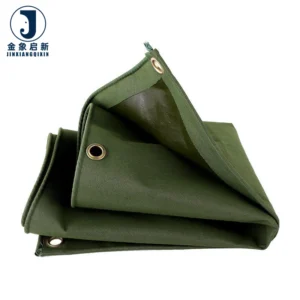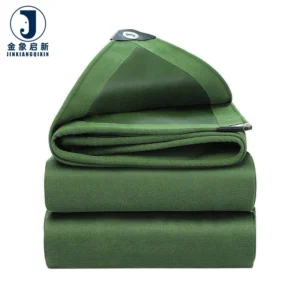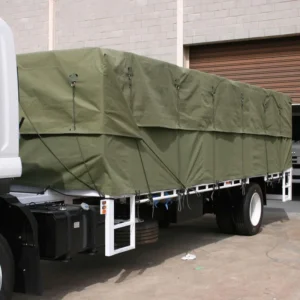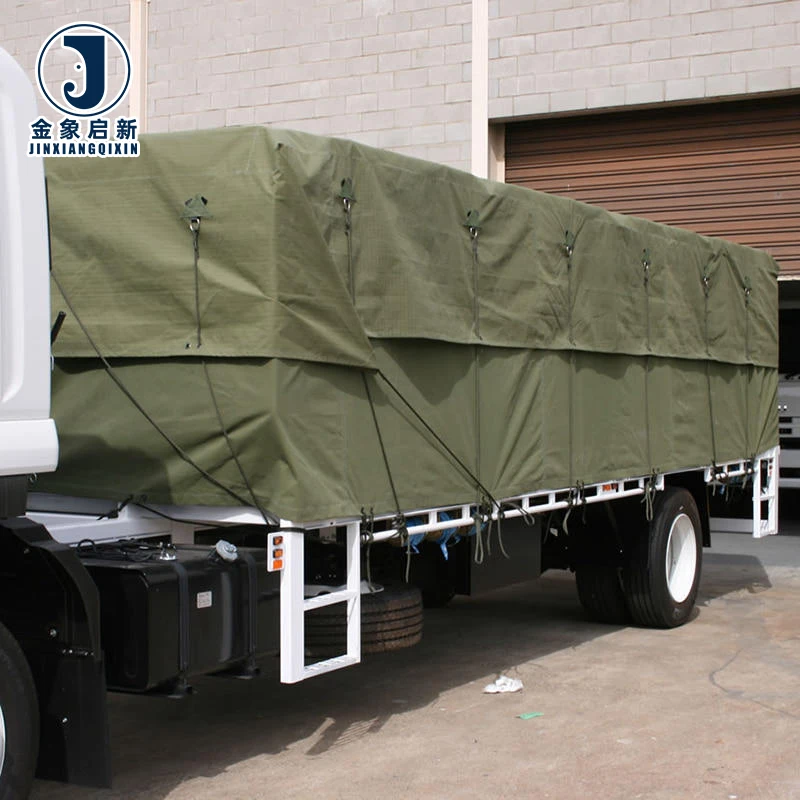
Precision Fit Engineering — every truck cover is dimensioned to the specific trailer model rather than cut from generic stock, eliminating the flap and abrasion that destroys ill-fitting tarps within weeks on the road.
Technical Specifications
| Parameter | Value |
|---|---|
| Product Type | PVC Coated Canvas Tarpaulin |
| Base Fabric | Polyester cotton industrial textile, 8–12 strands fine cotton yarn |
| Weight | 600gsm |
| Total Thickness | 0.5mm / 0.6mm / 0.7mm (multiple options) |
| Roll Width | 2m |
| Roll Length | 100m |
| Finish Product Size | Custom cut to trailer model dimensions or sold from inventory |
| Color | Army Green Camouflage / Custom options available |
| Eyelet Specification | Rust-proof aluminum eyelets spaced every 1 meter at corners and hem |
| Seam Construction | Folded and welded seams, sewn with poly ropes |
| Waterproof | Yes (waterproof rating not stated in source) |
| UV Treatment | UV resistant (test basis not stated in source) |
| Anti-Mildew | Mold resistant (test basis not stated in source) |
| Temperature Resistance | High- and low-temperature resistant (range not stated in source) |
| Corrosion Resistance | Yes |
| Certifications | ISO, CE (specific certificate numbers not stated) |
Application Suitability
| Application | Exposure & Requirement |
|---|---|
| Asphalt truck cover | Hot material contact, abrasion from aggregate load, repeated deployment and folding |
| Flatbed and curtain-side trailer top cover | Highway wind flex, rain and road spray, UV exposure during long-haul transit |
| Open-air cargo protection on transport fleets | Tarp-to-load abrasion at contact points, tie-down stress at eyelets, weather exposure over multi-day routes |
| Construction and equipment cover | Outdoor storage, dust and debris, UV and rain cycling across seasons |
Why Generic-Sized Truck Covers Fail Within Months on the Road
A cover cut to standard dimensions never sits flush against a specific trailer body — it flaps under wind load, and that constant flexing concentrates stress at seams and eyelets until the fabric tears.
Fleet operators replacing covers every few months often blame material quality when the real cause is dimensional mismatch. Excess fabric at the edges catches wind like a sail, multiplying the force on each eyelet and pulling seams apart at the stitch line. A PVC coated canvas tarpaulin for truck cover applications must match the exact profile of the trailer it protects — including wheel arch cutouts, tailgate clearance, and side rail height — to eliminate the movement that causes premature failure [NEED_CITE: common causes of premature tarpaulin failure in transport applications].
Cut-to-Model Sizing Eliminates the Flap That Destroys Covers
Every trailer model has a distinct profile — the deck height, side rail position, and rear door configuration vary between manufacturers and even between production years. This PVC coated canvas tarpaulin for truck cover use is cut from dimensional templates matched to specific vehicle models, so the fabric sits taut against the load without excess material hanging at the edges. Taut fabric does not catch wind, which means the tie-down system works as designed rather than fighting constant uplift force.
Reinforced at the Points Where Road Stress Concentrates
The eyelet line and hem edge take the highest mechanical load on any truck cover — every gust of crosswind and every braking event transfers force through these points. Rust-proof aluminum eyelets are spaced at 1-meter intervals along corners and hems, distributing load across a wider fabric area than standard spacing allows. Folded and welded seams are additionally sewn with poly ropes, creating a composite reinforcement that addresses the failure mode where the load flexes most during transit [NEED_CITE: tensile and tear test methods for coated fabrics per ISO 1421].
Understanding What 600gsm Means for a Truck Cover in Daily Service
GSM alone does not determine how a fabric performs under road conditions — the base fabric construction matters equally. The polyester-cotton industrial textile base uses 8–12 strands of fine cotton yarn, which creates a dense woven structure that resists tearing propagation once a puncture occurs. The PVC coating adds weight and provides the waterproof barrier, but it is the woven base that carries the tensile load when wind pulls against tie-downs. A heavier coating on a loosely woven base will crack and delaminate under flex, while this combination of dense weave and 600gsm total weight balances flexibility with mechanical strength. The available thickness options (0.5mm, 0.6mm, 0.7mm) allow selection based on whether the priority is lighter handling for daily deployment or heavier abrasion resistance for permanent installation.
What Happens When Seam Construction Is Overlooked
Seam failure is the most common reason truck covers are returned or replaced — not because the fabric failed, but because the join between panels separated under cyclic loading. Welded seams on PVC coated canvas rely on heat and pressure to fuse the coating layers together, but if the welding temperature or dwell time is set for a different coating weight, the bond will be incomplete. This shows up as peeling at the overlap after repeated flexing cycles, long before the body of the fabric shows any wear [NEED_CITE: welded seam failure modes in PVC coated technical textiles]. Poly-rope-sewn reinforcement at the hem adds a mechanical backup to the weld, so even if the thermal bond degrades over time, the stitched rope continues to carry the tie-down load.
Why Procurement Verification Matters Before the Cover Hits the Road
Confirming the exact trailer model and dimensions before cutting is the single most important step — a cover made 50mm too large on any edge will flap, and 50mm too small will not reach the tie-down points. Request a pre-shipment inspection record that documents dimensional checks against your specific vehicle drawing, GSM weight verification on a sample cut from the production roll, and seam integrity testing. Where covers are deployed across a visible fleet, review roll-to-roll colour consistency before the order ships — variation becomes obvious when two covers from different rolls are installed on adjacent vehicles. UV and weather-resistance claims should be supported by test documentation, particularly for fleets operating in high-exposure climates where treatment level determines service interval [NEED_CITE: UV degradation testing standards for outdoor PVC coated fabrics].
Sourcing From a Production Line Built for Transport Covers
Nearly 30 years of coated fabric production provides process control over coating weight and adhesion consistency across every roll in a fleet order. Three full production lines with 36 sets of professional equipment support the volume required for multi-vehicle fleet rollouts without splitting orders across different machines. A 10-person R&D team develops dimensional templates for new trailer models and handles custom sizing requests, producing samples within days for fit verification before fleet commitment. Dedicated QA/QC inspection at every production stage — including coating adhesion, seam weld strength, and eyelet pull-out resistance — is completed with 100% pre-shipment inspection rather than batch sampling.
Documentation & Verification
- Material specification sheet stating 600gsm, polyester-cotton base composition, and PVC coating type
- Pre-shipment dimensional check record matched to your specific trailer model drawing
- UV and mold-resistance test reports confirming treatment level for your operating climate
- ISO and CE certificates included in dispatch documentation package
- Roll packing list with individual roll weight and GSM verification
Fabrication, Handling & Storage
- Weld temperature and dwell time must match 600gsm PVC coating weight to ensure full bond penetration at seams
- Poly-rope hem reinforcement should be sewn before eyelet insertion to distribute load through both systems
- Store 2m-wide rolls vertically on end cores to prevent flat-spotting and permanent crease formation
- Allow cold-stored canvas to reach ambient temperature before unfolding to avoid cracking the PVC coating
- Clean with mild detergent only — solvent-based cleaners will degrade the PVC coating surface
- Field repairs on punctures require PVC-compatible adhesive patches matched to the coating chemistry
What to Include With Your Inquiry
Provide the exact trailer make, model, and year along with deck dimensions and side rail configuration so the cover template can be matched to your vehicle. Specify whether the cover will be deployed and removed daily or installed semi-permanently, as this determines the appropriate thickness selection from the available range. Confirm the quantity per vehicle model and whether colour matching across the fleet is required, so roll allocation can be planned from a single production batch for consistency.
Frequently Asked Questions
Q: How do I provide the right dimensions for my specific truck or trailer model?
A: Send the vehicle make, model, year, and any body modifications. We work from dimensional templates developed for common trailer configurations and can create new templates for specialised bodies. Where no template exists, a simple measurement guide covering deck length, width, side height, and any wheel arch or tailgate cutouts is sufficient to produce a pattern for your PVC coated canvas tarpaulin for truck cover.
Q: What reinforcement is applied at the eyelets and corners where tie-down stress concentrates?
A: Rust-proof aluminum eyelets are set at 1-meter intervals along the hem and at every corner. The hem is folded and welded, then sewn with poly rope to create a composite edge that distributes tie-down load across a broader fabric area. This dual reinforcement prevents the eyelet from pulling through the canvas under highway wind conditions.
Q: Can I get a sample cut to verify fit before placing a fleet-wide order?
A: Yes, a sample cover cut to your specific trailer dimensions can be produced for fit verification before committing to a full fleet order. This allows you to confirm the template accuracy, check eyelet positioning against your tie-down hardware, and assess handling weight for daily deployment routines.
Q: How do you ensure colour consistency across multiple covers in the same order?
A: Covers for a single fleet order are allocated from rolls produced in the same coating batch to minimise colour variation. A pre-shipment inspection compares adjacent rolls visually under standardised lighting before cutting begins, and any roll falling outside the accepted tolerance is removed from the order.
Q: What documentation ships with the order to confirm material grade and treatment?
A: Each dispatch includes a material specification sheet confirming 600gsm weight and base fabric composition, a pre-shipment inspection record with dimensional checks, ISO and CE certificates, and a roll packing list. UV and mold-resistance test reports are included where the treatment specification has been confirmed for your market requirements.