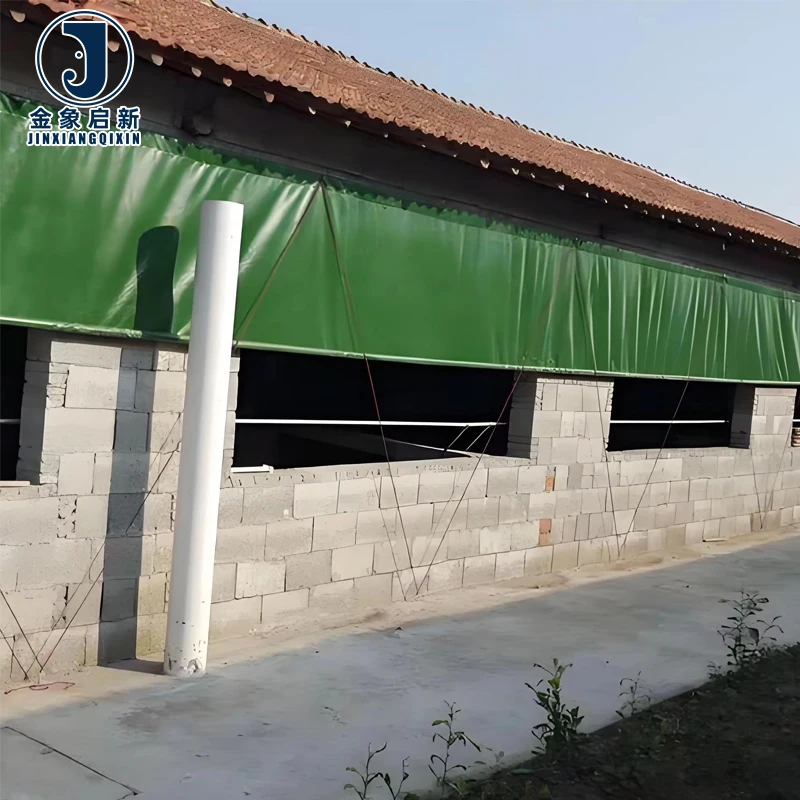
Coating Weight Control — Every roll of PVC coated tarpaulin for farm use is verified against stated GSM before dispatch, preventing the common shortfall between quotation and delivery.
Technical Specifications
| Parameter | Value |
|---|---|
| Product Type | PVC Coated Tarpaulin |
| Coating Material | PVC coated |
| Base Fabric Construction | Warp knitted, woven plain style |
| Waterproof Performance | Fully waterproof coated construction |
| Anti-Static Treatment | Claimed (test basis not stated in source) — confirm the certification required for your market |
| Tear Resistance | Tear resistant (grade not stated in source) |
| Color Options | Customizable colors |
| Usage Grade | Industrial strength / heavy-duty |
| Standards | ISO, CE certified facility |
Application Suitability
| Application | Exposure & Requirement |
|---|---|
| Poultry and broiler farm side curtains | Continuous moisture exposure, ammonia-rich atmosphere, frequent mechanical raising and lowering |
| Pig and sheep housing enclosure covers | Wind and rain load, abrasion against timber or steel frames, thermal fluctuation |
| Agricultural tent and temporary shelter | UV exposure, spanning tension across poles, rapid deployment and takedown |
| Farm equipment and feed stockpile covers | Waterproof barrier, puncture risk from sharp edges, repeated folding and unfolding |
Why PVC Coated Tarpaulin for Farm Covers Fails Before the Fabric Does
Seams carry the load that the fabric shrugs off.
When a poultry farm cover tears, the split rarely starts in the middle of the panel. It begins at the welded seam where the fabric bends over the frame rail every time the wind shifts. The base cloth holds, but the heat-welded join has already begun to delaminate. This is a pattern we see across agricultural installations where the weld temperature or dwell time was not matched to the PVC coating formulation. [NEED_CITE: tensile and tear test methods for coated fabrics per ISO 1421]. A PVC coated tarpaulin for farm use that arrives with the correct GSM but weak welds will still fail at the flex point first, leaving the operator replacing panels mid-season rather than at the planned interval.
How Warp Knitted Construction Handles Farm Shelter Tension
A warp knitted woven plain base fabric distributes load across intersecting yarn paths rather than relying on a simple over-under weave. When a livestock enclosure cover is tensioned across a curved frame, the knitted structure allows limited yarn movement that absorbs point loads without propagating a tear. For poultry and broiler farm curtains that are raised and lowered daily, this construction resists the repeated flex fatigue that causes plain woven fabrics to break down along fold lines. The PVC coated tarpaulin for farm applications benefits directly from this structural behaviour at the coating interface.
Waterproof Coating Integrity Under Agricultural Conditions
Farm environments present chemical exposure that goes beyond simple rain protection. Ammonia from livestock housing, fertiliser dust, and cleaning agents all contact the PVC surface repeatedly. The coating must maintain adhesion to the base fabric through these chemical cycles without softening, lifting, or becoming brittle. [NEED_CITE: chemical resistance testing standards for PVC coated agricultural fabrics]. Waterproof performance in this context means the coating layer remains continuous and bonded to the warp knitted substrate across the full width of the roll, including at the selvedge edges where coating thickness can vary during production.
Reading the Specification Sheet Beyond GSM Alone
GSM tells you the total weight of coating and base fabric combined per square metre, but it does not reveal how that weight is distributed. A heavy coating over a light base fabric may show the target GSM while offering poor tear resistance at stress points. Conversely, a dense warp knitted substrate with a moderate PVC coating layer delivers structural strength that weight alone would not predict. The relationship between base fabric denier, yarn count per centimetre in warp and weft, and coating thickness determines how the material performs when a farm shelter frame flexes under wind load. [NEED_CITE: relationship between base fabric density and tear strength in coated technical textiles]. This is why the specification sheet must itemise base fabric construction separately from total GSM.
The Hidden Cost of Batch Inconsistency Across Farm Cover Rolls
When a large poultry installation requires multiple rolls of PVC coated tarpaulin for farm covers, shade variation between rolls becomes visible the moment panels are hung side by side. The farm operator sees a patchwork effect across the shelter wall, and the installing contractor faces a choice between accepting the mismatch or returning rolls for replacement. [NEED_CITE: colour consistency standards and measurement methods for coated fabric batches]. This problem compounds when orders are placed across different production runs weeks apart, because pigment batching and coating line conditions can shift between runs even when the colour reference remains the same.
Why Buyers Specify Through Jinxiang for Agricultural Tarpaulin Projects
Three full production lines and 36 sets of professional equipment allow this PVC coated tarpaulin for farm applications to be manufactured at volume without sacrificing batch consistency across rolls. The 10-person R&D team handles colour matching and sample development so that custom shades are confirmed before the production run begins. Dedicated QA and QC inspection at every production stage catches coating weight deviation and seam quality issues before the roll is packed. ISO and CE certified processes underpin the documentation trail from raw material to dispatch. Pre-shipment inspection covers 100% of rolls rather than sampling a percentage, which matters when a single substandard roll in a multi-roll order can force a contractor to re-hang an entire shelter wall.
Documentation & Verification
- Material specification sheet stating GSM, base fabric construction and PVC coating weight per roll
- Colour reference and batch record linking each roll to its production run for shade traceability
- Pre-shipment inspection record confirming 100% QA check before dispatch
- ISO and CE certificates covering the manufacturing facility and process controls
- Certificate of origin and customs documentation for cross-border agricultural imports
- Anti-static test documentation available on request — confirm the standard required for your market
Fabrication, Handling & Storage
- Heat-weld seams using temperature and dwell time matched to the PVC coating formulation to prevent delamination at flex points
- Reinforce hem and eyelet zones where the warp knitted base fabric will carry tie-down or tensioning loads
- Store rolls upright on a flat surface to avoid creasing the PVC coating layer during warehouse holding
- Unroll in moderate temperatures to prevent cold-weather stiffness from cracking the PVC surface
- Use mild detergent for cleaning — avoid solvent-based agents that may attack the PVC coating bond
- Cut panels with allowance for thermal expansion and contraction across the farm shelter frame span
What We Need to Quotate Your Farm Cover Project Accurately
Provide the shelter frame dimensions, the number of panels required, and whether the PVC coated tarpaulin for farm covers will be used as fixed enclosure or movable curtain systems. Specify the colour reference and confirm whether anti-static certification is required by your local agricultural or occupational safety regulations. Indicate your target delivery date and whether you need rolls only or finished panels with welded hems and eyelets.
Frequently Asked Questions
Q: What GSM weight is recommended for poultry farm side curtains versus full enclosure covers?
A: Side curtains that are raised and lowered daily benefit from a lighter industrial-grade construction that reduces operator fatigue while maintaining tear resistance at the hem. Full enclosure covers spanning larger frame sections typically require a heavier PVC coating over the warp knitted base fabric to resist wind load without excessive deflection. We recommend requesting a specification sheet that itemises base fabric weight separately from coating weight to compare options.
Q: Can I order custom widths and colors with consistent batch matching across multiple rolls?
A: Custom widths and colors are available with lead times that vary based on the pigment and coating formulation required. Batch matching across multiple rolls is controlled through production run scheduling and pre-shipment colour inspection. We document the colour reference and batch number for each roll so that shade consistency can be verified before dispatch and traced after installation.
Q: Do you provide anti-static and flame-retardant test certificates with shipment?
A: Anti-static treatment is claimed for this fabric — we recommend specifying the test standard required by your market or site safety regulation so that the appropriate certification can be arranged. Flame-retardant grades are available separately. Confirm the specific standard such as NFPA 701 or DIN 4102 B1 that your project requires, and we will supply the corresponding test documentation with your shipment.
Q: How do you ensure color consistency when I order multiple rolls for the same farm project?
A: All rolls in a single order are scheduled within the same production run where possible, with pigment batches mixed to the confirmed colour reference. The pre-shipment inspection record documents shade readings for each roll. If your project requires rolls produced across separate runs, we supply comparison samples so that you can approve any variation before the full order is dispatched.
Q: What is the lead time for custom-sized tarpaulin rolls with reinforced hems and eyelets?
A: Lead times depend on the custom width, colour, and finishing requirements specified. Standard stock widths ship faster than custom widths that require dedicated line scheduling. Reinforced hems and eyelet installation add fabrication time after the coating and curing stages. We provide a confirmed lead time with the quotation so that your project planning reflects the actual production and dispatch schedule.