Verified Coating Weight — PVC coating mass is checked at every production stage, not just stated on the quotation, ensuring the material arriving at your facility matches the specification agreed for awning, canopy and transport cover applications.
Technical Specifications
| Parameter | Value |
|---|---|
| Product Type | PVC Coated Tarpaulin |
| Coating Material | PVC coated |
| UV Treatment | Anti-UV (test basis available on request) |
| Weight (GSM) | Medium weight (exact GSM not stated in source) |
| Waterproof Rating | Waterproof (rating not stated in source) |
| Flame Retardant Grade | Not stated in source |
| Base Fabric Denier | Not stated in source |
| Mesh Count | Not stated in source |
| Coating Method | Not stated in source |
| Total Thickness | Not stated in source |
| Width | Not stated in source |
| Roll Length | Not stated in source |
| Tensile Strength | Not stated in source |
| Tear Strength | Not stated in source |
| Eyelet & Hem Options | Not stated in source |
| Key Features | Waterproof construction, custom width and length available, eyelets and reinforced hems available |
Application Suitability
| Application | Exposure & Requirement |
|---|---|
| Truck and trailer load cover | Road debris impact, wind flex at tie-down points, sustained UV and rain exposure |
| Outdoor awning and shade sail | Tension stress at mounting points, direct sun and UV degradation, rain pooling |
| Construction canopy cover | Site dust and abrasion, UV exposure during multi-month projects, water runoff |
| Transport side curtain | Constant flexing along the curtain track, road spray, abrasion against the load |
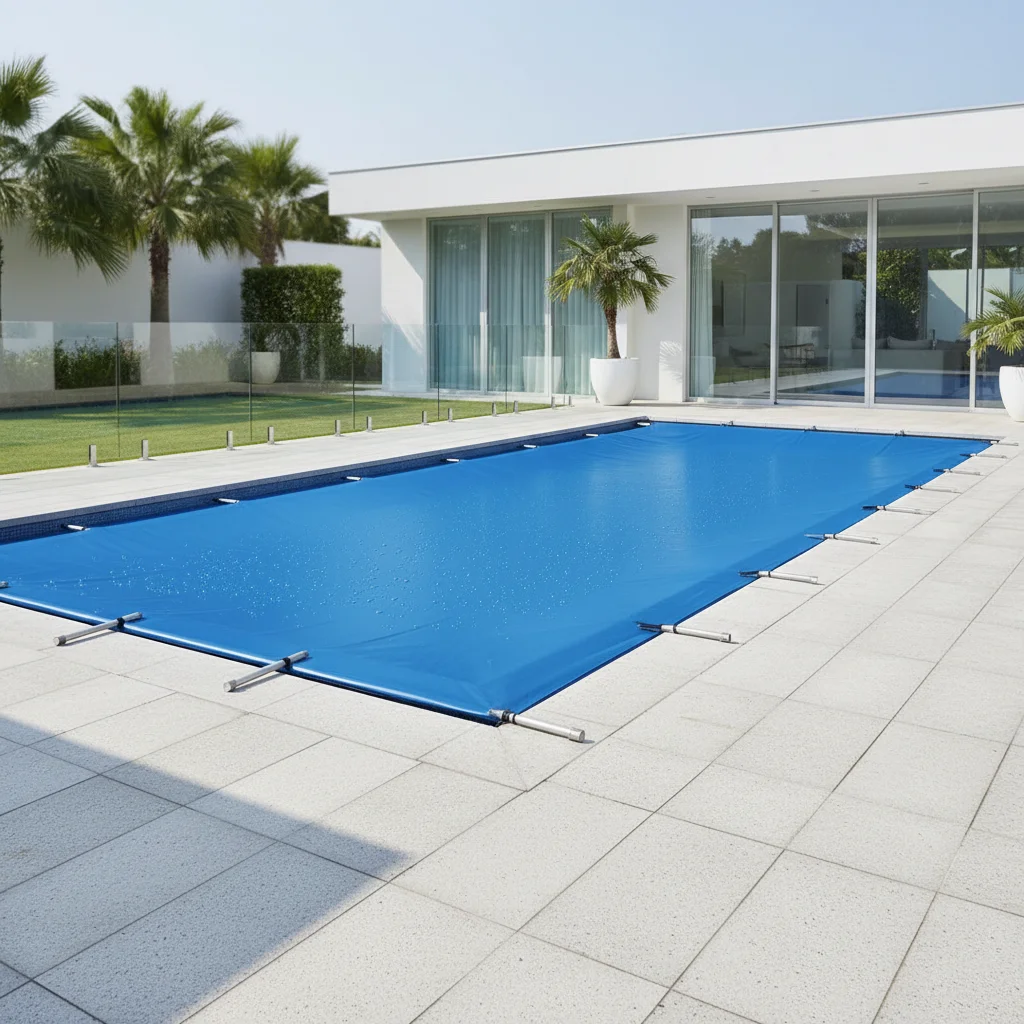
| Pool cover | Water immersion, chlorine or salt exposure, UV degradation from full sun |
| Pet and dog house cover | Localized abrasion from animal contact, outdoor weather, cleaning chemical resistance |
What Happens When a Truck Cover Fails at the Flex Point
A PVC coated tarpaulin for truck and transport cover fails most often not in the fabric itself but at the welded seam where the load flexes against the tie-down point during transit.
The PVC coated tarpaulin for truck and transport cover specification sheet may show adequate tensile values across the fabric face, yet the heat-welded junction between panels carries the mechanical stress differently. When coating adhesion at the weld line is inconsistent, the seam parts under repeated load movement while the surrounding fabric remains intact. [NEED_CITE: tensile and tear test methods for coated fabrics per ISO 1421] Fleet operators then face uncovered cargo, roadside inspection failures, and replacement costs that far exceed the initial material saving.
Welding Behaviour and Seam Integrity in PVC Coated Fabrics
PVC coated tarpaulin for truck and transport cover fabric relies on heat welding to join panels, and the coating formulation directly controls how cleanly those seams fuse. A PVC coating with consistent plasticizer distribution allows the weld to bond at a predictable temperature window, reducing the risk of either under-welding or burning through the base fabric. When the coating weight varies across the roll surface, the operator must adjust weld parameters mid-run, which introduces weak points at transition zones.
Custom Sizing and Fitment for Moving Loads
Every trailer profile and canopy frame differs in its rail spacing, corner radii, and tie-down layout. Our covers are produced to your exact dimension drawings rather than cut from stock templates, so each panel aligns with the structure it must protect. Reinforced hems and eyelet placements are positioned according to your load-securing system, preventing the cover from lifting at speed or pulling away from the frame in crosswind. This approach eliminates the gap between a generic-size tarpaulin and the actual equipment dimensions it must serve. [NEED_CITE: DIN 4102 fire classification for building materials]
How Base Fabric and Coating Work Together Under Tension
The strength of a coated tarpaulin comes from two distinct layers acting in combination. The woven polyester base fabric provides tensile and tear resistance through its denier count and mesh density — higher denier yarns resist individual thread breakage, while a tighter weave distributes load across more threads before a tear can propagate. The PVC coating adds waterproofing, UV screening, and abrasion protection to the fabric surface, but it also contributes to peel strength at welded seams. A medium-weight PVC coating applied by knife-over-roll or calendering will produce different surface textures, adhesion values, and flex behaviour. Knife-coated fabrics typically offer higher peel strength because the coating penetrates the base weave more deeply, which matters when a cover must flex repeatedly against a load without the coating delaminating from the fabric backing.
The Hidden Cost of Specifying by GSM Alone
Buyers who compare suppliers on grams per square metre alone often discover that two fabrics at the same GSM can behave very differently once installed. One roll may achieve its weight through a thicker coating on a lighter base fabric, trading tear resistance for waterproofing surface mass. Another may use a denser base weave with a thinner coating, gaining strength but losing the surface protection needed for prolonged UV exposure. [NEED_CITE: UV degradation testing methods for PVC coated textiles] When the specification is not broken down into base fabric denier, mesh count, and coating weight separately, the buyer cannot predict which failure mode will appear first — and the cost of a failed cover in transit or on a construction site is never just the material cost.
Why Procure PVC Coated Tarpaulin Through This Channel
Three full production lines and 36 sets of professional equipment support the volume and scheduling reliability that fleet operators and transport equipment builders require.
A dedicated QA and QC process inspects every roll at each production stage, with 100% pre-shipment inspection to verify coating weight, colour consistency, and seam integrity before dispatch.
A 10-person R&D team handles material selection, pattern development, and custom sizing so that covers arrive fitted to your specific trailer, awning, or canopy profile rather than requiring on-site modification.
Samples are developed within days for custom requirements, allowing you to verify fitment, colour, and coating feel before committing to a production run.
ISO and CE certified production provides the documentation trail that compliance-sensitive buyers in transport, construction, and aviation ventilation require.
Documentation & Verification
- Material specification sheet stating GSM, base fabric type, and PVC coating details per roll
- Pre-shipment inspection record confirming coating weight and colour match before dispatch
- UV treatment test report supplied with documentation where applicable to your market
- Roll packing list with individual roll dimensions and net weight for customs clearance
- Certificate of origin prepared to match your destination country requirements
Fabrication, Handling & Storage
- Heat-weld seams using temperature settings matched to the PVC coating formulation to avoid delamination at flex points
- Position eyelets and reinforced hems per the load-securing layout drawing, not at generic intervals
- Store rolls on their cores in a dry, shaded area to prevent permanent creasing of the PVC coating surface
- Allow cold-stored rolls to reach ambient temperature before unrolling to prevent coating micro-cracking
- Clean PVC surfaces with mild detergent only; solvents may soften the plasticizer and reduce coating adhesion
- Plan cut patterns around standard roll widths to minimize offcuts and weld seam count per cover
Requesting a Fitment-Ready Quotation
Provide the exact dimensions of your trailer, awning frame, or canopy structure, along with the tie-down layout and eyelet spacing you need. Specify whether you require roll stock for your own fabrication or finished covers cut and welded to size. Indicate the environmental exposure conditions — sustained sun, road salt, chlorine splash — so the correct coating grade and treatment package can be recommended for your application.
Frequently Asked Questions
Q: How do I confirm the GSM on arrival matches the quotation?
A: Each roll undergoes a coating weight check during pre-shipment inspection, and the inspection record travels with your shipment. You can weigh a known-area sample on receipt and compare it to the documented value. If any discrepancy appears, the pre-shipment inspection record provides the baseline for resolution.
Q: Can I obtain a test report for anti-UV treatment?
A: Anti-UV treatment is applied during coating, and the test report is available upon request to confirm the UV stability level. Specify the standard or exposure duration relevant to your market at the inquiry stage so the correct test protocol is applied to your batch.
Q: What is the lead time for custom width, length, or colour?
A: Custom sizing and colour runs are produced on dedicated lines alongside standard stock. Lead times depend on the complexity of your specification and current production scheduling. Submit your requirements early in your planning cycle so the sample approval and production run fit within your project timeline.
Q: How do you maintain colour consistency across multiple rolls?
A: Colour is controlled at the compounding stage and verified at each production checkpoint. Rolls in a single order are produced from the same coating batch to eliminate shade variation. The pre-shipment inspection record documents the colour reference and batch match before dispatch.
Q: What is the difference between welded and stitched seams for load covers?
A: Heat-welded seams fuse the PVC coating layers together, creating a waterproof bond that flexes with the fabric. Stitched seams rely on thread strength and leave needle holes that can leak. For truck and transport covers exposed to rain and load flexing, welded seams generally provide better long-term performance at the stress points.