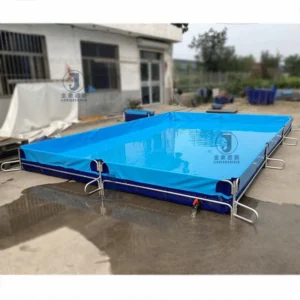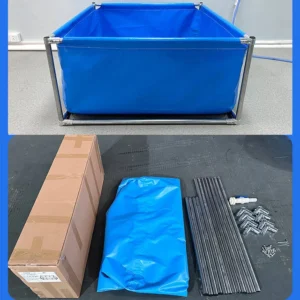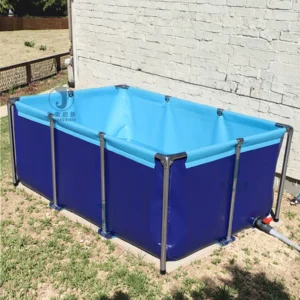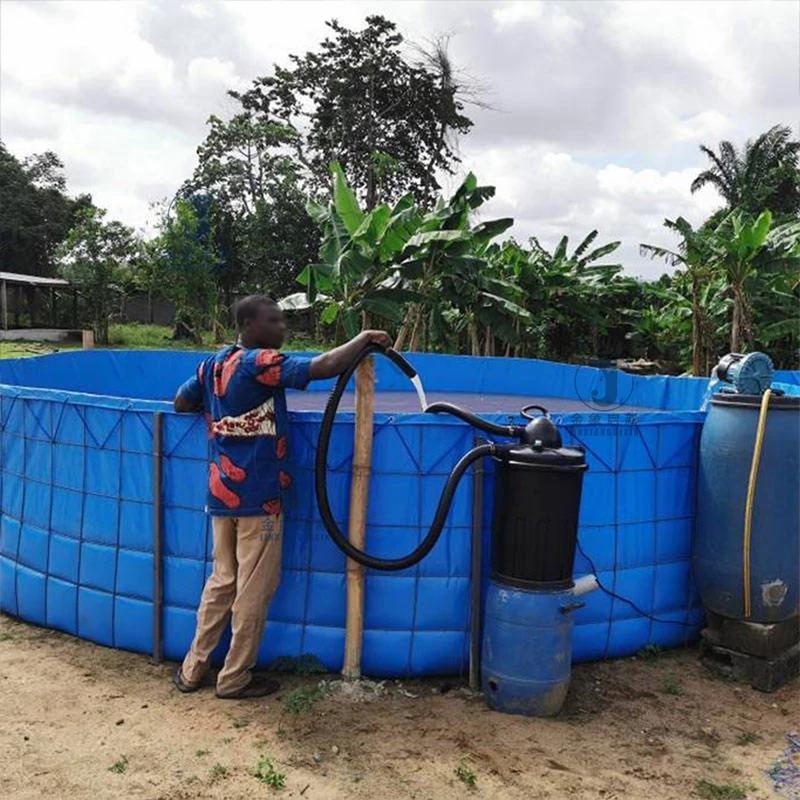
Custom Width and Length Fabrication — PVC coated tarpaulin rolls supplied in exact dimensions with 100% pre-shipment inspection, eliminating on-site waste for pond and tank liner projects.
Technical Specifications
| Parameter | Value |
|---|---|
| Product Type | PVC Tarpaulin 0.65mm for Fish Pond |
| Base Fabric Yarn Count | 500D840D / 500D1000D / 1000D1000D / 1000D1300D / 1000D2000D / 1300D1300D |
| Mesh Density | 2020 / 3019 / 30*15 |
| Coating Material | Double-Sided PVC on Polyester Base |
| GSM Range | 350 – 900 g/m² |
| Thickness Range | 0.29mm – 0.65mm |
| Tensile Strength (Warp) | 1650 – 3900 N |
| Tensile Strength (Weft) | 1600 – 3500 N |
| Key Features | Water Resistant, Waterproof, Flame Retardant (grade not stated — confirm required grade), Anti-UV (test basis not stated — confirm exposure rating) |
| Surface | Smooth Leather-like Texture |
| Repairability | Hot Air Weldable |
| Service Life | 3-5 years |
| Standards | ISO, CE |
Application Suitability
| Application | Exposure & Requirement |
|---|---|
| Aquaculture fish pond liner | Permanent water immersion, soil chemistry contact, puncture risk from substrate |
| Shrimp farm containment | Saline water exposure, UV degradation under open sky, mechanical damage during harvest |
| Agricultural water reservoir | Standing water pressure, algae growth, seasonal temperature fluctuation |
| Truck bed liner for live fish transport | Dynamic flexing, road vibration, constant water contact, abrasion against metal surfaces |
| Decorative landscape water feature | UV exposure, root penetration risk, aesthetic surface requirements |
Why "Flame Retardant" Claims Fail Site Inspections Without a Documented Grade
A flame retardant label means nothing until the test standard and classification are named on the certificate.
Fleet operators and aquaculture contractors regularly face site audits where the safety officer asks for the fire classification of every material on the premises. A PVC tarpaulin for fish pond or transport liner marked simply as "flame retardant" without a referenced standard — such as B1 per DIN 4102 or an NFPA 701 pass — will not satisfy the inspector. The result is a work stoppage until replacement fabric arrives [NEED_CITE: fire safety documentation requirements for temporary structures and containment systems]. When multiple rolls are already welded in place, the cost of removing and reinstalling far exceeds the original material cost. Specifying the required grade at the inquiry stage, and receiving a test report that names the standard and classification, prevents this scenario entirely.
Coating Integrity for Continuous Water Immersion
A pond liner lives under constant hydrostatic pressure. The PVC tarpaulin fish pond liner uses double-sided PVC coating over a polyester base fabric, creating a continuous waterproof barrier that resists water migration through the weave. Single-coated fabrics allow moisture to reach the base yarn over time, leading to delamination at the coating interface. The smooth leather-like surface on both sides also minimizes algae adhesion, reducing maintenance frequency for aquaculture operators managing multiple ponds across a single season.
Tensile Capacity at Seam and Anchor Points
Pond liners experience concentrated stress where the fabric is anchored to the basin edge or where welded seams join adjacent panels. With tensile strength reaching up to 3900 N warp and 3500 N weft on the heavier yarn count grades, this PVC coated tarpaulin resists tear propagation at these critical junctions. The polyester base fabric — available in denier options from 500D840D through 1300D1300D — provides dimensional stability that keeps welded seams flat under load. Operators lining deep ponds or large reservoirs should specify the heavier grades to match the increased hydrostatic pressure at depth [NEED_CITE: tensile and tear test methods for coated fabrics per ISO 1421].
How Yarn Count and Density Determine Real-World Puncture Resistance
The base fabric construction — expressed as yarn count and mesh density — controls how the PVC tarpaulin for fish pond responds to sharp objects in the substrate. A 1000D1000D yarn at 3019 density distributes point loads across more intersection points than a 500D840D at 2020, reducing the chance that a single rock or root penetrates through to the water side. GSM alone does not capture this behaviour: a heavier coating can raise the weight figure without adding puncture resistance if the base fabric remains open. Matching denier and density to the actual ground conditions — compacted clay versus gravel versus lined concrete — is what separates a liner that holds for the full production cycle from one that requires emergency patching within weeks of filling.
The Hidden Cost of Specifying by GSM Alone
Buyers who select pond liner fabric based only on a target GSM often receive material that meets the weight figure but fails in the field. A manufacturer can achieve a stated GSM by increasing coating thickness on a lighter base fabric, producing a roll that feels heavy but tears easily at the weld line or punctures under substrate pressure. When this happens mid-season, the aquaculture operator faces partial pond drainage, stock loss, and emergency liner replacement — costs that dwarf the savings from choosing a cheaper specification [NEED_CITE: coated fabric failure modes related to base fabric versus coating weight ratio]. Requesting the yarn count, mesh density, and tensile values alongside GSM closes this gap. Every roll dispatched from this facility carries a material specification sheet documenting all four parameters, so what arrives on site matches what was agreed in the quotation.
Why Procurement Teams Source This PVC Tarpaulin Here
Three full production lines and 36 sets of professional equipment support bulk roll output with consistent coating weight across the entire order, so adjacent pond sections do not show thickness variation after installation.
The 10-person R&D team develops custom-width samples within days, allowing operators to confirm fit against actual basin dimensions before committing to full production.
Dedicated QA/QC inspection at every production stage — including coating adhesion checks and seam integrity tests — catches deviations before rolls are packed, not after they arrive at the port.
ISO and CE certified processes provide the documentation trail that cross-border aquaculture projects require for customs clearance and site compliance audits.
Sample development covers material selection, custom sizing, and colour matching, giving buyers a physical reference to approve before the production run begins.
Documentation & Verification
- Material specification sheet stating base fabric denier, mesh density, GSM, and colour reference per roll
- Weight verification per roll against the stated GSM before dispatch, documented on the inspection record
- Test report for flame retardant or anti-UV grades where applicable, naming the standard and classification
- Pre-shipment inspection record with 100% coverage of coating adhesion and surface integrity
- Certificate of origin and customs documentation for cross-border aquaculture and transport projects
- Roll packing list with individual roll dimensions and net weight for container loading planning
Fabrication, Handling & Storage
- Hot air welding parameters should be tested on scrap from the same 0.65mm roll before joining pond liner panels
- Store PVC tarpaulin rolls upright on pallets to prevent flat-spot deformation on the double-sided PVC coating surface
- Unroll at ambient temperature above 10°C to avoid creasing the polyester base fabric in cold conditions
- Clean the smooth leather-like surface with mild detergent; avoid solvents that attack the PVC coating layer
- Field puncture repairs are performed by hot air welding a patch cut from the same yarn count grade
- Plan cut layouts to minimize weld seams in high-pressure zones near the pond basin floor
What to Include in Your Inquiry
Specify the pond or tank dimensions, water depth, and substrate type so the correct yarn count and GSM grade can be recommended. State whether flame retardant or anti-UV certification is required by your local regulations, and name the applicable standard if known. Confirm whether you need rolls in stock width for on-site cutting or pre-cut panels welded to your basin measurements. Indicate your annual roll consumption to align production scheduling with your installation timeline.
Frequently Asked Questions
Q: What GSM weight is recommended for fish pond liners?
A: The right GSM depends on pond depth, substrate conditions, and expected mechanical stress during harvest. A material specification sheet listing yarn count, mesh density, and tensile strength alongside GSM gives a complete picture. Lighter grades suit shallow lined ponds, while deeper or gravel-bottom installations require heavier base fabric construction. Request a sample in your target grade to verify fit before bulk order.
Q: Can you supply custom sizes for irregular pond shapes?
A: Yes. Rolls are available in custom width and length, and pre-cut panels can be welded to match irregular basin geometries. The R&D team develops a sample within days so you can confirm dimensions against the actual pond before full production begins. Minimum order quantities apply based on the selected yarn count and colour.
Q: How do I verify the anti-UV treatment is effective?
A: Anti-UV treatment is available on this PVC tarpaulin range, but the specific test basis and exposure rating should be confirmed for your market. Request a test report that names the standard and exposure hours before placing the order. This documentation ensures the material meets the UV stability requirements of your local aquaculture regulations.
Q: How do I repair punctures in the field?
A: The PVC coated surface is repairable by hot air welding. Cut a patch from the same yarn count and thickness grade, clean both surfaces, and apply hot air at the recommended temperature until the coating fuses. Test welding parameters on scrap material first. This method restores waterproof integrity without removing the liner from the pond.
Q: What is the difference between PVC and PE for pond applications?
A: PVC coated tarpaulin offers substantially higher tensile strength, better weld seam integrity, and greater puncture resistance compared to PE film. The polyester base fabric provides dimensional stability that PE lacks under hydrostatic pressure. PVC also supports hot air welding for custom shapes and field repairs, while PE typically requires adhesive tape that degrades under continuous water immersion.