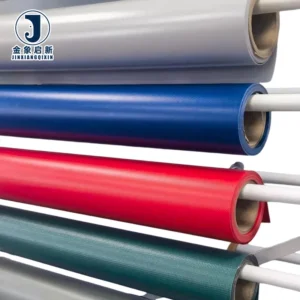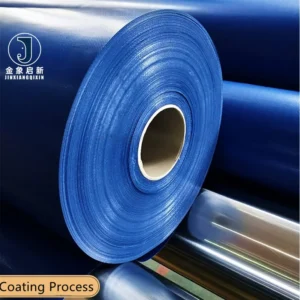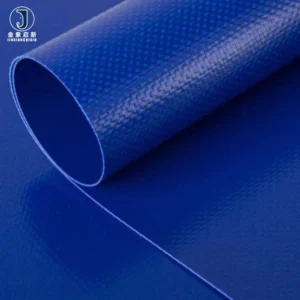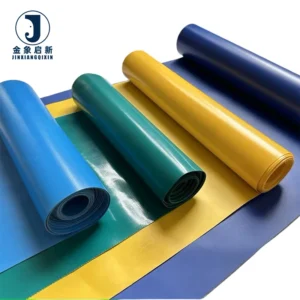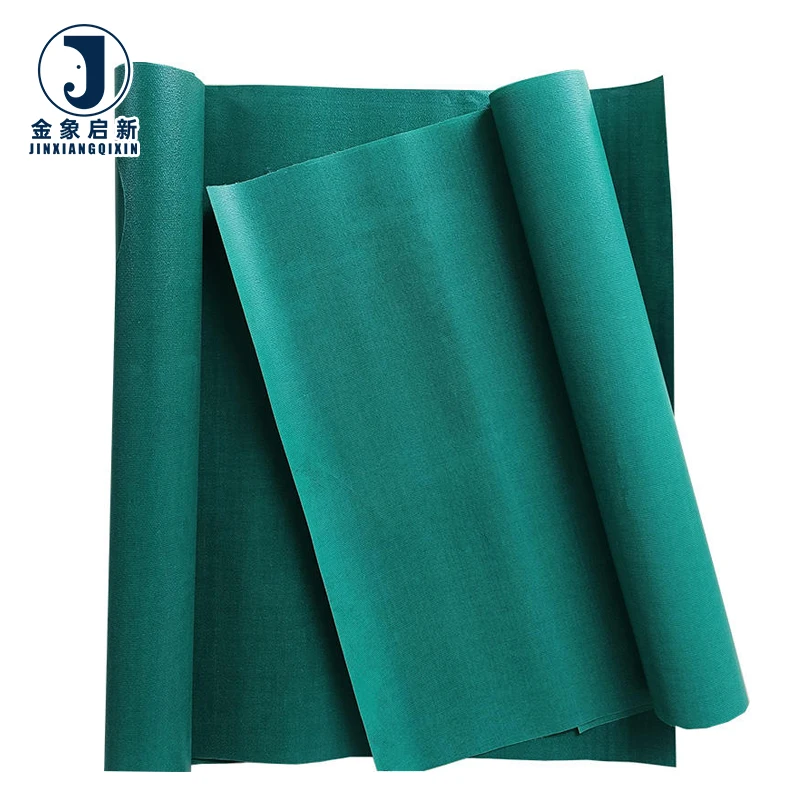
Coating Adhesion Control — Hot-melt and laminated coating processes bond PVC to high-tenacity polyester mesh with consistent peel strength, verified at every production stage before dispatch.
Technical Specifications
| Parameter | Value |
|---|---|
| Product Type | PVC Tarpaulin Roll |
| Material | PVC coated high-strength polyester mesh fabric |
| Coating Technology | Laminated technology & Hot-melt coating technology |
| Weight Options | 350gsm / 420gsm / 500gsm / 550gsm / 600gsm / 750gsm |
| Total Thickness | 0.32mm / 0.35mm / 0.4mm / 0.45mm / 0.5mm / 0.65mm |
| Roll Size | 2m × 75m / 2.1m × 50m |
| Color Options | Blue / Red / Yellow / Light blue / Grey (customized) |
| Key Features | Waterproof, sunproof, anti-mildew, cold crack resistance |
| Flame Retardant | Available — confirm the grade required for your market |
| Anti-Static | Available — confirm the standard required for your application |
| Service Life | Suited to extended outdoor exposure under normal transport conditions |
Application Suitability
| Application | Exposure & Requirement |
|---|---|
| Truck side curtain fabric | Constant flexing at rollers, road abrasion, tie-down stress at hems, UV and weather exposure |
| Custom-fit trailer covers | Load movement and vibration, wind lift at highway speed, repeated tensioning and release cycles |
| Flatbed cargo protection tarps | Direct rain and sun exposure, puncture risk from shifting loads, abrasion against steel decks |
| Truck awning and canopy fabric | Repeated deployment and stowage, creasing fatigue, prolonged outdoor UV exposure |
Why Coating Adhesion Matters More Than Weight on a Moving Load
A truck tarpaulin fails at the weld line first when the PVC coating separates from the base fabric under flex stress — not because the fabric tears.
When a trailer side curtain flexes thousands of times per trip, the bond between the PVC layer and the polyester mesh determines whether the seam holds or peels open. I have reviewed field returns where heavy-grade PVC coated tarpaulin for truck and transport panels delaminated along the heat-welded edge while the fabric body remained intact. The failure originates at the coating-to-yarn interface, where repeated bending breaks a weak adhesive bond [NEED_CITE: peel strength test methods for coated fabrics per ISO 2411]. GSM alone does not predict this behaviour — a 750gsm roll with poor lamination will fail faster than a 500gsm roll with strong hot-melt adhesion.
How Hot-Melt Coating Supports Weld Integrity at Flex Points
The hot-melt coating technology forces molten PVC into the weave structure of the high-tenacity polyester mesh, creating a mechanical bond that resists separation under repeated bending. This matters for truck and trailer applications where the fabric flexes at every tie-down point and along the welded hem. PVC coated tarpaulin for truck and transport use must sustain this flex cycle without the coating lifting from the yarn surface, because once delamination starts at a weld line, moisture enters and accelerates the failure across the panel.
Cold Crack Resistance and Its Role in Long-Haul Transport
Trailer covers move between climate zones, and a tarpaulin that stays flexible in warm conditions can stiffen and crack when folded at low temperatures. The cold crack resistance specified for this product range addresses the brittleness threshold where PVC begins to lose elasticity. When a fleet operator runs routes through cold regions, the fabric must tolerate being folded, tensioned and released at temperatures well below freezing without developing micro-cracks at crease lines [NEED_CITE: low-temperature bend test standards for flexible PVC]. This property directly affects the usable life of covers on refrigerated and open-deck transport.
Reading the Specification Sheet Beyond the GSM Number
The weight in grams per square metre tells you how much material is present, but the base fabric denier and weave density determine how that weight translates into tensile and tear resistance. A 500gsm roll woven from high-tenacity yarns at tight density can outperform a 600gsm roll built on a loose, standard-tenacity base. The coating method — laminated versus hot-melt — controls peel strength and therefore how well heat-welded seams survive. Thickness correlates with abrasion resistance on flatbed decks, but a thicker coating on a weak base fabric will crack rather than wear evenly. The available GSM grades from 350gsm to 750gsm allow spec-to-load matching: lighter weights for side curtains that cycle open and closed, heavier weights for flatbed covers exposed to load abrasion. Selecting the correct combination requires matching the base fabric construction and coating weight to the actual stress profile of the vehicle and route.
What Happens When the Wrong Grade Goes on the Road
Specifying a light-grade roll for a flatbed cover that carries abrasive loads leads to early coating wear and fabric exposure at contact points. Ordering rolls without confirming colour consistency across the batch results in visible shade variation when multiple panels are installed side by side on a trailer fleet [NEED_CITE: colour fastness evaluation methods for coated textiles]. Accepting a generic size instead of a cover cut to the specific trailer model leaves excess fabric that flaps in transit, accelerating fatigue at the hem. These failures surface weeks after delivery, making pre-shipment verification essential.
Why Procurement Teams Source This Range Here
Three full production lines with dedicated coating equipment maintain batch-to-batch GSM consistency across multiple rolls in the same order. The ten-person R&D team develops custom widths, colours and cut-to-model samples within days, supporting fleet operators who need exact trailer fitment. QA/QC inspection at every coating and lamination stage catches adhesion and weight deviations before the roll reaches the packing line. Pre-shipment inspection covers every roll, with documented GSM verification against the original quotation. Custom printing of branding is available on request for fleet operators who mark their trailers with company identity.
Documentation & Verification
- Material specification sheet confirming exact GSM, base fabric construction and coating weight per roll
- Test reports for flame retardant and UV treatments where applicable to the selected grade
- Pre-shipment inspection record documenting roll-by-roll weight and dimension checks
- Certificate of origin and customs documentation supporting cross-border transport procurement
- Roll packing list with batch identifiers for traceability across container loads
Fabrication, Handling & Storage
- Heat-weld at temperatures matched to the selected coating technology — hot-melt and laminated grades require different dwell times
- Allow rolls to reach ambient temperature before unrolling in cold conditions to avoid crease cracking on the PVC surface
- Store rolls upright on pallets to prevent flat-spot deformation that affects tensioning during side curtain installation
- Reinforce tie-down eyelet zones with additional PVC patches to distribute load across the polyester mesh base fabric
- Use compatible PVC adhesive for field repairs, matching the coating chemistry of the selected grade for proper bond strength
What to Include in Your Enquiry
Provide the specific truck or trailer model, the operating climate range, and whether you need rolls or finished cut-to-size covers. Specify the GSM grade and any required treatments such as flame retardant or anti-static certification for your terminal or route compliance. Confirm the colour reference and whether batch consistency across multiple rolls is critical for side-by-side installation on a fleet.
Frequently Asked Questions
Q: How is GSM verified on arrival to ensure the material matches the quoted specification?
A: Each roll undergoes weight verification during pre-shipment inspection, and a material specification sheet accompanies the shipment stating the confirmed GSM, base fabric details and coating weight. Buyers can cross-check this documentation against the original quotation upon receipt.
Q: Can truck covers be cut and finished to fit a specific trailer model rather than a generic size?
A: Yes. The R&D team works from vehicle dimension drawings to produce covers tailored to individual truck and trailer models. Samples are developed within days for approval before bulk production begins, ensuring the fit matches the actual vehicle profile.
Q: How is batch-to-batch colour consistency controlled when ordering multiple rolls for side curtains?
A: Colour matching is controlled at the coating stage with reference standards checked across all rolls in the same production run. Pre-shipment inspection includes visual comparison to confirm uniform shade before the rolls are packed and dispatched.
Q: What flame retardant or anti-static certifications can be supplied if the transport route requires compliance?
A: Flame retardant and anti-static treatments are available as special finishes. The specific grade and test standard depend on your market requirements, so confirm the certification needed at enquiry stage so the correct treatment and documentation can be arranged.
Q: What eyelet spacing and hem reinforcement options are available for tie-down durability?
A: Eyelet spacing and hem construction are configured to match the load and tie-down pattern of the specific trailer. Reinforcement patches are applied at high-stress zones to distribute tension across the polyester base fabric and prevent pull-through at flex points.