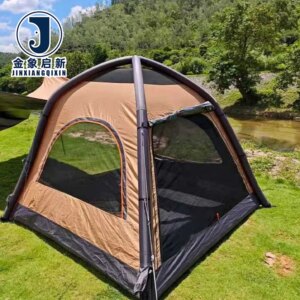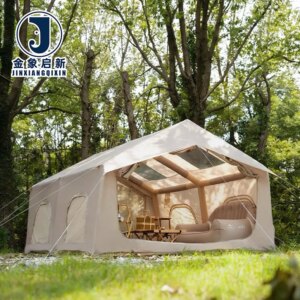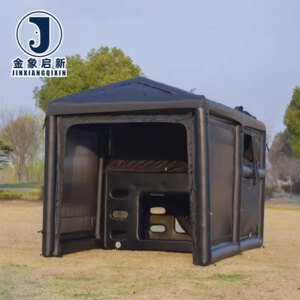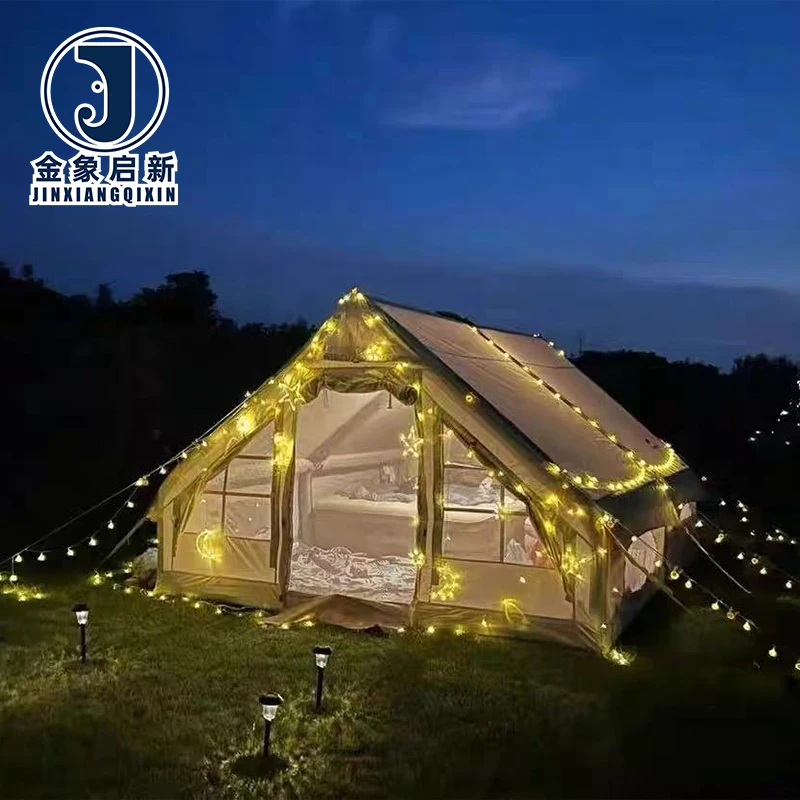
Production Consistency Backed by Process Control — 36 sets of processing equipment maintain tight tolerances across every inflatable tent fabric roll, verified at 12 quality checkpoints before dispatch.
Technical Specifications
| Parameter | Value |
|---|---|
| Product Type | Inflatable Tent |
| Core Material | PVC tarpaulin |
| Capacity | 4-6 Person |
| Key Performance | Waterproof, UV-resistant, quick automatic opening |
| Waterproof Rating | Minimum 3000mm water column |
| UV Resistance | 4000 hours accelerated testing |
| Tensile Strength | ≥200N/5cm (test basis not stated) |
| Door Design | Double door |
| Customization | OEM & ODM — sample customization, pattern printing |
| Certifications | ISO9001, ISO14001, ISO45001, CE |
Application Suitability
| Application | Exposure & Requirement |
|---|---|
| Commercial outdoor gear manufacturing | Repeated inflation cycles, UV exposure, waterproof integrity under field conditions |
| Outdoor recreation business supply | Batch-to-batch color consistency, reliable lead times, branded presentation |
| Engineering project temporary shelters | Rapid deployment, wind load resistance, weather protection over extended use |
| Industrial outdoor equipment lines | Integration into product catalogs, dimensional precision, certification documentation |
Why Batch Consistency Separates Reliable Inflatable Tent Fabric from Problematic Shipments
An inflatable tent manufacturer cannot afford color drift or coating variance between production runs.
When sourcing PVC tarpaulin for inflatable tent construction, buyers often discover that the first sample roll performs perfectly while subsequent batches show visible shade differences or inconsistent weld behavior. This inconsistency forces production line adjustments, delays assembly schedules, and generates warranty claims from end users who expect uniform appearance across their product range. The root cause typically traces back to coating weight variation or pigment dispersion issues that only surface once multiple rolls are compared side by side under factory lighting [NEED_CITE: common causes of color variation in PVC coated fabric production].
Coating Weight Control Across Every Inflatable Tent Fabric Roll
Consistent PVC coating application directly determines how the material behaves during inflation and deflation cycles. When coating weight drifts between rolls, some panels flex more readily than others, creating uneven stress distribution across welded seams. This inflatable tent manufacturer maintains in-house coating operations with calibrated application heads, ensuring the stated GSM is achieved and verified on every roll that enters the fabrication stage. Buyers ordering multiple rolls for a single production run receive material with matched coating weights, eliminating the panel stiffness mismatch that causes premature seam fatigue.
Weld Integrity at High-Flex Zones
The inflation bladders and structural tubes of an inflatable tent experience repeated bending at connection points every time the shelter is deployed and packed away. Welded seams at these zones must match or exceed the tensile strength of the base fabric itself, otherwise the seam fails while the surrounding material remains intact [NEED_CITE: tensile and tear test methods for coated fabrics per ISO 1421]. This inflatable tent fabric supports hot-air and wedge welding processes, with the PVC coating formulation designed to achieve consistent melt behavior across the full width of each roll. Fabricators can dial in stable welding parameters once and maintain them throughout the production run.
Reading the Specification Sheet Beyond the Headline Numbers
Waterproof rating, UV treatment duration, and tensile strength values each tell part of the story, but their interaction determines real-world performance. A minimum 3000mm water column rating indicates the coating resists hydrostatic pressure during sustained rainfall, yet this performance depends on the coating remaining intact after repeated flexing. The 4000-hour UV accelerated testing validates that the material retains structural properties after prolonged sun exposure, but the test result must be matched to the actual deployment climate — equatorial installations demand different degradation allowances than temperate zones. Tensile strength of ≥200N/5cm provides a baseline for load-bearing capacity, though this figure should be evaluated alongside tear propagation resistance, which governs how a small puncture behaves under stress. Coating adhesion to the base fabric ties these properties together; weak adhesion causes delamination that negates every other specification [NEED_CITE: relationship between coating adhesion and long-term fabric performance].
What Happens When Fabric Specifications Are Taken at Face Value
A quotation that lists a target GSM without a per-roll verification record leaves the buyer exposed to underweight material that arrives looking correct but performs below expectation. Similarly, UV resistance claims without an accompanying accelerated test report provide no assurance that the treatment was actually applied to the batch being shipped. Welded seams on inflatable structures concentrate stress at tube junctions — if the coating formulation varies between rolls, weld parameters that worked on the sample will produce weak joints on production material [NEED_CITE: weld strength testing standards for PVC coated fabrics]. These failures rarely appear during incoming inspection and only emerge after the finished tent has been deployed in the field.
Why Fabricators Source This Material for Inflatable Tent Production
Three full production lines running PVC tarpaulin coating provide the throughput capacity to fulfill multi-roll orders without splitting batches across different machines, which is a primary cause of inter-roll inconsistency. The 10-technician R&D team develops custom color matches and pattern prints with sample rolls produced on the same equipment used for bulk runs, so the approved sample accurately represents what arrives at the factory door. Dedicated QA/QC inspection at every production stage catches coating weight drift, color shade deviation, and surface defects before material reaches the packing area. The 9,180 m² facility consolidates coating, printing, cutting, and packing under one roof, reducing handling damage and lead time variability. ISO9001, ISO14001, ISO45001, and CE certifications are maintained with current audit records available for buyer review.
Documentation & Verification
- Material specification sheet confirming GSM, coating type, and dimensional tolerances for the ordered inflatable tent fabric
- Batch-specific test report covering waterproof rating and UV resistance values measured on the shipped production run
- ISO9001, ISO14001, ISO45001, and CE certificates included in the shipment documentation package
- Pre-shipment inspection record listing roll-by-roll coating weight verification results
- Certificate of origin and customs documentation prepared for destination country import requirements
Fabrication, Handling & Storage
- Set hot-air welding temperature based on the PVC coating formulation specified for this inflatable tent fabric to achieve full seam fusion
- Store rolls upright on pallets in a dry, shaded area to prevent coating compression marks that transfer to finished tent panels
- Use compatible PVC adhesive for field repairs, matching the coating chemistry of the base inflatable tent material
- Allow material to acclimate to ambient temperature before cutting in cold conditions to avoid coating micro-cracking
- Plan cutting layouts to minimize weld seams at high-stress inflation tube junctions on the double-door tent design
What We Need to Move Your Inquiry Forward
Provide the intended end-use environment and expected deployment conditions so we can confirm the coating weight and treatment package suits your market. Specify target dimensions, color references or Pantone codes, and any pattern printing or logo placement requirements. Indicate your annual volume estimate and whether you need rolls or finished cut panels, along with the compliance certifications your destination market requires.
Frequently Asked Questions
Q: How is batch-to-batch color and performance consistency ensured for custom inflatable tent orders?
A: Every production run is processed on the same production line used for the approved sample, with in-process coating weight checks and spectrophotometer shade verification at multiple stages. A batch-specific inspection report accompanies each shipment, documenting the measured values against the approved specification so you can confirm consistency before releasing material to your assembly line.
Q: What customization options are available for size, color, pattern printing and branding?
A: The 10-technician R&D team develops custom color matches, pattern prints, and logo placements with sample rolls produced for your approval before bulk manufacturing begins. Dimensional specifications are cut to your drawings, and the double-door configuration can be adapted to your design requirements with reinforced weld zones at structural stress points.
Q: What is the sample development process and lead time before bulk production?
A: Once your specifications are confirmed, the R&D team produces sample material on the same production equipment used for bulk orders, ensuring the sample accurately represents final production quality. After you review and approve the sample, bulk manufacturing proceeds with the same coating formulation, color batch, and processing parameters locked in from the sample stage.
Q: Which certifications and test reports are included for customs clearance and market compliance?
A: Each shipment includes ISO9001, ISO14001, ISO45001, and CE certificates alongside a certificate of origin and customs documentation package. Batch-specific test reports covering waterproof rating and UV resistance values are provided, giving you the verification documentation needed for import clearance and distributor compliance requirements in your destination market.
Q: How are waterproof and UV-resistant performance claims validated and documented per shipment?
A: The minimum 3000mm water column waterproof rating and 4000-hour UV accelerated testing results are measured on material from the actual production batch being shipped, not referenced from a generic catalog specification. These measured values are recorded on the batch inspection report included with your documentation, providing traceable performance verification for each roll received.