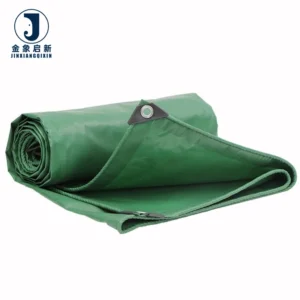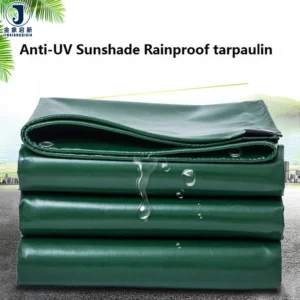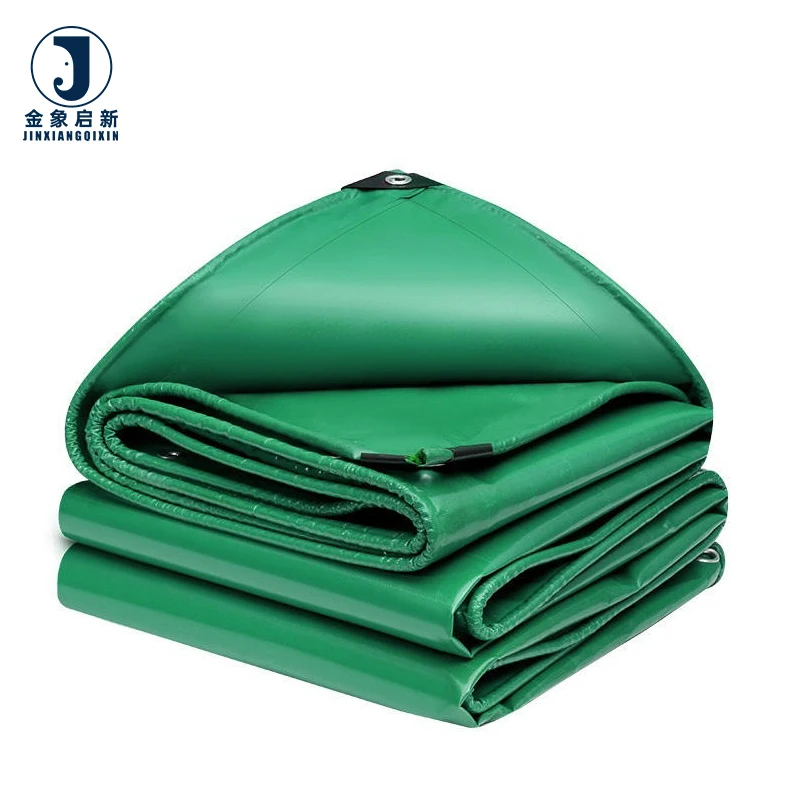
Process Control Over Coating Adhesion — Jinxiang’s three full production lines maintain consistent PVC bond strength across every roll, ensuring the coating does not delaminate at flex points under long-term truck and farm cover use.
Technical Specifications
| Parameter | Value |
|---|---|
| Product Type | PVC Tarpaulin Roll |
| Coating Material | PVC |
| Base Fabric | Warp Knitted Polyester |
| Weave Style | Plain |
| Waterproof | Yes |
| Anti-Static | Available in anti-static grades — confirm the grade required for your market |
| Tear Resistance | Claimed — test basis not stated in source |
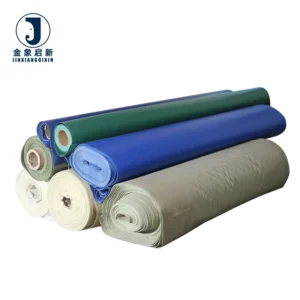
| Color | Customizable |
| Finish | Not stated in source |
| Flame Retardant | Available in flame retardant grades — confirm the grade required for your market |
| UV Treatment | Available with UV treatment — confirm the grade required for your market |
| Weight (GSM) | Not stated in source |
| Width | Not stated in source |
| Roll Length | Not stated in source |
| Certification | ISO, CE |
Application Suitability
| Application | Exposure & Requirement |
|---|---|
| Truck and trailer load covers | Constant road abrasion, tie-down tension, rain and wind exposure during transit |
| Poultry and livestock shelter covers | Continuous outdoor weathering, moisture ingress, ammonia and organic contact |
| Agricultural tent and enclosure fabric | Repeated assembly and dismantling, UV exposure, wind-driven rain |
| Farm equipment and stockpile protection | Standing water, ground contact, puncture from rough surfaces |
Why a Generic Truck Cover Fails Where Yours Should Not
A cover cut to a generic size will fail at the seams long before the fabric itself tears, because excess material flaps under load movement and concentrates stress at every eyelet. Specifying a PVC Tarpaulin for farm and transport cover use requires matching the exact trailer model dimensions with reinforced hem placement tied to your securing system.
I have watched fleet operators replace entire cover sets within a single season because the original supplier used a one-size template. The fabric was intact, but the welds had peeled apart at every corner where the load shifted during braking. That kind of failure is not a material problem — it is a specification and cutting problem [NEED_CITE: common failure modes in transport tarpaulin covers under cyclic loading].
Covering a Moving Load Demands More Than Waterproof Fabric
When a truck or trailer rolls down the highway, the cargo shifts, the cover flexes, and every tie-down point becomes a stress concentrator. A PVC Tarpaulin for farm and transport cover must hold its coating adhesion through thousands of these flex cycles without delaminating at the base fabric interface. The warp knitted polyester base in this roll stock provides multidirectional tear resistance, meaning a puncture or cut at a high-stress zone does not propagate into a full-length split.
Seam Integrity Where the Load Flexes Most
The weakest point on any fitted truck cover is the welded seam at corners and tie-down patches. If the heat-weld temperature is too low, the PVC layers never fully fuse and the seam peels under tension. If it is too high, the coating degrades and becomes brittle. Consistent seam performance depends on process control at the production stage — not on the fabric specification alone. This is where a supplier’s in-process QA at every stage matters [NEED_CITE: heat-weld parameter control for PVC coated fabric seams].
Reading the Specification Sheet Beyond the Headline Number
The weight of a coated fabric tells you the combined mass of base cloth and PVC coating per square metre, but it does not reveal how that weight is distributed. A roll with a heavy coating over a light base fabric may feel substantial on arrival yet tear easily at tie-down points because the underlying yarn density is low. Conversely, a tightly woven warp knitted base with a moderate coating weight can outperform a heavier roll in real-world tensile and tear demands. Always request the base fabric denier and weave density alongside the GSM figure so you can assess the structural contribution of each component independently.
The plain weave construction used here provides a balanced warp-and-weft interlock that resists bias stretching — a common cause of distortion when covers are tensioned over uneven loads. Custom color options let fleet operators match existing livery without needing to source from a separate dye house, reducing both lead time and batch-to-batch variation risk.
What Happens When Roll-to-Roll Consistency Breaks Down
A colour shift between two rolls in the same order becomes immediately visible once they are installed side by side on adjacent trailers or along a continuous farm shelter. The buyer then faces a choice: accept a mismatched appearance or reject the entire delivery and wait for replacements. Either outcome costs time and damages credibility with the end user. Batch consistency in both colour and coating weight is not a premium feature — it is a baseline expectation for any professional-grade PVC Tarpaulin for farm and transport cover projects [NEED_CITE: batch colour variation tolerance standards for coated textiles].
Sourcing That Matches How You Actually Buy
Every roll is produced on one of three dedicated lines with 36 sets of professional equipment, meaning capacity is available for fleet-scale orders without sacrificing per-roll attention. The 10-person R&D team handles sample development within days when you need to confirm colour, weight, or sizing before committing to full production. Dedicated QA/QC checkpoints at each production stage catch coating inconsistencies before they leave the factory.
Pre-shipment inspection covers 100 percent of rolls, not a statistical sample, so the documentation you receive reflects what was actually shipped. Custom width and length options are supported without the inflated minimums that typically apply to non-stock specifications. The result is a supply process built around how transport fleet operators and agricultural cover buyers actually specify and order.
Documentation & Verification
- Material specification sheet stating base fabric denier, PVC coating weight, and colour reference per roll
- Weight verification measured per roll against the stated GSM before dispatch
- ISO and CE certificates covering the production system and product compliance scope
- Pre-shipment inspection record confirming coating adhesion and visual quality across all rolls
- Certificate of origin and customs documentation for cross-border shipment support
- UV and flame retardant test reports supplied where applicable grades are specified
Fabrication, Handling & Storage
- Heat-weld at manufacturer-recommended temperature to ensure PVC coating fuses fully without degrading the base fabric
- Store rolls horizontally on a flat surface to prevent permanent creasing in the PVC coating layer
- Allow cold-stored rolls to acclimatise before unrolling to avoid cracking the PVC surface in low temperatures
- Use compatible PVC-based repair patches for field repairs so the adhesive bonds to the coating chemistry
- Plan cutting layout to minimise offcuts and reduce the number of welded seams on each finished cover
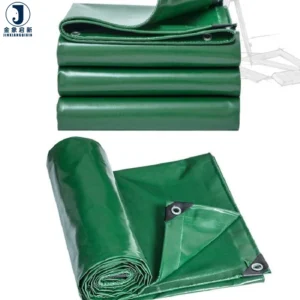
- Reinforce eyelet zones with additional PVC patches to distribute tie-down loads across the warp knitted base
How to Scope Your Enquiry
Provide the specific trailer model or farm structure dimensions so the cover can be cut to fit rather than adapted from a generic template. Indicate your local fire safety or anti-static compliance requirements if the cover will be used in regulated environments such as mining sites or enclosed livestock facilities. Specify the annual volume and whether you need roll stock for your own fabrication line or finished covers with hemming and eyelets installed.
Frequently Asked Questions
Q: How do I verify the GSM on arrival matches what was quoted?
A: Request the pre-shipment inspection record that documents the measured weight per roll. On receipt, you can confirm by cutting a known-area sample from the roll edge and weighing it on a calibrated scale. Any discrepancy between the quoted specification and delivered weight should be raised immediately with the inspection report as reference.
Q: How should I specify truck cover sizing for my exact trailer model?
A: Provide the trailer manufacturer, model designation, and year along with the cargo deck dimensions and any protrusions such as refrigeration units or tail lifts. The cover is then cut to match those specific measurements with hem reinforcement and eyelet spacing aligned to your existing tie-down rail or rope system.
Q: What eyelet spacing and hem reinforcement options are available?
A: Standard spacing follows your tie-down configuration, typically at regular intervals along the hem. Reinforced PVC patches are applied at each eyelet position to distribute load across the warp knitted base fabric rather than concentrating stress on a single puncture point through the coating.
Q: Can you guarantee colour consistency across multiple rolls for a fleet order?
A: Every roll in a single order is produced under the same coating batch with in-process QA checks on colour at each stage. The pre-shipment inspection record documents colour verification roll by roll, so any variation is caught before dispatch rather than discovered during installation.
Q: How do welded seams perform at load flex points?
A: Seam integrity depends on correct heat-weld parameters matched to the PVC coating formulation and base fabric thickness. The production process includes weld testing during fabrication to confirm peel strength before the cover leaves the line, ensuring seams hold through repeated flex cycles under load movement.