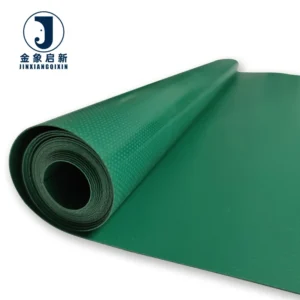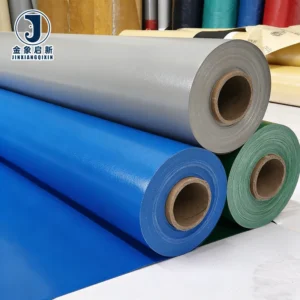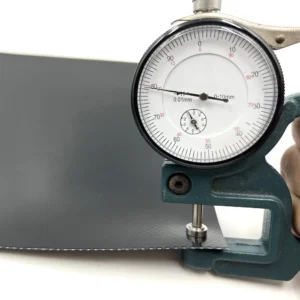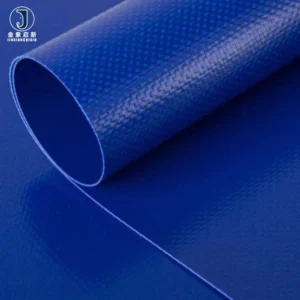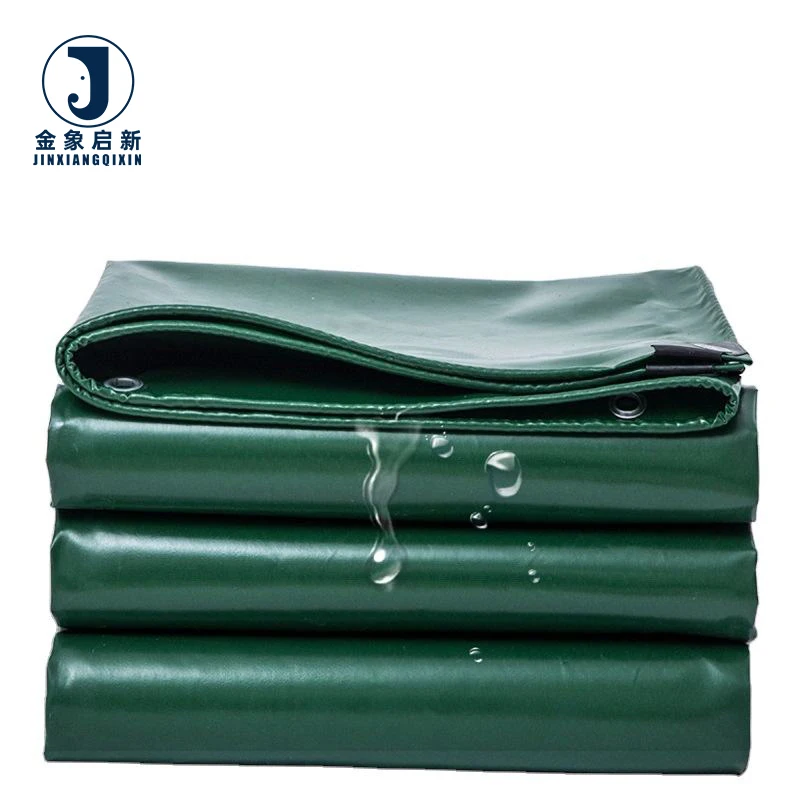
Coating Control — Three full production lines maintain precise GSM output across every roll, verified by 100% pre-shipment weight sampling before dispatch.
Technical Specifications
| Parameter | Value |
|---|---|
| Product Type | PVC Tarpaulin Roll |
| Coating Material | PVC |
| Base Fabric | High-strength polyester mesh fabric |
| Coating Technology | Laminated technology & Hot-melt Coating technology |
| Weight (GSM) | 350gsm, 420gsm, 500gsm, 550gsm, 600gsm, 750gsm |
| Total Thickness | 0.32mm, 0.35mm, 0.4mm, 0.45mm, 0.5mm, 0.65mm |
| Roll Size Options | 2m width × 75m length / 2.1m width × 50m length |
| Colour Range | Blue, Red, Yellow, Light Blue, Grey (custom options available) |
| Surface Finish | Glossy Surface or Matt Surface |
| Key Features | Cold crack resistance, anti-mildew, waterproof, sunproof, colour fastness |
| Flame Retardant | Available in flame retardant grades — confirm the grade required for your market |
| Anti-Static Treatment | Available — verify specific standard with manufacturer catalog |
| UV Treatment | Available — confirm test basis applicable to your region |
| Certifications | ISO, CE |
Application Suitability
| Application | Exposure & Requirement |
|---|---|
| Truck side curtain fabric | Constant flexing at hinge points, road debris abrasion, daily UV exposure, tie-down tension stress |
| Flatbed trailer load cover | Wind flap fatigue, water ingress under highway speed, edge abrasion from ratchet straps |
| Tipper trailer enclosure | Heavy particulate contact, repeated folding and unfolding, chemical exposure from bulk loads |
| Transport equipment OEM fitment | Precision dimension matching to trailer model, weld seam integrity under dynamic load |
| Curtain-side replacement panels | Colour match to existing fleet livery, consistent GSM across replacement batches |
Why a Quoted GSM Does Not Guarantee the Fabric You Receive
GSM on paper means nothing without weight sampling at the point of dispatch.
The PVC tarpaulin for truck and trailer cover market is flooded with rolls that arrive lighter than the specification agreed at quotation stage. The discrepancy is rarely dramatic enough to catch by hand — it shows up only when seams split prematurely under tie-down tension or when the fabric flex-cracks along fold lines within months of service. [NEED_CITE: pre-shipment weight verification methods for coated fabrics] Fleet operators replacing side curtains often discover the roll they received was coated to a lower GSM than the sample they approved, but the difference was invisible until the first winter cold snap exposed the reduced cold crack resistance.
Coating Adhesion and What It Means for Truck Covers
Laminated technology and hot-melt coating technology each produce different adhesion profiles between the PVC layers and the polyester base fabric. For truck side curtains that undergo thousands of flex cycles daily, the bond between coating and substrate determines whether the PVC delaminates at stress points before the fabric itself fails. Hot-melt coating penetrates the mesh structure more deeply, creating a mechanical lock that resists separation under the dynamic loads experienced on curtain-side trailers. This PVC tarpaulin for truck and trailer cover is produced using either method depending on the grade selected, and the choice affects how the material responds to high-frequency welding during fabrication.
Cold Crack Resistance in Real Transport Conditions
A truck cover that becomes brittle at low temperatures will crack at fold lines and around eyelet reinforcements when the curtain is retracted in cold weather. Cold crack resistance is not a single threshold — it varies with plasticiser formulation and coating weight. Heavier grades such as the 600gsm and 750gsm options in this range carry more PVC compound, which influences low-temperature flexibility. [NEED_CITE: cold crack test methods for PVC coated fabrics in transport applications] Fleet operators running routes across climate zones need to match the grade to the coldest expected operating environment rather than defaulting to a mid-range option that may not hold up in winter conditions.
How Coating Method and Base Fabric Interact Under Load
The high-strength polyester mesh fabric provides the structural backbone, but the coating method determines how effectively load transfers from the PVC surface into the yarn structure. Laminated coating bonds a pre-formed PVC film to the mesh, producing a smooth surface with consistent thickness — suited to applications where appearance and cleanability matter alongside strength. Hot-melt coating forces molten PVC into the mesh interstices, creating a thicker bond zone that improves tear propagation resistance. When selecting a PVC tarpaulin for truck and trailer cover applications, the interplay between base fabric density and coating penetration depth governs how the material behaves at welded seams, which are typically the first failure point on a trailer curtain. [NEED_CITE: tensile and tear test methods for coated fabrics per ISO 1421]
What Happens When the Wrong Grade Goes on a Trailer
Specifying a lighter GSM than the application demands leads to predictable failure patterns: edge hems tear out around tie-down points, welded seams open along the curtain track, and the fabric develops pinholes at flex lines within the first season. The cost of replacing a single trailer curtain — including downtime, fabrication labour and freight — far exceeds the price difference between adjacent GSM grades. Buyers who focus only on per-metre cost often pay more over the life of the fleet. [NEED_CITE: total cost of ownership for transport tarpaulin covers vs initial material cost] Colour inconsistency across rolls in the same order creates visible panel mismatches once installed side by side on a curtain-side trailer, forcing partial replacement or full fleet re-covering.
Why Procurement Through This Channel Works for Fleet Orders
Deep process control over coating weight and adhesion is maintained across three full production lines with 36 sets of professional equipment, ensuring that bulk orders for fleet curtain replacements maintain roll-to-roll consistency. A dedicated 10-person R&D team handles custom sizing confirmed against specific trailer model dimensions before production begins — eliminating the generic-size covers that flap and fail prematurely. Every roll undergoes in-process QA with 100% pre-shipment inspection, so the PVC tarpaulin for truck and trailer cover you receive matches the GSM, colour and finish stated on the quotation. Custom width, colour and pattern printing are supported with realistic lead times rather than inflated minimums.
Documentation & Verification
- Material specification sheet stating exact coating weight, base fabric construction and colour reference per roll
- Pre-shipment inspection record confirming GSM verification and roll-to-roll colour consistency
- UV and flame retardant test reports matched to the specific grade ordered — not generic certificates
- Roll packing list with individual roll weight and length for container loading calculation
- Certificate of origin and customs documentation supporting international freight clearance
Fabrication, Handling & Storage
- High-frequency welding suited to hot-melt coated grades; adjust dwell time for thicker GSM options
- Allow rolls to acclimatise before unrolling in cold conditions to avoid stress cracking at fold lines
- Store rolls upright on cores to prevent flat-spot creasing that transfers to finished curtains
- Matte surface options reduce glare on side curtains and accept printed branding with appropriate ink systems
- Reinforce tie-down eyelet zones with additional PVC patches regardless of GSM grade selected
What to Include in Your Enquiry
Specify the trailer models you are covering — curtain-side, flatbed or tipper — along with the exact panel dimensions required, so the PVC tarpaulin for truck and trailer cover can be sized to your fleet rather than cut to a generic pattern. State whether you need rolls only or finished panels with eyelets and hems, and confirm any colour reference or flame retardant grade your market requires. Indicate your annual volume so production can be scheduled with batch consistency across repeat orders.
Frequently Asked Questions
Q: How do you verify GSM matches what was quoted before shipment?
A: Each roll is weighed during pre-shipment inspection and compared against the stated GSM on your material specification sheet. Any roll falling outside tolerance is held before packing. We supply the inspection record with your shipment so your receiving team can cross-check without independent testing on arrival.
Q: What eyelet spacing and hem reinforcement options are available for truck and trailer applications?
A: Standard hem reinforcement uses folded PVC with heat-welded seams. Eyelet spacing is set to your specification — common intervals for curtain-side trailers differ from flatbed tie-down patterns. Confirm your trailer track system and strap configuration so placement matches your hardware.
Q: How do I specify custom cut sizes for my specific trailer model?
A: Provide the trailer manufacturer, model and body dimensions including track-to-track width and curtain drop length. Our R&D team confirms the cutting pattern against those measurements before production begins, so the PVC tarpaulin for truck and trailer cover fits without field trimming or excess material.
Q: How is colour consistency maintained across multiple rolls in the same order?
A: All rolls in a single order are coated from the same colour batch with a reference swatch approved before full production. The pre-shipment inspection includes visual colour comparison across rolls to catch any variation before dispatch, preventing panel mismatch on curtain-side installations.
Q: What is the weld strength at seams compared to the base fabric tear strength?
A: High-frequency welding on hot-melt coated grades produces seam strength approaching the base fabric tear value, depending on GSM and welding parameters. We recommend test welds on sample pieces from your ordered grade to confirm settings before full panel fabrication.