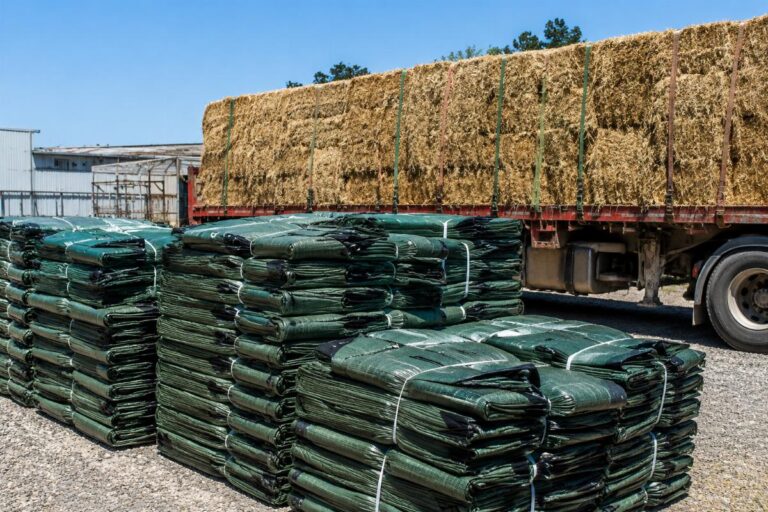
Wholesale PVC Tarp for Agricultural Silage Coverage in Peru
Heavier is not always better.
Sourcing silage covers for Peru requires specific high-UV resistance and acid-proof coatings, not standard domestic agricultural tarps. Correct GSM selection and heat-sealing standards are critical to prevent feed spoilage in humid coastal climates. Buyers must prioritize coating formulation over raw weight to withstand the unique combination of intense Andean UV radiation and acidic silage effluent.
Walking through the warehouses at the Port of Callao years ago, I watched containers of agricultural tarpaulins being unloaded with a sense of dread that only comes from experience. The paperwork was perfect, the customs clearance smooth, but the product inside was destined for failure. A client had ordered what they thought was a premium PVC Tarp for Silage Coverage Peru solution, specifying a standard 550gsm double-coated fabric common in temperate regions. Within months, photos arrived showing yellowed, brittle surfaces and cracked eyelets. The silage underneath had spoiled, turning a profitable harvest into a total loss. That incident shifted my entire approach to sourcing. It taught me that the environmental variables in Peru—specifically the high-altitude UV index and the chemical aggression of fermented feed—demand a technical specification far beyond basic waterproofing. [NEED_CITE: UV intensity variations in Andean regions vs coastal zones]
The mistake was assuming that "agricultural grade" is a universal standard. It is not. In the context of Latin American agriculture, particularly in Peru’s diverse microclimates, the definition of durability changes drastically from the coast to the highlands. This guide breaks down the technical realities of selecting the right cover, moving beyond marketing claims to the physical properties that actually determine longevity.
Why Standard Tarps Fail in Peru’s Silage Bunkers?
The core reason for premature failure is a mismatch between material chemistry and local environmental stressors. Many buyers assume that a black polyethylene (PE) sheet or a standard PVC tarp will suffice because it keeps rain out. However, silage coverage is not just about water exclusion; it is about creating an anaerobic environment while resisting chemical and physical degradation.
In coastal areas like Callao or Piura, humidity combines with salt air to accelerate hydrolysis in lower-quality PVC compounds. Hydrolysis is the chemical breakdown of a compound due to reaction with water. For a PVC Tarp for Silage Coverage Peru, this means the plasticizer migrates out of the fabric, leaving it stiff and prone to cracking under the weight of tires or sandbags used for sealing. [NEED_CITE: Chemical mechanisms of PVC hydrolysis in humid saline environments]
In the highlands, such as the regions around Cusco or Arequipa, the primary enemy is ultraviolet radiation. The UV index at higher altitudes is significantly more intense than at sea level. Standard stabilizers found in generic tarps degrade rapidly under this exposure, leading to chalking and loss of tensile strength. A tarp that lasts three years in Europe might fail in less than one year in the Peruvian Andes if it lacks specific UV-absorbing additives.
Furthermore, the fermentation process itself generates acids. Silage juice has a low pH, often ranging between 3.5 and 4.5. This acidic effluent can corrode untreated metal eyelets and degrade non-resistant coatings. I have seen reinforced patches peel away because the adhesive used was not compatible with acidic conditions, leaving weak points where wind could lift the cover and break the seal.
The solution lies in recognizing that the PVC Tarp for Silage Coverage Peru market requires a specialized formulation. It is not enough to be waterproof; the material must be chemically inert to organic acids and physically resilient to extreme thermal cycling.
Key Specifications for Silage Covers
When evaluating suppliers, the focus must shift from simple weight metrics to comprehensive performance indicators. A common misconception is that higher GSM (grams per square meter) automatically equals better quality. While weight correlates with thickness, it does not guarantee coating quality or base fabric integrity.
For effective silage preservation, the following specifications should be prioritized:
| Specification | Basic/Standard Grade | Recommended for Peru | Reason for Selection |
|---|---|---|---|
| Base Fabric Density | Low tenacity polyester | High tenacity polyester | Resists stretching under tension from wind or weights. |
| Coating Formulation | Standard PVC mix | Anti-hydrolysis & Acid-resistant PVC | Prevents breakdown from moisture and silage juice. [NEED_CITE: Importance of anti-hydrolysis agents in tropical/agricultural PVC] |
| UV Stabilization | Minimal or none | High-grade UV absorbers | Essential for high-altitude longevity in Andean regions. |
| Seam Construction | Stitched | Heat-welded | Creates a homogeneous bond that is waterproof and stronger than the fabric itself. |
| Edge Reinforcement | Single layer hem | Double-layer reinforced hem | Distributes stress at tie-down points to prevent tearing. |
A PVC Tarp for Silage Coverage Peru sourced with these specs will typically start at a higher GSM, often above 650gsm, but the value is in the coating technology, not just the bulk. The base fabric should be made from high-tenacity polyester yarns, which offer superior dimensional stability compared to cheaper alternatives. This ensures that the tarp does not sag excessively when wet or expand/contract dramatically with temperature changes, which can loosen the seal over the bunker.
Heat-welded seams are non-negotiable. Stitched seams, even when taped, create needle holes that can become pathways for moisture and air infiltration. Heat welding fuses the layers together, creating a seamless barrier that maintains the integrity of the anaerobic environment. In my experience, failures almost always begin at the seams or edges, so reinforcing these areas with extra layers of PVC is a critical design feature.
Manufacturers like Jinxiang, who specialize in coated technical fabrics, can customize these parameters. They offer GSM ranges from 440 to 1000gsm, allowing buyers to select the exact balance of weight and durability needed for their specific storage method. Whether using large bunkers or smaller clamps, the ability to tailor the PVC Tarp for Silage Coverage Peru to exact dimensions reduces waste and improves handling efficiency.
Customization for Local Farming Conditions
Peru’s agricultural landscape is not monolithic. The requirements for a silage cover in the humid north differ from those in the dry, high-altitude south. Customization is not just a luxury; it is a necessity for operational efficiency.
Color selection plays a surprising role in temperature management. Black tarps absorb heat, which can be beneficial in cooler highland regions to help maintain fermentation temperatures during cold nights. However, in warmer coastal areas, excessive heat buildup under a black tarp can lead to secondary fermentation or spoilage at the surface layer. In these cases, white or silver-top tarps might be more appropriate to reflect sunlight and keep the feed cooler. [NEED_CITE: Thermal effects of tarp color on silage fermentation temperatures]
Size customization is equally important. Standard roll sizes may not fit the specific dimensions of local bunkers, leading to overlaps that are difficult to seal properly. Excess material creates folds where water can pool, adding unnecessary weight and creating potential entry points for air. By ordering custom-sized PVC Tarp for Silage Coverage Peru sheets, farmers can ensure a tight fit that minimizes the need for complex folding and tucking.
Additionally, the method of securing the tarp varies by region. In windy coastal areas, reinforced eyelets with larger inner diameters allow for thicker ropes or bungee cords, providing a more secure hold against gusts. In contrast, in areas where sandbags or tire walls are used, a smooth, flat edge without protruding hardware might be preferred to ensure a tight seal against the ground.
Understanding these local nuances allows for a more effective procurement strategy. It moves the conversation from buying a commodity to investing in a system designed for specific environmental challenges.
Logistics & Quality Control for Latin America Imports
Even the best-made tarp can arrive damaged if logistics are not managed correctly. The journey from manufacturing facilities to ports like Callao involves multiple handling stages, each presenting risks.
Packaging is the first line of defense. Tarps rolled too tightly or without adequate protection can develop creases that turn into cracks, especially in colder temperatures. A roll diameter of less than 50cm is often recommended for easier handling by farm workers, but this must be balanced with the risk of tight rolling causing memory effects in the PVC. Proper interleaving with protective paper or film prevents the layers from sticking together, which can happen when PVC is stored under pressure in warm containers.
Quality control before shipment is vital. Inspecting seam integrity, eyelet placement, and overall surface finish should be part of the pre-shipment inspection process. Verifying that the PVC Tarp for Silage Coverage Peru meets the specified GSM and coating requirements ensures that what arrives matches what was ordered. [NEED_CITE: Standard quality control procedures for exported coated textiles]
Documentation also plays a role in smooth customs clearance. Ensuring that certificates of origin and material safety data sheets are accurate and complete prevents delays at the port. Delays mean demurrage charges, which eat into the budget and can force rushed unloading, increasing the risk of damage.
By focusing on these logistical details, buyers can reduce the total cost of ownership and ensure that the product arrives in ready-to-use condition.
Conclusion
Specificity saves silage.
Selecting the right PVC Tarp for Silage Coverage Peru involves looking beyond basic waterproofing to address UV resistance, acid tolerance, and mechanical strength. Success depends on matching technical specifications to local environmental conditions and ensuring robust logistics. Prioritizing quality formulations and proper construction methods prevents costly spoilage and extends the life of the investment.