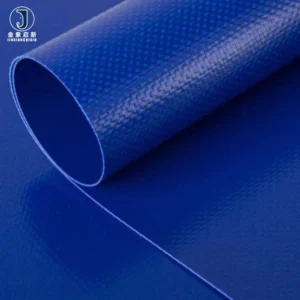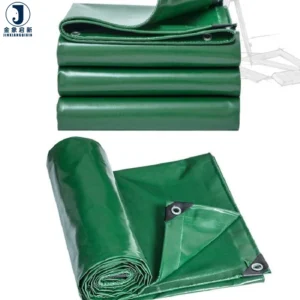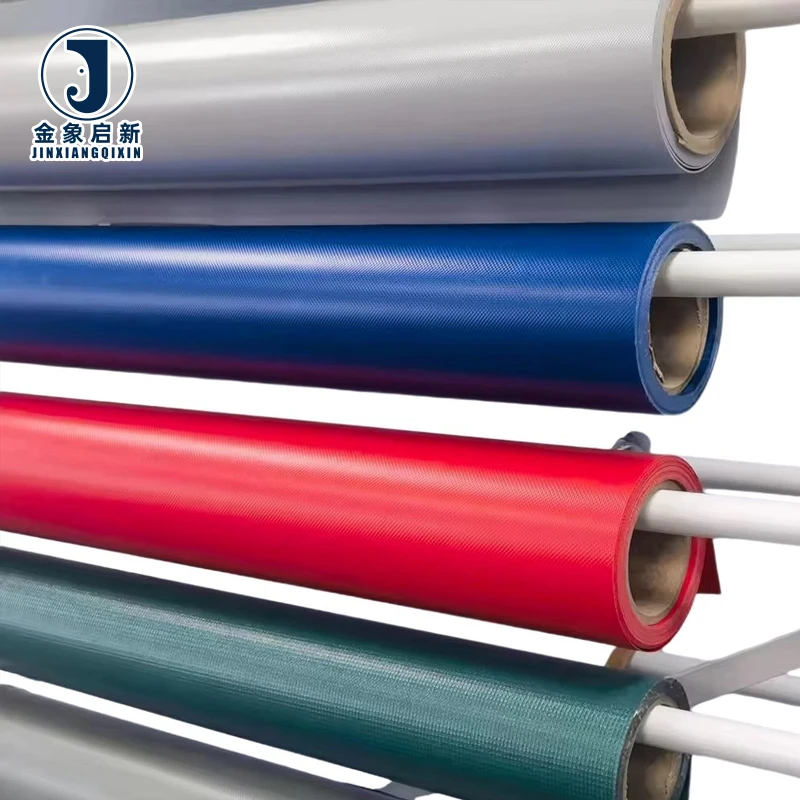
Proven Coating Control — Nearly 30 years of PVC tarpaulin roll production for truck, tent and shelter fabrics, with GSM tested per roll before shipment to ensure what arrives matches what was quoted.
Technical Specifications
| Parameter | Value |
|---|---|
| Product Type | PVC Tarpaulin Roll for Tent and Shelter |
| Base Fabric Denier | 1000D |
| Coating Material | PVC |
| Light Blocking | Blackout |
| UV Treatment | Anti-UV (grade not stated — confirm required standard for your market) |
| Flame Retardant | Fire retardant (grade not stated — request test report matched to compliance market) |
| Anti-Mildew | Antibacterial and mildew proof |
| Chemical Resistance | Oil, stain, acid and alkali resistance |
| Temperature Resistance | High temperature and cold resistance |
| Finish | Anti-oxidation and weather resistance |
| Flexibility | Highly flexible, resistant to cracking |
| Welding Compatibility | HF, hot air, sewing |
| Surface | Self-cleaning system |
Application Suitability
| Application | Exposure & Requirement |
|---|---|
| Truck and trailer side curtains | Constant flexing at load points, road abrasion, UV and weather exposure |
| Custom-fit truck covers | Tension from tie-downs, repeated folding, wind-driven rain |
| Event and exhibition shade tents | Prolonged sun exposure, crowd proximity, fire safety compliance |
| Tensile and architectural membrane structures | Permanent tension loads, wind uplift, long-term UV degradation |
| Portable storage and shelter systems | Handling wear, ground contact, temperature cycling |
| Airport hangar covers | Large span tension, fuel vapour exposure, strict flame-retardant codes |
What "Flame Retardant" Really Means Without a Certified Grade
A flame-retardant claim is only as reliable as the test report that backs it.
Tent and shelter fabric buyers routinely see quotations that state "fire retardant" without naming the standard or grade. On arrival, the material may pass a basic burn test but fail the certification required by local building or event safety codes. A truck side curtain or exhibition tent that cannot prove compliance at inspection costs far more than a re-test — it can mean denied entry, dismantled structures, or rejected fleet deliveries. When sourcing 1000D PVC tarpaulin for shelter or transport, request the specific flame-retardant grade and test report matched to your compliance market before production begins. [NEED_CITE: fire classification standards for temporary structures and transport covers]
Covering a Moving Load Demands More Than Weight Claims
A truck cover or side curtain built from PVC tarpaulin roll stock flexes hundreds of times per trip. At each stress point — where tie-downs pull, where the load shifts, where the fabric meets the buckle — the base fabric takes the real strain. The 1000D denier base provides tensile and tear performance that keeps the panel intact through repeated vibration and road shock. This is the difference between a cover that holds for the season and one that splits at the first hard turn.
Blackout Construction for Light-Sensitive and Shelter Uses
The blackout layer blocks light transmission through the fabric, which matters for cargo that degrades under UV exposure and for event tents where interior lighting control is essential. For fleet operators running refrigerated or light-sensitive loads, and for exhibition builders managing booth ambiance, blackout PVC tarpaulin roll delivers the opacity needed without adding a second fabric layer. Confirm the blackout grade against your application before ordering, as light-blocking levels vary across product runs.
How Coating Weight and Base Denier Work Together
GSM alone does not predict how a PVC tarpaulin roll will perform under tension. The 1000D base fabric provides the structural skeleton — the warp and weft yarns carry tensile and tear loads. The PVC coating adds weight, weather resistance, and the surface that accepts welds. A heavy coating on a light base fabric may feel stiff but tear easily along the yarn line; a lighter coating on a dense 1000D weave can outperform it in real-world flex. When evaluating material for truck covers or tensile structures, ask for both the base fabric denier and the coating weight separately, not just the combined GSM. [NEED_CITE: tensile and tear test methods for coated fabrics per ISO 1421] Welding compatibility — HF, hot air, or sewing — depends on how the coating bonds to that base, and each method behaves differently at flex points.
The Cost of Specifying on Price Per Roll Alone
Fleet operators and shelter builders who select PVC tarpaulin roll on the lowest per-kilogram quote often discover the real cost at installation. Material that arrives lighter than the quoted GSM stretches beyond its recovery point under tie-down tension. Colour that shifts between rolls in the same shipment shows immediately when panels hang side by side on a trailer or tent frame. Welded seams that fail before the fabric does leave cargo exposed and require full panel replacement. These failures trace back to coating weight and batch consistency, not to the fabric breaking in a way the spec should have predicted. [NEED_CITE: pre-shipment inspection practices for coated fabric rolls]
Why Sourcing This Fabric Through Jinxiang Works for Transport and Shelter Builds
Three full production lines and 36 sets of professional equipment support bulk roll orders with consistent output across production runs, so fleet-wide colour and weight stay uniform. A 10-person R&D team develops custom widths, cut-to-model truck cover panels, and shelter fabric samples within days rather than weeks. Every roll passes dedicated QA/QC inspection at each production stage, with 100% pre-shipment verification of GSM, colour, and coating adhesion. ISO and CE certified processes underpin the coating control that keeps PVC adhesion stable across the 1000D base, whether the end use is a side curtain or a tensile membrane.
Documentation & Verification
- Material specification sheet confirming 1000D base fabric denier, coating weight, and blackout property per roll
- UV and flame-retardant test reports supplied to match the compliance standard required in your market
- Pre-shipment inspection record covering GSM verification, colour consistency, and weld integrity across the order
- Roll packing list with certificate of origin and customs documentation for cross-border dispatch
Fabrication, Handling & Storage
- HF, hot air, and sewing are all compatible — select weld method based on the flex stress at each seam location
- Reinforced hems and tie-down points should be specified at inquiry to match truck or trailer anchor geometry
- Store rolls upright on pallets to prevent flat-spot creases that weaken the PVC coating at the fold line
- Allow cold-transported rolls to reach ambient temperature before unrolling to avoid coating micro-cracking
- Self-cleaning surface tolerates mild detergent; avoid solvent-based cleaners that degrade the PVC top coat
What to Include With Your Inquiry
Provide the specific trailer or tent structure dimensions, the operating environment including UV and temperature extremes, and any fire-retardant or anti-static grade required by local code. Specify whether you need full rolls or cut-to-model panels, target colour references, and estimated annual volume so batch consistency can be planned from the first production run.
Frequently Asked Questions
Q: How do I specify the exact trailer dimensions for a custom-fit truck cover?
A: Provide the make, model, and year of the truck or trailer along with measurements at the tie-down points, roof curve radius, and tailgate clearance. The 1000D PVC tarpaulin roll is then cut and welded to match those dimensions, with eyelet and hem reinforcement placed at your specified anchor locations. Sample panels can be developed before full production to verify fit.
Q: Which welding method works best for seams that flex under transport loads?
A: HF welding produces a fused bond suited to high-stress flex points on side curtains and truck covers. Hot air welding works well for field repairs and curved seams. Sewing with sealed stitch lines is preferred where mechanical fasteners are needed. The choice depends on the seam location and the degree of repeated bending the panel will experience.
Q: Can you ensure colour stays consistent across every roll in a large fleet order?
A: Yes. Every roll undergoes colour check during production and again at pre-shipment inspection. The 1000D PVC tarpaulin roll is batch-matched so panels installed side by side on trailers or shelter frames show no visible variation. Request the inspection record with your shipment for full traceability.
Q: How is blackout performance confirmed before the fabric ships?
A: Blackout is verified during the pre-shipment inspection by testing light transmission through the coated fabric. The result is recorded on the inspection report supplied with your dispatch documentation. If your application requires a specific opacity level for light-sensitive cargo or exhibition use, state the requirement at inquiry so the correct grade is produced.
Q: Do you supply this PVC tarpaulin by the roll or in finished cut sizes?
A: Both options are available. Rolls are supplied in custom widths for manufacturers fabricating their own tents, shelters, or side curtains. Cut-to-model panels with welded hems and reinforcement are produced for fleet operators who need covers fitted to specific truck and trailer dimensions. Confirm your preferred format and quantities at the inquiry stage.