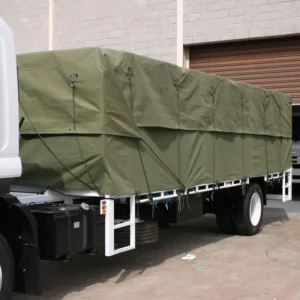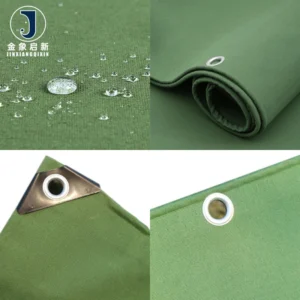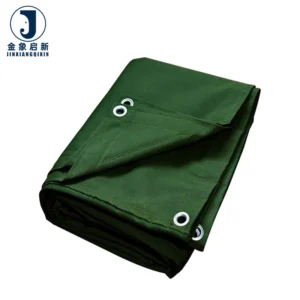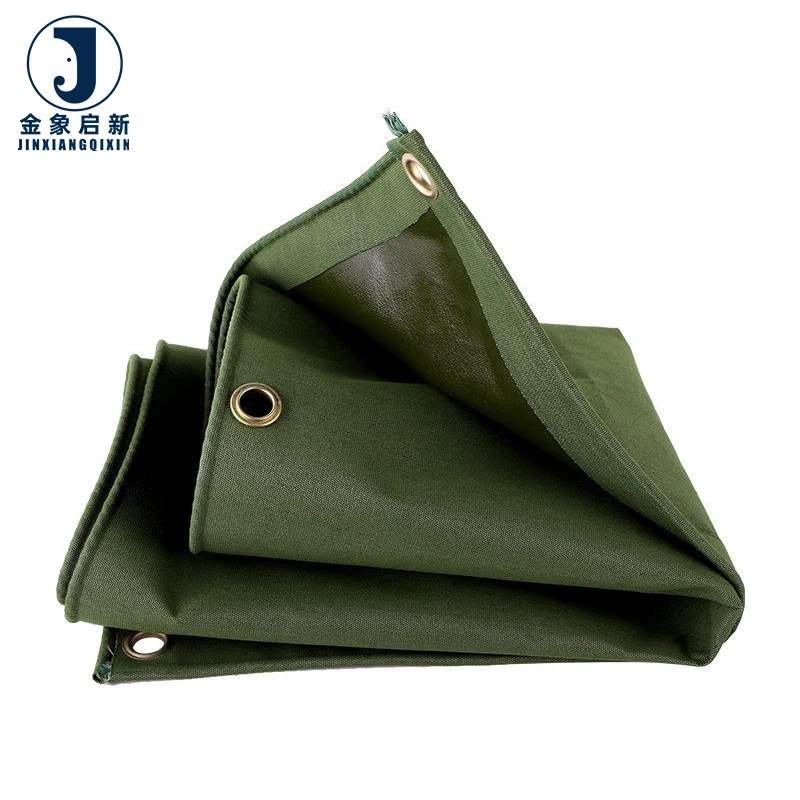
Process Control — Three full production lines and 36 sets of equipment manage coating weight and adhesion from raw yarn to finished roll, keeping this 600 GSM laminated canvas consistent across fleet-scale transport cover orders.
Technical Specifications
| Parameter | Value |
|---|---|
| Product Type | Canvas Tarpaulin |
| Weight | 600 GSM |
| Base Fabric | Woven Plain Canvas |
| Coating Method | Laminated |
| Waterproof | Yes |
| UV Resistance | Available — test basis not stated in source, confirm grade for your market |
| Flame Retardant | Available — grade not stated in source, confirm the grade required for your market |
| Edge Reinforcement | Reinforced Edges |
| Key Features | Waterproof, UV resistant treatment, flame retardant treatment, reinforced edges |
Application Suitability
| Application | Exposure & Requirement |
|---|---|
| Truck and trailer flatbed load covers | Constant road vibration, tie-down abrasion at hems, wind-driven rain, UV from prolonged outdoor transit |
| Construction equipment and material site covers | Ground contact moisture, dirt and debris loading, crane hook abrasion, sun exposure across seasons |
| Outdoor cargo protection for logistics fleets | Repeated folding and unfolding at depots, strap friction at contact points, temperature cycling |
Why Generic Truck Covers Fail Before the Fabric Does
Welded seams and flex-point abrasion are where most truck covers fail first — this laminated canvas construction with reinforced edges is built to resist tearing at the highest-stress tie-down zones.
A Heavy Duty Canvas Tarpaulin 600 GSM holds its shape under load flex where lighter covers stretch and split at the hem line.
Every logistics fleet has a stack of retired covers that are still sound across the main panel but torn at the grommets or delaminated along the welded seam. The fabric itself did not fail — the stress concentration points did. Covers cut to generic dimensions rather than the specific trailer model create excess material that flaps, folds and rubs against itself at speed, accelerating wear at exactly the points where reinforcement matters most. [NEED_CITE: stress concentration failure patterns in transport tarpaulins per ISO 1421 tensile and tear test methods]
Fleet operators replacing covers twice a season are rarely facing a fabric problem. They are facing a specification problem — the wrong size, the wrong edge treatment, or a coating method that separates under repeated flex cycles.
Trailer Model Fitment and Tie-Down Zone Protection
A Heavy Duty Canvas Tarpaulin 600 GSM cut to the exact dimensions of a specific trailer model eliminates the excess fabric that causes flapping and self-abrasion during transit. The reinforced edges distribute tie-down strap pressure across a wider area of the woven plain canvas base, preventing the concentrated point loads that pull grommets through lighter materials. R&D support for custom sizing means each cover in a fleet order can be matched to its assigned vehicle.
Laminated Coating Behaviour Under Road Conditions
The laminated coating process bonds the waterproof layer to the woven canvas base, creating a barrier that resists water penetration during sustained rain exposure on long-haul routes. Unlike dip-coated fabrics where the coating sits on the surface, lamination integrates the layers so that road grit and debris do not work between the coating and the base fabric over time. This construction method suits the repeated folding and unfolding cycle that transport covers endure at loading docks and distribution centres. [NEED_CITE: coating adhesion test methods for laminated tarpaulin fabrics]
Reading the 600 GSM Specification in Context
GSM measures total fabric weight per square metre, combining the woven plain canvas base and the laminated coating together. A 600 GSM reading tells you the material has substantial mass, but the tensile and tear performance depends equally on the base fabric weave density and yarn denier. Two fabrics at identical GSM can behave very differently under load if one uses a loosely woven base with heavier coating while the other uses a tighter weave with lighter coating. The woven plain canvas base in this product provides a structured grid that resists tear propagation in both warp and weft directions, which matters when a tie-down strap catches a corner and concentrates force on a single point. Lamination as a coating method adds waterproofing without significantly changing the hand or flexibility of the base canvas, so the cover remains workable in cold conditions rather than becoming stiff and prone to cracking.
The Cost of Underspecifying Edge Reinforcement
Covers that arrive with the stated GSM but fail within months almost always fail at the edges, not the field. Standard hemming without reinforcement concentrates strap load onto a single stitch line through the coated fabric, and once one stitch pulls through the laminate, the tear propagates along the hem within days. Fleet operators who have moved to reinforced edge construction report significantly fewer mid-season replacements, because the load distribution prevents the initial stitch failure that starts the cascade. [NEED_CITE: hem and edge reinforcement failure analysis in heavy-duty tarpaulins]
Specifying reinforced edges at the inquiry stage costs marginally more than standard hemming but eliminates the pattern of covers returning to the workshop for patch repairs every few weeks.
Why Procurement Teams Source This Canvas Here
Nearly 30 years of focused coated fabric production means the coating weight and adhesion parameters for this 600 GSM laminated canvas are controlled through established process routines, not trial runs.
Three full production lines and 36 sets of professional equipment support fleet-scale orders with consistent on-time delivery, so transport operators can plan cover replacement around maintenance schedules rather than supplier delays.
A 10-person R&D team handles custom sizing to specific trailer models, pattern marking, and sample development, producing samples within days so buyers can verify fitment before committing to bulk production.
Dedicated QA/QC at every production stage with 100% inspection before shipment catches GSM deviation, coating delamination, and edge reinforcement defects before the rolls or finished covers leave the facility.
Material specification sheets, test reports, and pre-shipment inspection records ship with every order, giving fleet procurement teams the documentation their compliance departments require. [NEED_CITE: DIN 4102 fire classification and ISO 1421 tensile test documentation standards]
Documentation & Verification
- Material specification sheet stating 600 GSM weight, woven plain canvas base, and laminated coating method
- GSM verification per roll against the quoted weight before dispatch
- Pre-shipment inspection record covering edge reinforcement integrity and lamination bond
- UV and flame retardant test reports supplied where applicable grades are specified
- Roll packing list and certificate of origin for customs clearance
- Custom sizing drawings confirming trailer model dimensions for finished covers
Fabrication, Handling & Storage
- Heat welding parameters must account for the laminated coating to avoid delamination at seam lines
- Reinforced edges require heavier-duty sewing needles matched to 600 GSM canvas thickness
- Store rolls on their cores horizontally to prevent permanent creasing in the laminated layer
- Allow cold-stored 600 GSM canvas to reach ambient temperature before unfolding to avoid coating crack
- Use neutral pH cleaners on the laminated surface to preserve the waterproof barrier integrity
- Cut patterns with allowance for hem fold-back to maintain reinforced edge load distribution
What to Include in Your Inquiry
Provide the specific trailer model dimensions or the flatbed length and width you need covered, along with the tie-down configuration so edge reinforcement can be positioned at the actual strap contact points. If your market requires flame retardant certification for transport covers, state the standard your compliance team references so the correct grade can be confirmed before sampling. Indicate whether you need finished covers with grommets and hems or roll stock for your own fabrication, and confirm the colour requirement so batch consistency can be maintained across your fleet order.
Frequently Asked Questions
Q: How do I verify the 600 GSM weight when the shipment arrives?
A: Request a pre-shipment inspection record that documents GSM readings taken from each production roll. On arrival, cut a measured sample from the roll edge and weigh it on a calibrated scale to confirm the weight matches the quoted 600 GSM specification. Any significant deviation should be reported with photographic evidence before the material is cut or fabricated into finished covers.
Q: Can I get covers sized to my specific trailer model rather than a generic cut?
A: The R&D team develops custom patterns based on your trailer model dimensions, including allowance for hem fold-back and grommet placement at your actual tie-down points. Provide the trailer make, model, and bed dimensions along with photographs of the current cover fitment. Samples are produced within days so you can verify the fit before the full fleet order enters production.
Q: What edge reinforcement options are available for tie-down security?
A: Reinforced edges are standard on this product, distributing strap pressure across the woven plain canvas base to prevent grommet pull-through. Additional webbing can be specified along high-stress hem lines for fleets using heavy-duty ratchet straps. Provide your strap width and tie-down spacing so the reinforcement can be positioned at the exact contact points rather than as a general hem treatment.
Q: Is UV resistance independently tested and certified?
A: UV resistant treatment is applied to this laminated canvas, but the specific test basis is not stated in the current documentation. If your procurement specification requires a UV resistance rating or test certificate, request this at the inquiry stage so the appropriate test can be arranged before production. Different markets reference different UV exposure standards, and confirming the required standard early avoids delays.
Q: Will colour match across multiple covers in a single fleet order?
A: Batch colour consistency is controlled through the lamination process, and the pre-shipment inspection includes visual comparison across rolls in the same production run. For fleet orders where covers will be visible side by side, request a colour approval sample before bulk production proceeds. Specify your colour reference using a standard system so the target is documented and measurable across future reorders.