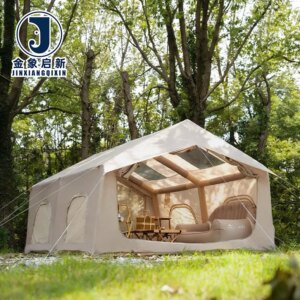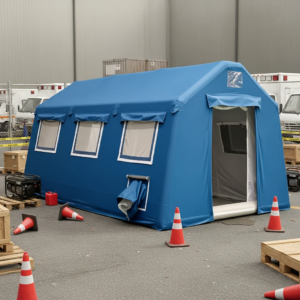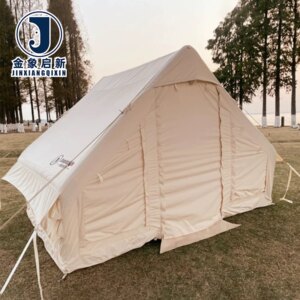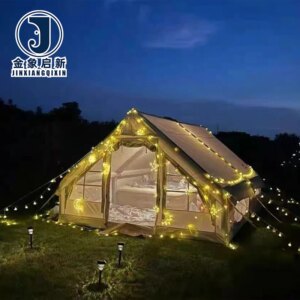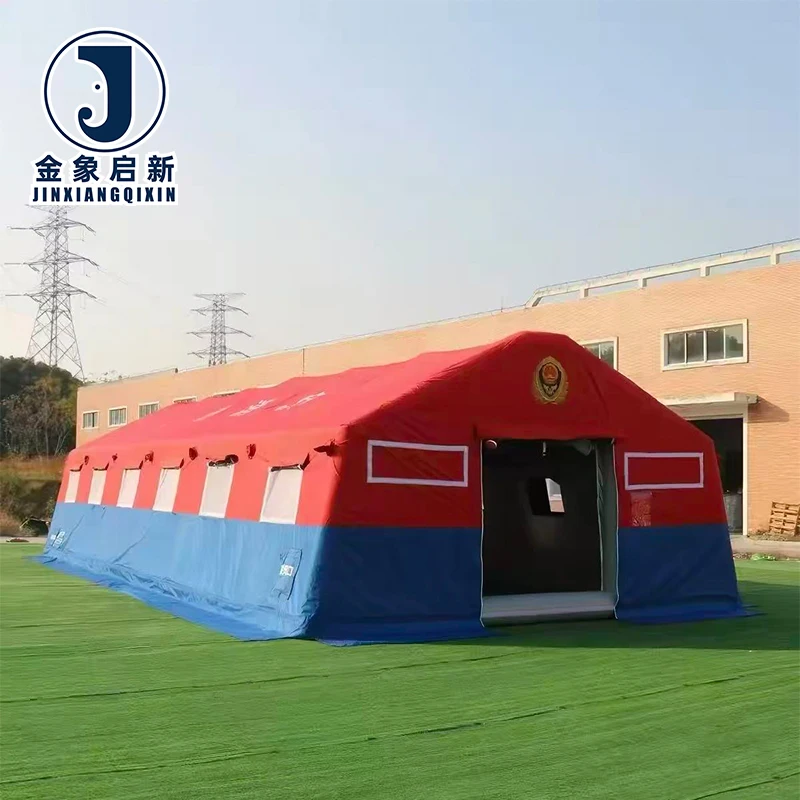
Deep Process Control on Coated Fabric — Jinan Jinxiang maintains strict QA/QC at every production stage for this PVC Inflatable Tent, ensuring material consistency across batches with 100% pre-shipment inspection.
Technical Specifications
| Parameter | Value |
|---|---|
| Product Type | Inflatable Tent |
| Core Material | PVC Tarpaulin |
| Key Performance | Waterproof, Tear-resistant |
| UV Resistance | UV-resistant (test basis not stated in source) |
| Construction | Extended Type, Single Layer |
| Customization | OEM & ODM (sample customization, pattern printing) |
| Standards | ISO9001, ISO14001, ISO45001, CE |
Application Suitability
| Application | Exposure & Requirement |
|---|---|
| Roadside Incident Staging | Rapid deployment under traffic vibration, weather exposure, and low-light conditions requiring high-visibility shelter |
| Logistics Depot Overflow Storage | Constant loading/unloading contact, forklift maneuvering proximity, and prolonged outdoor weathering |
| Mobile Fleet Convoy Shelter | Frequent assembly and disassembly cycles, transport portability, and variable climate exposure across routes |
| Construction Site Command Center | Dust and debris impact, equipment staging loads, and extended four-season outdoor occupation |
Why Generic Sizing Fails Transport Fleet Staging Operations
A PVC Inflatable Tent cut to a standard dimension often leaves critical gaps at the staging perimeter, exposing cargo and personnel to the elements.
When a transport operator deploys an emergency shelter at a breakdown site or logistics hub, the footprint must align precisely with the trailer width and the adjacent staging lane. Generic sizes force crews to improvise with additional tarps or leave sections open, defeating the purpose of rapid containment [NEED_CITE: dimensional tolerance requirements for temporary transport shelters]. Material performance also varies when the tent is stretched beyond its intended span, accelerating seam stress and reducing service life. Sourcing a PVC Inflatable Tent for truck and transport rapid deployment means specifying exact dimensions validated through pre-production samples, not accepting catalog defaults.
Model-Specific Dimensioning for Fleet Operations
Fleet operators managing diverse trailer configurations require shelter dimensions that match their exact vehicle profiles. Our PVC Inflatable Tent development process begins with the buyer providing trailer model data and staging area constraints. The R&D team translates these inputs into cut patterns and inflation chamber layouts, producing a sample unit for on-site fitment testing before bulk production is authorized. This approach eliminates the mismatch between shelter footprint and operational reality that plagues off-the-shelf purchases.
Weather Exposure and Material Endurance on the Road
Transport staging environments subject shelter fabric to conditions far more aggressive than static storage. Road salt spray, diesel exhaust residue, and abrasion from cargo handling equipment demand a PVC tarpaulin core that maintains waterproof integrity through repeated deployment cycles. The single-layer extended type construction balances interior volume for personnel and equipment staging against the weight and packed dimensions required for transport portability [NEED_CITE: coated fabric degradation factors in transport environments]. Tear-resistant properties are essential when the tent is dragged across gravel or asphalt during setup.
Specification Interpretation for Procurement Decisions
The waterproof rating of PVC tarpaulin depends on coating continuity and seam welding quality, not merely the base fabric specification. When evaluating a PVC Inflatable Tent for transport applications, buyers should examine the coating weight and the adhesion strength between the PVC layer and the base fabric, as these determine long-term water resistance under flex and abrasion. UV resistance claims require test documentation specifying the standard and exposure duration; without this, the claim remains unverifiable for procurement compliance. Tear resistance is governed by the base fabric denier and weave density alongside the coating formulation — higher coating weight alone does not guarantee superior tear performance [NEED_CITE: relationship between base fabric construction and tear propagation in coated fabrics per ISO 1421]. Understanding these relationships prevents specification errors that surface only after the tent has been deployed in the field.
The Hidden Cost of Specification Mismatches in Emergency Shelters
When a logistics operator accepts an inflatable tent without verifying UV treatment documentation, the fabric may show surface chalking and embrittlement after one season of roadside deployment, forcing premature replacement. Similarly, tear resistance that falls short of the actual handling regime — where crews drag the shelter across uneven ground during rapid setup — leads to propagating rips that compromise the entire unit [NEED_CITE: common failure modes of temporary transport shelters under repeated deployment]. Batch-to-batch variation in coating weight can mean the first unit performs acceptably while subsequent units fail under identical conditions, creating unpredictable maintenance costs across a fleet’s shelter inventory.
Why Source This PVC Inflatable Tent Through Jinan Jinxiang
Nearly 30 years of focused coated fabric production provides the process depth needed to control coating weight and adhesion consistently across production runs. Three full production lines and 36 sets of professional equipment support bulk order fulfillment without sacrificing the dimensional precision required for model-specific transport shelters. The 10-technician R&D team handles the translation from fleet operator requirements — including custom sizing and pattern printing for corporate branding — into validated sample units before production commitment. Dedicated QA/QC personnel conduct full-process inspection, generating traceable records that accompany each shipment. Sample development within days allows buyers to verify fit, construction, and material performance before authorizing volume orders, reducing procurement risk on critical emergency staging equipment.
Documentation & Verification
- Material specification sheet confirming PVC coating type, base fabric construction, and treatment claims for each batch
- Pre-shipment inspection record verifying dimensional accuracy and inflation chamber integrity against approved sample
- ISO 9001, ISO 14001, ISO 45001, and CE certificates included with every dispatch
- Test report for UV resistance and tear performance provided where grade and standard are specified at inquiry
- Roll packing list with batch traceability for multi-unit fleet orders
Fabrication, Handling & Storage
- Heat welding parameters must match PVC coating weight to ensure seam strength equals fabric strength
- Store deflated units in dry, ventilated conditions to prevent moisture entrapment between PVC tarpaulin layers
- Avoid sharp fold creases during packing to prevent coating crack initiation at repeated flex points
- Clean surfaces with mild detergent compatible with PVC coating to preserve waterproof integrity
- Inspect inflation valves and chamber seams before each deployment cycle for early wear detection
- Repair minor tears with PVC-compatible adhesive patches matching the coating formulation
Inquiry and Specification Guidance
To ensure the PVC Inflatable Tent meets your operational staging requirements, provide the specific trailer models or staging dimensions your fleet operates. Indicate the climatic conditions and exposure duration typical for your deployment scenarios, along with any corporate branding or pattern printing requirements. Specify whether UV resistance or other treatment claims require test documentation for your procurement compliance process, and confirm whether sample validation is needed before bulk authorization.
Frequently Asked Questions
Q: How do we specify custom dimensions for our exact trailer staging requirements?
A: Provide the trailer model designations and the required staging footprint dimensions. Our R&D team develops a sample PVC Inflatable Tent to these specifications for your fitment validation before production proceeds, ensuring the shelter integrates precisely with your fleet’s operational geometry.
Q: What pattern printing and branding options are available for fleet identification?
A: OEM and ODM customization includes pattern printing to match fleet livery and corporate identity. Specify the artwork, color references, and placement requirements during inquiry. Sample units are produced with the branding applied for visual approval before the full order enters production.
Q: What test data supports the tear resistance claims for repeated deployment?
A: Tear resistance is determined by base fabric construction and coating formulation. Request the specific test standard and result documentation during inquiry to verify performance against your deployment regime, as test basis must be stated to substantiate durability claims for procurement compliance.
Q: What is the basis for the UV resistance claim on this inflatable tent?
A: UV resistance is listed as a key performance attribute, though the specific test basis is not stated in the source documentation. Buyers requiring verified UV performance for their market compliance should request the applicable test standard and exposure duration report during the specification phase.
Q: How does the sample development and approval process work before bulk commitment?
A: Upon receiving your dimensional and specification requirements, the R&D team produces a sample PVC Inflatable Tent for your evaluation. Once you approve the sample for size, fit, construction, and material performance, bulk production is authorized with the approved sample serving as the quality benchmark.