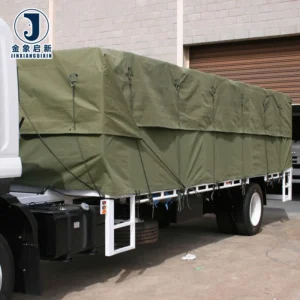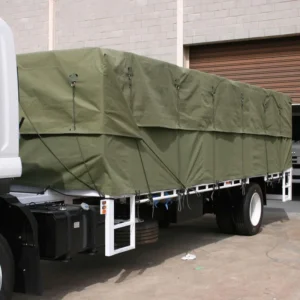
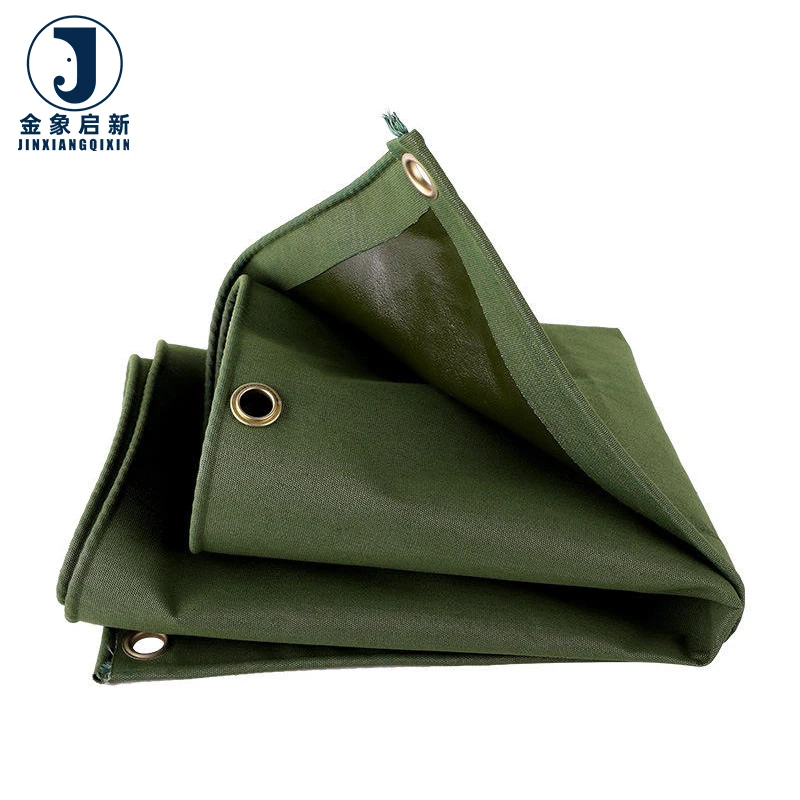
Deep process control over coating weight and adhesion — every roll of polyester cotton canvas tarpaulin is verified against the stated 600gsm before leaving the line, ensuring transport fleets receive covers that match the quoted weight and perform under highway wind and weather exposure.
Technical Specifications
| Parameter | Value |
|---|---|
| Product Type | Canvas Tarpaulin |
| Base Fabric | Polyester cotton industrial textile, 8–12 strands fine cotton yarn |
| Weight | 600 GSM |
| Total Thickness | 0.5 mm / 0.6 mm / 0.7 mm options |
| Roll Width | 2 m |
| Roll Length | 100 m |
| Color | Army Green Camouflage / Custom |
| Waterproof | Yes |
| UV Treatment | Anti-UV (test basis not stated in source — request report for your exposure zone) |
| Flame Retardant | Not stated — available in flame retardant grades, confirm the grade required for your market |
| Eyelet & Hem | Rust-proof aluminium eyelets every 1 m at corners and hem; folding and seams welded and sewn with poly ropes |
| Certification | CE, ISO |
Application Suitability
| Application | Exposure & Requirement |
|---|---|
| Flatbed truck cover | Constant road vibration, wind flex at load surface, rain and debris impact at highway speed |
| Trailer side curtain fabric | Repeated folding and tension cycles, abrasion against load edges, prolonged UV exposure |
| Construction equipment cover | Standing water, dust ingress, forklift and crane contact abrasion |
| Asphalt transport cover | Elevated material temperature, bitumen staining risk, thermal cycling |
| Tent and canopy structure | Wind uplift tension on eyelets, rain pooling, seasonal UV accumulation |
Why a Generic-Size Truck Cover Costs More Than a Custom-Fit Canvas Tarpaulin for Truck Cover
A cover that fits your exact trailer model eliminates exposed load gaps and excess material that flaps, tears and fails early.
Fleet operators ordering standard rectangular covers often find corners that do not align with tie-down points, leaving the load partially exposed during transit. Excess fabric bunches and flaps in crosswind, concentrating abrasion at fold lines where the material rubs against itself under tension. [NEED_CITE: common failure modes in transport tarpaulins under road vibration and wind load] A canvas tarpaulin for truck cover cut to the specific vehicle dimensions sits flush against the load, distributing tie-down forces evenly through the reinforced hem and rust-proof aluminium eyelets spaced every metre.
Securing the Load Against Highway Wind and Flex
When a flatbed travels at speed, the cover experiences continuous micro-flexing across its surface. The 600 GSM polyester cotton construction provides a balance between flexibility for folding and stiffness for load restraint. Rust-proof aluminium eyelets placed at one-metre intervals along corners and the full hem distribute tie-down strap loads across the fabric edge rather than concentrating force at a single grommet point. Welded and poly-rope sewn seams at fold and stress points reinforce the areas where a moving load pushes hardest against the canvas tarpaulin for truck cover.
Cut to Your Vehicle, Not to a Standard Rectangle
Transport equipment builders and fleet operators work with a wide range of trailer configurations — step-deck, curtain-side, low-loader, extendable flatbed. Each demands different dimensions, eyelet placements and reinforcement zones. This canvas tarpaulin is produced in 2 m roll width and 100 m roll length, then cut, welded and finished to the exact vehicle drawing. Reinforced poly-rope hems are sewn at the perimeter to maintain edge integrity through repeated tensioning cycles. [NEED_CITE: tensile and tear test methods for coated fabrics per ISO 1421]
Understanding Weight, Thickness and Weave as a System
The 600 GSM weight alone does not define load-bearing capacity — it is the interaction between the polyester cotton base yarn count, the weave density and the coating adhesion that determines how the fabric resists tearing under tension. The 8–12 strand fine cotton yarn construction creates a tight weave that resists puncture from sharp load edges, while the 0.5 mm to 0.7 mm thickness range allows selection based on the abrasion severity of the transport environment. Thicker options suit routes with frequent gravel debris; thinner options reduce folded bulk for covers that are deployed and stowed daily.
What Happens When the Hem Fails Before the Fabric Does
The most common point of failure on a truck cover is not the field of the fabric but the hem line, where tie-down straps pull against the edge under load movement. A hem that is only folded and stitched, without poly-rope reinforcement, concentrates strap tension on the thread, which cuts through the weave over time. On this canvas tarpaulin for truck cover, folding and seams are both welded and sewn with poly ropes, spreading the load across a wider fabric zone and extending the interval between cover replacement. [NEED_CITE: weld seam integrity under cyclic flex loading in coated transport fabrics]
Why We Focus on Model-Fit Transport Covers
Three full production lines and 36 sets of professional equipment support cutting to specific truck and trailer drawings without requiring a large batch to justify the set-up. A 10-person R&D team handles pattern development, custom sizing and sample production so that a prototype cover can be confirmed before bulk cutting begins. Every roll undergoes 100 per-cent pre-shipment inspection, with dimensional checks against the agreed vehicle drawing and weight verification to confirm the 600 GSM specification on arrival. Samples are developed within days for custom fitment requirements, allowing fleet operators to trial the canvas tarpaulin for truck cover on one vehicle before ordering across the fleet.
Documentation & Verification
- Weight verification record per roll confirming 600 GSM before dispatch
- Dimensional check sheet matching cover cut to the agreed truck or trailer drawing
- UV treatment test report available on request for outdoor weathering validation
- Roll packing list with batch reference for traceability across multi-vehicle orders
- Certificate of origin and customs documentation for cross-border shipment
Fabrication, Handling & Storage
- Weld seams at 600 GSM require controlled heat and dwell time to avoid scorching the cotton yarn base
- Poly-rope sewn hems must align with eyelet placement to distribute strap load evenly
- Store rolls flat or upright on core to prevent permanent creasing of the 0.5–0.7 mm canvas
- Allow canvas tarpaulin to reach ambient temperature before unfolding in cold conditions to avoid stiff-fibre cracking
- Use mild detergent and soft brush for cleaning to preserve the anti-UV treatment on the surface
Sending Your Enquiry
Provide the truck or trailer model designation, overall load dimensions and preferred tie-down strap layout so the canvas tarpaulin for truck cover can be cut and reinforced to match. Specify whether the anti-UV treatment requires a documented test basis for your operating climate, and indicate if a flame retardant grade is mandated by your fleet compliance policy. State the quantity of covers and whether a prototype sample is needed before full production.
Frequently Asked Questions
Q: How is the 600 GSM weight verified on arrival to match the quotation?
A: Each roll is weighed and measured during pre-shipment inspection, and a verification record is included with dispatch documentation. On receipt, you can cross-check by cutting a known-area sample and weighing it. If any discrepancy is found, the batch reference allows full traceability back to the production run.
Q: What UV test basis supports the anti-UV claim for long-haul road exposure?
A: The anti-UV treatment is applied during production, but the specific test standard is not stated in the base specification. Request the test report relevant to your operating region and exposure duration so you can confirm suitability against your fleet compliance requirements before placing a bulk order.
Q: Can the tarpaulin be cut to fit specific truck and trailer model dimensions?
A: Yes. Covers are cut from 2 m wide roll stock to the exact dimensions of your vehicle drawing, including step-deck and curtain-side configurations. Eyelet placement and poly-rope hem reinforcement are positioned according to your tie-down strap layout for secure load restraint.
Q: What eyelet spacing and hem reinforcement is available for high-wind tie-down?
A: Rust-proof aluminium eyelets are spaced every one metre at corners and along the full hem, with poly-rope sewn into the folded edge. For high-wind routes or heavier loads, additional eyelet rows or closer spacing can be specified during the cutting and finishing stage.
Q: How is seam integrity ensured at flex points under a moving load?
A: Fold and stress-point seams are both welded and sewn with poly ropes to spread strap and load forces across a wider fabric zone. This dual reinforcement addresses the area where cyclic flexing under road vibration most commonly causes hem and seam failure before the fabric field degrades.