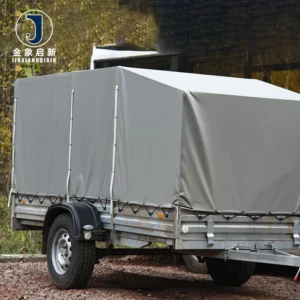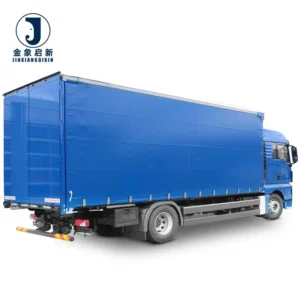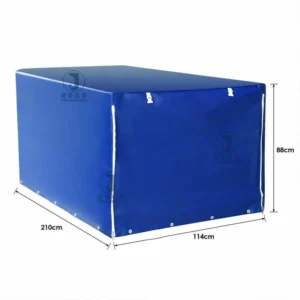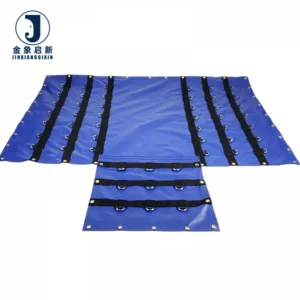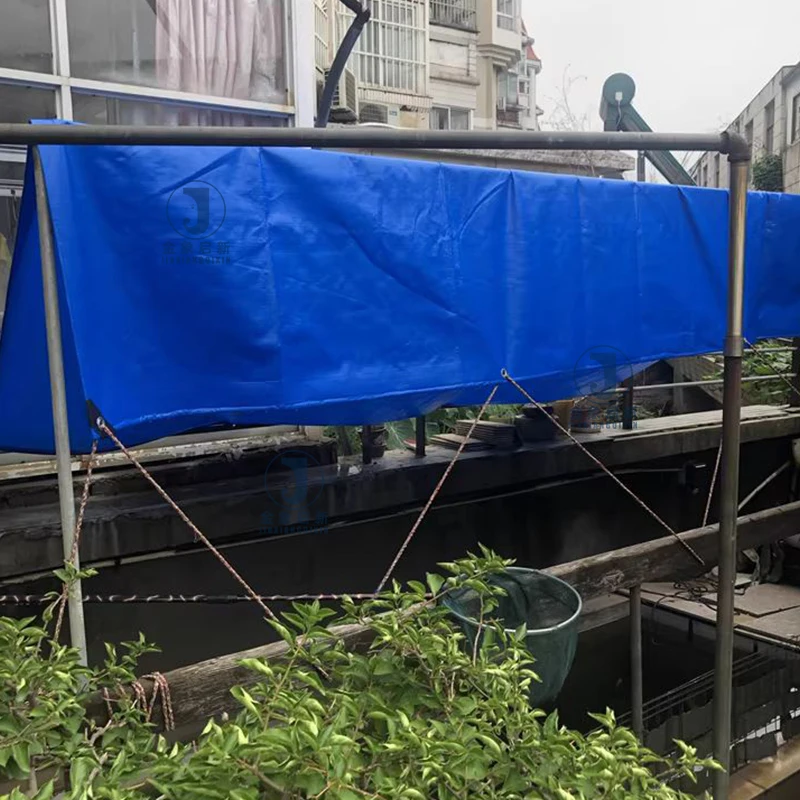
Application-driven engineering — Every PVC Truck Cover is cut and fabricated to match a specific trailer model, with seams and eyelets placed where road vibration concentrates the highest stress.
Technical Specifications
| Parameter | Value |
|---|---|
| Product Type | PVC Tarpaulin Truck Cover |
| Base Fabric | High-tenacity polyester woven scrim |
| Coating Material | PVC coated (knife-over-edge or calender, depending on grade) |
| Weight (GSM) | Custom lightweight to heavy-duty grades available |
| Thickness | Custom, varies by GSM selection |
| Color Options | Single and double side color options available |
| Surface Finish | Available in glossy or matte finish |
| UV Treatment | Anti-UV treatment available — confirm the grade required for your market |
| Flame Retardant | Flame retardant grades available — confirm the certification required for your jurisdiction |
| Edge Reinforcement | Reinforced hems with heat-welded seams |
| Tie-Down Hardware | Galvanized eyelets at custom spacing intervals |
| Width | Custom width per vehicle or roll order |
| Length | Custom length per vehicle or roll order |
| Printing | Pattern printing and branding available |
| Certification | ISO and CE certified production facility |
Application Suitability
| Application | Exposure & Requirement |
|---|---|
| Flatbed truck load covering | Wind uplift, road debris impact, rain ingress, UV degradation, daily flexing at tie-down points |
| Curtain-side trailer fabric | Constant lateral flexing, abrasion against load edges, weather sealing at curtain tracks |
| Tipper and dump truck cover | Abrasive material contact, hydraulic frame movement, repeated folding and unfolding |
| Container transport cover | Salt spray during coastal transit, UV exposure on open decks, container corner fitting tie-downs |
| Fleet standardization program | Consistent appearance across mixed vehicle rosters, uniform branding, long-term color retention |
Why a Generic-Size PVC Truck Cover Fails on a Moving Load
Fitment accuracy determines whether your cover survives its first season or tears at the hem within weeks.
Most truck cover failures trace back to a simple mismatch: the tarpaulin was ordered by a generic dimension rather than cut to the exact vehicle profile. When a PVC Truck Cover is even slightly oversized, excess fabric flaps in wind shear at highway speed, creating cyclical stress that fatigues the welded seams. Undersized covers overstretch at the eyelets, pulling the hem reinforcement away from the base fabric. Fleet operators who replace covers every few months often discover the root cause is not material quality but dimensional error. The stress concentration at a poorly fitted corner can exceed the tensile rating of the fabric itself [NEED_CITE: stress distribution at fabric corners under dynamic load per ISO 1421 test methods].
Cut-to-Fit Engineering for Specific Truck and Trailer Models
Our approach starts with the vehicle. Rather than asking for a length and width, we request the truck or trailer model, body type, and any structural protrusions such as lashing rails, headboards, or hydraulic mounts. The PVC Truck Cover is then patterned to wrap these features without excess material that would flap or chafe. For curtain-side applications, the fabric is cut with track-compatible edges and reinforced at the slider contact zones where abrasion is continuous. This model-specific method eliminates the most common field complaints from transport fleets: loose fabric at the rear, stretched eyelets at the front, and worn patches where the cover rubs against the load edge.
Seam and Eyelet Placement for Road-Grade Stress
A truck cover does not fail in the middle of a panel — it fails at the seams and eyelets. We position welded seams away from the highest flex zones and reinforce them with additional PVC strip overlays where the load shifts during braking and cornering. Eyelet spacing is calculated based on the expected tie-down load and wind uplift pressure at operating speed. Galvanized eyelets are set through reinforced hem sections with PP rope or PVC-welded webbing, distributing point loads across a wider fabric area. This prevents the pull-through tears that destroy covers during long-haul transit [NEED_CITE: eyelet pull-out resistance testing methods for coated fabrics].
How GSM, Coating Weight, and Base Fabric Interact in a Truck Cover
The weight stated on a quotation only tells part of the story. A PVC Truck Cover rated at a given GSM includes both the polyester base fabric and the PVC coating on each side. The base fabric denier and weave density determine tensile and tear strength, while the coating weight governs waterproofing, abrasion resistance, and UV protection. A cover with a heavy coating on a low-density scrim may weigh the same as one with a lighter coating on a high-density scrim, but their field performance differs drastically: the former resists abrasion but tears easily at a puncture point, while the latter handles mechanical stress but wears through the coating faster. For fleet applications, we recommend selecting the base fabric specification first based on expected load stress, then matching the coating weight to the environmental exposure — highway UV, coastal salt, or industrial chemical contact. The relationship between these parameters determines whether a cover lasts one season or several.
The Hidden Cost of Specifying on Price Per Square Meter Alone
When buyers compare PVC truck covers on cost per area, they often receive a product that meets the quoted GSM by loading the coating with filler rather than increasing the base fabric strength. The result is a cover that passes incoming weight inspection but develops micro-cracks in the coating within months, allowing*common failure is batch-to-batch color variation across a fleet order — when covers installed on adjacent trailers show visible shade differences, the entire fleet appearance suffers and re-ordering a single replacement becomes impossible without a noticeable mismatch. Welded seams on under-specified fabric also fail prematurely, because the heat required for a strong weld degrades a thin base scrim. These failures rarely appear in the first inspection but emerge after weeks of road exposure, by which time the supplier relationship has already moved on [NEED_CITE: delamination failure modes in PVC coated polyester fabrics].
Why Transport Fleets Source PVC Truck Covers Through This Facility
Our three full production lines and 36 sets of professional equipment handle the volume requirements of fleet-wide cover programs without sacrificing lead time reliability. The 10-person R&D team develops pattern cuts for new trailer models and runs sample fabrication so you can verify fitment before committing to a production batch. Every PVC Truck Cover undergoes dedicated QA/QC at each production stage, with 100% inspection before shipment — including dimensional verification against the vehicle drawing and seam strength checks at stress points. Nearly 30 years of coated fabric process control means we hold tight tolerances on coating weight and adhesion, which is where generic suppliers drift. Samples for custom sizing, color, or printing are developed within days, not weeks, keeping your fleet maintenance schedule on track.
Documentation & Verification
- GSM verification report per roll confirming actual weight against the quotation specification
- Dimensional inspection record matched to the specific truck or trailer model drawing
- Test report for UV or flame-retardant grades where applicable, stating the test standard used
- ISO and CE certificates covering the production facility and quality management system
- Pre-shipment inspection record with photographic evidence of seam and eyelet reinforcement
- Roll packing list with color batch reference for fleet-wide consistency tracking
Fabrication, Handling & Storage
- Heat-weld seams at manufacturer-recommended temperature to avoid degrading the base scrim in custom PVC truck cover panels
- Reinforce eyelet zones with additional PVC patches on heavy-duty GSM grades to prevent pull-through under tie-down load
- Store rolls vertically on pallets to prevent flat-spot creasing that weakens the coating at fold lines
- Allow cold-stored PVC covers to reach ambient temperature before unfolding to avoid low-temperature cracking at hem folds
- Use non-solvent cleaners on matte finish surfaces to preserve the coating integrity and prevent gloss patching
What We Need to Quote Your PVC Truck Cover Accurately
To provide a precise specification and lead time, share your truck or trailer model, body type, and the number of units in your fleet. Let us know the environmental exposure — highway transit, coastal routes, or industrial sites — so we can recommend the appropriate GSM grade and treatment package. If you require flame retardant or anti-UV certification for your market, specify the standard your compliance team requires. For branding or color consistency across multiple units, provide your Pantone or RAL reference and the total quantity so we can plan a single production batch.
Frequently Asked Questions
Q: How do you ensure the PVC Truck Cover fits my specific trailer model?
A: We request the vehicle model, body dimensions, and any structural protrusions such as lashing rails or headboards. A pattern is developed from these inputs, and a sample cover is fabricated for physical fitment verification before full production begins. This eliminates generic-size mismatch issues.
Q: What test reports support the anti-UV or flame-retardant claims on your truck covers?
A: Where UV or flame-retardant treatment is specified, we provide a test report from a recognized laboratory stating the test standard used and the grade achieved. If your market requires a specific certification, confirm the standard during inquiry so we match the treatment and documentation.
Q: Why do welded seams fail on truck covers, and how do you prevent it?
A: Seam failure usually occurs when the heat-welding temperature degrades the base scrim or when the seam sits directly on a high-flex zone. We reinforce seams with additional PVC strip overlays and position them away from peak stress areas based on the trailer model profile and load behavior.
Q: Can I get consistent color across a fleet order of multiple PVC truck covers?
A: Yes. All covers in a single fleet order are produced in one batch using the same pigment formulation. We include a color batch reference on the packing list so future replacement orders can be matched. Roll-to-roll consistency is verified during pre-shipment inspection.
Q: What documentation ships with the covers for fleet compliance records?
A: Each shipment includes a GSM verification report, dimensional inspection record, pre-shipment inspection with photographs, ISO and CE certificates, and applicable treatment test reports. The roll packing list references color batch numbers for traceability across your fleet maintenance records.