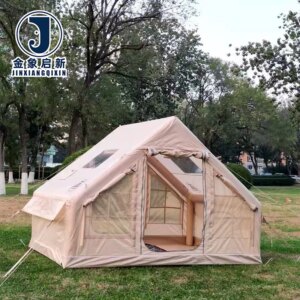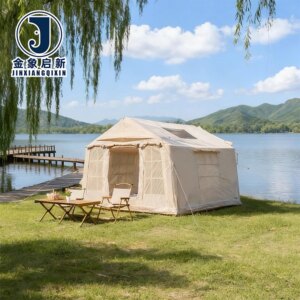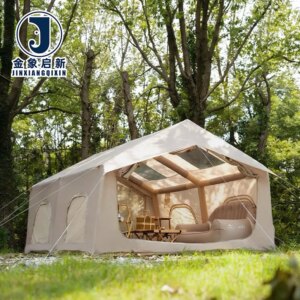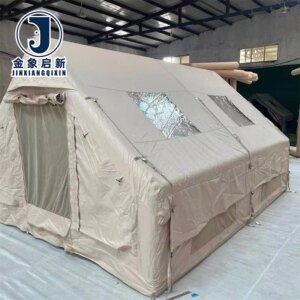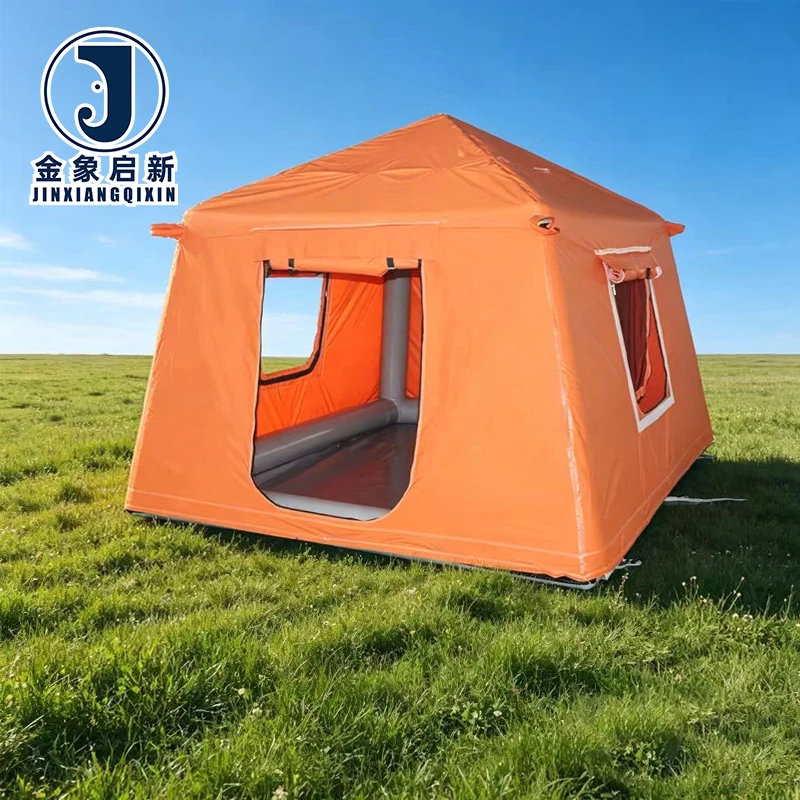
Proven Batch Consistency — Our 3 full production lines and 36 sets of equipment ensure every roll of Inflatable Tent Fabric for Truck and Transport Application maintains uniform coating weight, colour and tensile performance across your entire order.
Technical Specifications
| Parameter | Value |
|---|---|
| Product Type | Inflatable Tent |
| Core Material | 420D Oxford Cloth |
| Capacity | 5-8 Person |
| Construction | Single Layer |
| Design | Four-Season |
| Opening Mechanism | Quick Automatic Opening (Inflatable) |
| Tensile Strength | ≥300N/5cm (test basis not stated in source) |
| Abrasion Resistance | ≥500 cycles (test basis not stated in source) |
| UV Protection | UPF 50+ (test basis not stated in source) |
| Weight | ≤8kg (source value — verify against manufacturer catalog) |
| Waterproof Rating | 1000mm water column (test basis not stated in source) |
| Seam Strength | ≥250N (test basis not stated in source) |
| Deployment Cycle Tested | 500+ cycles (source value — verify against manufacturer catalog) |
| Customization | OEM & ODM (sample customization, pattern printing) |
| Standards | ISO9001, ISO14001, ISO45001, CE |
Application Suitability
| Application | Exposure & Requirement |
|---|---|
| Fleet operators requiring rapid-deploy shelter | Roadside deployment, vehicle storage constraints, repeated inflation cycles, weather exposure |
| Transport equipment builders integrating inflatable modules | Vehicle body fitment, structural integration, abrasion at contact points, dimensional stability |
| Commercial outdoor event and field operations teams | High-frequency setup and teardown, batch supply consistency, branding requirements, UV exposure |
Why Generic Sizing Fails in Fleet Deployment Scenarios
Off-the-shelf inflatable tents rarely align with the specific dimensions of truck beds, trailer footprints, or job-site staging areas. Custom cut patterns and vehicle-specific sizing eliminate the gap between generic shelter and operational reality.
Fleet managers frequently report that standard 5-8 person tents either overhang vehicle edges, creating wind-catch hazards during transport, or fall short of covering the required work zone. When Inflatable Tent Fabric for Truck and Transport Application is procured without accounting for the exact deployment footprint, the result is either wasted material or inadequate coverage — both of which compromise the shelter’s function in the field [NEED_CITE: dimensional fitment standards for vehicle-mounted shelters].
Vehicle-Specific Fitment and Structural Integration
Transport equipment builders require inflatable tent modules that integrate cleanly with vehicle bodies, whether mounted on flatbeds, enclosed trailers, or specialized service trucks. The 420D Oxford cloth base provides the tensile foundation needed for repeated inflation and deflation cycles without structural fatigue. Quick automatic opening mechanisms, rated through 500+ deployment cycles, ensure that field crews can establish shelter rapidly without manual pole assembly or complex rigging.
Deployment Speed Under Operational Pressure
Commercial camping operations and field teams operate on tight schedules where shelter setup time directly impacts productivity or customer experience. Single-layer construction keeps total unit weight at or below 8kg, enabling one-person transport and positioning before inflation begins. The inflatable beam structure deploys automatically once pressurized, reducing setup from a multi-person, multi-minute task to a single-operator procedure. This efficiency compounds across fleet operations where multiple units must be established simultaneously [NEED_CITE: deployment time comparisons between inflatable and traditional pole tents].
Reading the Specs: What 420D Oxford Cloth Actually Means for Your Application
The denier count — 420D — refers to the weight in grams of 9,000 meters of the base yarn, which correlates to yarn thickness and, by extension, the fabric’s resistance to abrasion and puncture. However, denier alone does not determine final performance; the weave density and coating adhesion are equally critical. A 420D base with loose weave will exhibit lower tear propagation resistance than a tighter weave of the same denier. The single-layer construction prioritizes weight efficiency and pack size over thermal insulation, making it suited to three-season and mild four-season conditions rather than extreme cold. The stated UPF 50+ UV protection and 1000mm waterproof rating indicate treatment levels, but buyers should confirm whether these values derive from standardized test methods (such as ISO 1421 for tensile properties or AATCC 183 for UV protection) or from supplier-internal measurements. The ≥300N/5cm tensile strength and ≥250N seam strength figures suggest adequate performance for inflatable structural applications, provided the seams are heat-welded rather than stitched, as stitched seams in inflatable structures tend to leak under sustained internal pressure.
The Cost of Overlooking Seam Construction in Inflatable Structures
Inflatable tents place continuous stress on seams during inflation, use, and deflation cycles. When seams are stitched rather than welded, needle holes create leak paths that compromise structural rigidity and require higher inflation pressure to maintain shape. This additional pressure accelerates fabric fatigue at stress concentration points. Batch colour inconsistency across panels — often resulting from different coating runs or base fabric lots — becomes visually apparent once the tent is fully inflated and viewed in direct sunlight, forcing operators to reject units that are functionally sound but aesthetically mismatched. Welded seams that fail before the fabric itself typically indicate improper heat or pressure settings during fabrication, a problem that surfaces only after repeated deployment cycles in the field [NEED_CITE: common failure modes in inflatable tent seam construction].
Production Capability Aligned with Commercial Procurement
Jinan Jinxiang operates three full production lines with 36 sets of professional equipment, providing the capacity to fulfil bulk orders for commercial outdoor operators and transport equipment builders without extended lead times. The 10-person R&D team handles custom sizing, pattern printing, and sample development, delivering prototypes within days rather than weeks for buyer validation before mass production proceeds. Dedicated QA/QC protocols inspect every production stage, with 100% pre-shipment inspection ensuring that GSM, colour, and dimensional specifications match the approved sample. ISO9001, ISO14001, ISO45001, and CE certifications are maintained to support import compliance across North American, European, and Asian markets. OEM and ODM customization extends to branding, colour matching, and deployment-specific sizing tailored to vehicle dimensions or operational footprints.
Documentation & Verification
- Material specification sheet confirming 420D Oxford base, coating type, and treatment levels
- Test reports for UV protection and waterproof rating citing applicable standards
- Batch-specific pre-shipment inspection records with colour and dimensional verification
- ISO9001, ISO14001, ISO45001, and CE certificates accompanying each shipment
- Certificate of origin and customs documentation for international import compliance
- Roll or unit packing list with weight and quantity reconciliation
Fabrication, Handling & Storage
- Heat-weld seam construction using temperature and dwell settings validated for 420D Oxford coating compatibility
- Store inflatable units partially inflated or loosely rolled to prevent permanent crease marks on coated surfaces
- Avoid prolonged compression in packed state during transport to maintain inflatable beam structural memory
- Use mild detergent and soft brush for cleaning; abrasive cleaners may degrade UV treatment layer
- Field repair of minor punctures requires compatible coating adhesive and patch material matching base fabric weight
- Inflate to manufacturer-specified pressure only; over-pressurization accelerates seam stress and fabric fatigue
Moving Forward with Your Procurement
Provide your specific vehicle dimensions or deployment footprint, anticipated deployment frequency, and any branding or colour requirements to enable accurate sizing and quotation. If your market mandates specific UV or waterproof test standards, state those requirements upfront so that test reports can be prepared to the correct methodology. Confirm whether you require finished inflatable tent units or fabric by the roll for in-house fabrication.
Frequently Asked Questions
Q: Can you supply the inflatable tent fabric by the roll instead of finished units?
A: Yes, we supply 420D Oxford-based inflatable tent fabric by the roll for manufacturers who handle cutting, welding, and assembly in-house. Roll widths and lengths are customized to your production requirements, and we provide material specification sheets with GSM, base fabric denier, and coating details for your engineering review.
Q: How do you verify that UV treatment matches the UPF 50+ claim?
A: We provide test reports citing the applicable standard upon request. Buyers should specify which test method their market requires — for example, AATCC 183 or AS/NZS 4399 — so that testing is conducted to the correct protocol before shipment.
Q: What custom sizing options are available for vehicle-specific applications?
A: We develop custom patterns based on your vehicle dimensions or deployment footprint, with samples produced within days for your approval. OEM customization includes size, colour, pattern printing, and branding, with minimum order quantities adjusted to your annual procurement volume.
Q: How do you ensure batch colour consistency across multiple units?
A: Every production run undergoes pre-shipment inspection with batch-specific colour verification against the approved sample. We maintain coating and base fabric lot traceability to prevent colour variation between units delivered in the same order.
Q: Do you provide certification accepted in European and North American markets?
A: We maintain ISO9001, ISO14001, ISO45001, and CE certifications, and we supply certificates of origin and customs documentation to support import compliance. Specific fire-retardant or additional test certifications are available upon request based on your destination market requirements.