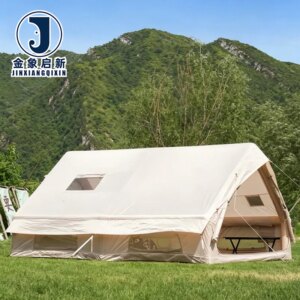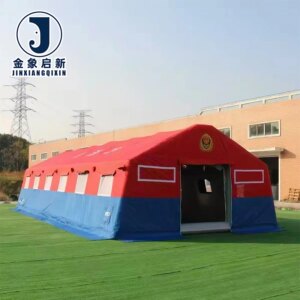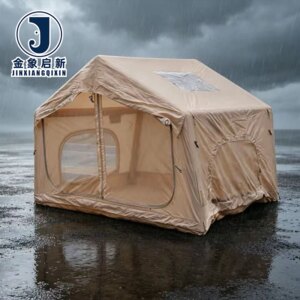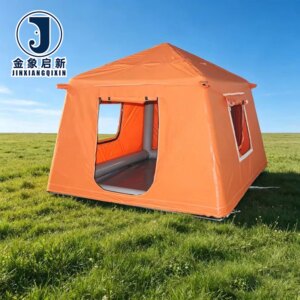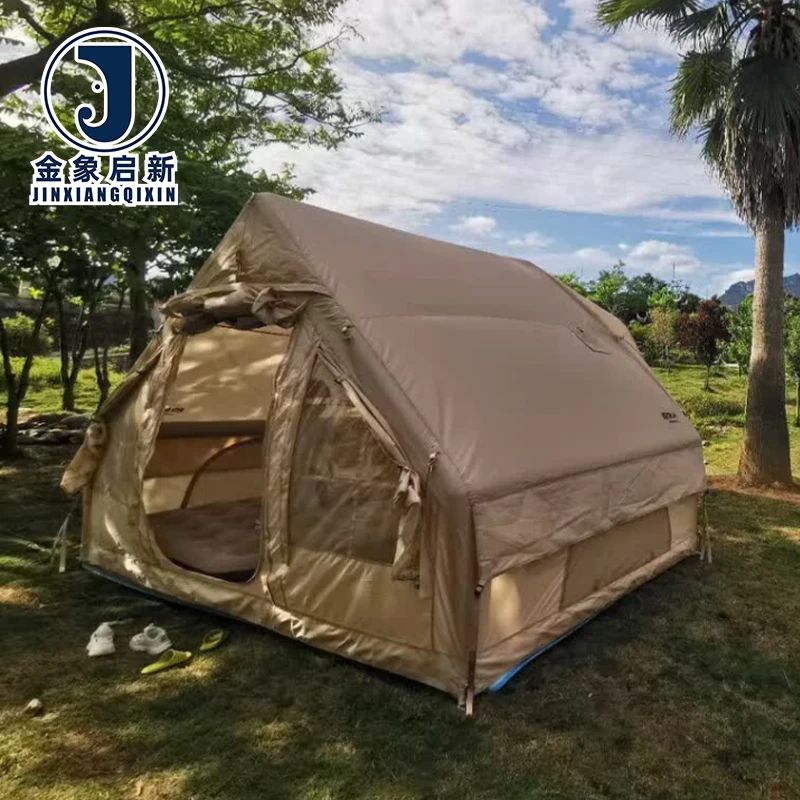
Deep Process Control — nearly 30 years focused on coated fabric gives Jinan Jinxiang tight command over coating weight, adhesion and seam integrity across every roll that leaves the line.
Technical Specifications
| Parameter | Value |
|---|---|
| Product Type | Inflatable Tent |
| Core Material | PVC tarpaulin |
| Capacity | 8–10 Person |
| Season Rating | 4 Season |
| Opening Mechanism | Automatic Opening (inflatable) |
| Key Features | Waterproof, UV-resistant, tear-resistant, fire-retardant, anti-static |
| Customization | OEM & ODM — sample customization, pattern printing |
| Certifications | ISO 9001, ISO 14001, ISO 45001, CE |
Note: Flame-retardant grade, anti-static surface resistance, UV test basis and tear-resistance grade are not stated in the source specification. Confirm the specific grade and test standard required for your target market before committing to production.
Application Suitability
| Application | Exposure & Requirement |
|---|---|
| Commercial campground & glamping | Year-round guest occupancy, repeated inflation cycles, wind gusts, UV exposure, guest safety compliance |
| Outdoor events & festivals | Rapid deployment, high foot traffic, temporary structural loads, fire marshal inspection |
| Adventure tourism base camp | Remote site exposure, multi-season weather, frequent relocation and repacking |
| Temporary workforce housing | Extended occupancy, weather isolation, site-safety fire and anti-static mandates |
| Outdoor exhibitions & trade shows | Brand visibility, short-term weather protection, frequent assembly and teardown |
Why Welded Seams Fail Before the Fabric Does on Inflatable Tents
Seam failure on inflatable structures almost always traces back to heat-weld parameters that do not match the coating chemistry and fabric weight.
When an inflatable tent panel flexes during inflation or under wind load, the welded joint experiences concentrated stress at the edge of the overlap. If the weld temperature or dwell time was set for a lighter-grade material, the bond line becomes the weakest point — not the PVC tarpaulin itself. Commercial campground operators and event crews report that seam splits appear first at high-stress corners and valve surrounds, often mid-season when replacement disrupts booked schedules [NEED_CITE: tensile and shear test methods for welded coated fabric seams per ISO 1421]. The inflatable tent for commercial outdoor use must therefore be specified not just on fabric weight, but on verified weld peel strength.
Airtight Chamber Integrity Through Repeated Inflation Cycles
Every inflation and deflation cycle flexes the PVC tarpaulin at the seam overlap. For a commercial inflatable tent deployed across a full campground season, that means thousands of pressure transitions. The coating must maintain adhesion to the base fabric under cyclic loading, and the heat-welded overlap must resist peel forces that increase as internal pressure rises. Material selection starts with matching the coating formulation to the weld process — a mismatch here causes delamination that is invisible during pre-shipment inspection but appears after weeks of field use.
Fire and Anti-Static Compliance for Commercial Gathering Environments
Tents used for commercial events, workforce housing or glamping sites fall under fire-safety and anti-static scrutiny from local inspectors. The PVC tarpaulin used in this inflatable tent for commercial outdoor use is available in fire-retardant grades — confirm the grade required for your market, as regulations differ between jurisdictions. Anti-static treatment is also available to address dust and particulate environments common on construction and mining sites [NEED_CITE: fire classification standards for temporary membrane structures]. Requesting the specific test report before production ensures the material matches what the site inspector will demand on arrival.
Reading the Specification Sheet Beyond GSM
GSM — grams per square metre — tells you the total weight of fabric and coating combined, but it does not isolate base fabric density from coating thickness. A heavy coating on a loosely woven base can yield a high GSM reading while offering poor tear propagation resistance. For inflatable tent structures, the base fabric denier and weave density determine how well the material resists the point loads created by anchoring straps and internal pressure ribs. The coating thickness governs airtightness, UV screening and weld behaviour. When reviewing a specification sheet, evaluate base fabric construction and coating weight as separate data points rather than relying on a single GSM figure [NEED_CITE: relationship between base fabric denier and tear strength in PVC coated textiles].
The Hidden Cost of Specifying on Price Per Kilogram Alone
When purchasing decisions focus solely on unit cost, suppliers may meet the quoted GSM by increasing filler content in the coating rather than maintaining base fabric quality. The result is a PVC tarpaulin that passes incoming weight inspection but tears more easily during the first strong wind event. For inflatable tent operators running seasonal commercial sites, this failure pattern appears as panel splitting at stress points — a problem that cannot be patched reliably in the field and forces full panel replacement. Batch-to-batch colour variation compounds the issue when replacement panels do not match the originals once installed side by side [NEED_CITE: coating filler content and its effect on tear propagation in PVC tarpaulin].
What This Production Line Brings to Your Inflatable Tent Order
Three full production lines and 36 sets of professional processing equipment support volume runs of inflatable tent for commercial outdoor use without splitting your order across multiple facilities. The 10-person R&D team handles material selection, pattern printing and sample development, moving from your initial enquiry to a physical sample in days rather than weeks. A dedicated QA and QC team inspects at every production stage with 100 percent pre-shipment inspection — every roll or finished panel is checked before packing. ISO 9001, ISO 14001, ISO 45001 and CE certifications are held at facility level, providing the documentation trail that commercial buyers and site inspectors require. Custom widths, colours and printed branding are handled within the same production workflow rather than outsourced.
Documentation & Verification
- Material specification sheet stating PVC tarpaulin base fabric, coating type and confirmed GSM for your inflatable tent order
- Fire-retardant and anti-static test reports matched to the grade specified on your purchase order
- Pre-shipment inspection record covering colour consistency, weld integrity and dimensional accuracy
- ISO 9001, ISO 14001, ISO 45001 and CE certificates available for compliance submission
- Roll packing list and certificate of origin prepared for export customs clearance
Fabrication, Handling & Storage
- Heat-weld temperature and dwell time must be matched to the PVC tarpaulin coating formulation — confirm parameters with sample welds before production
- Store rolls upright on pallets to prevent permanent creasing in the PVC coating that weakens inflation chamber integrity
- Avoid dragging cut panels across abrasive surfaces during tent assembly to protect the coated finish from scoring
- Clean with mild detergent and soft brush — solvent-based cleaners may degrade the PVC coating surface and reduce UV protection
- Repair minor punctures with compatible PVC adhesive patches applied to a clean, dry surface before re-inflation
What to Include in Your Enquiry
Specify the intended deployment environment — permanent campground site, seasonal event circuit or temporary workforce camp — along with the expected wind and weather exposure range. State the fire-retardant grade and any anti-static standard your local regulations require so that test reports can be prepared in advance. Confirm whether you need finished inflatable tent panels welded to your dimensions or roll stock for your own fabrication line, and provide your annual volume estimate to support pricing and lead-time planning.
Frequently Asked Questions
Q: What fire-retardant certification does the inflatable tent fabric carry?
A: The PVC tarpaulin is available in fire-retardant grades suitable for commercial structures. The specific grade must be confirmed against your local fire safety regulations — standards vary between regions. Request the applicable test report during the enquiry stage so the material specification matches your compliance requirements before production begins.
Q: Can the tent fabric be customised for branded commercial deployments?
A: Yes. OEM and ODM services include custom sizing, colour matching and pattern printing on the PVC tarpaulin surface. A pre-production sample is developed within days for your approval, ensuring the printed branding and material finish meet your visual standard before the full order enters mass production.
Q: How do welded seams perform under repeated inflation and deflation?
A: Heat-welded seams on this PVC tarpaulin are engineered to withstand cyclic pressure changes typical of inflatable tent operation. Weld peel strength depends on correct temperature and dwell-time settings matched to the coating formulation. Requesting a weld test sample allows you to verify seam integrity under your own inflation protocol before committing to a bulk order.
Q: What controls ensure batch-to-batch consistency across large orders?
A: Every production run passes through dedicated QA and QC inspection with 100 percent pre-shipment checking. Colour consistency, coating weight and dimensional accuracy are verified per batch. The pre-shipment inspection record accompanies your shipment, providing documented evidence that all rolls or panels in your order meet the agreed specification.
Q: Is the PVC tarpaulin suitable for year-round outdoor exposure?
A: The material is rated as a four-season inflatable tent fabric with waterproof, UV-resistant and tear-resistant properties. For permanent installation in extreme climates, confirm the UV treatment test basis and expected service life with the R&D team so the specification aligns with your deployment duration and local weather conditions.