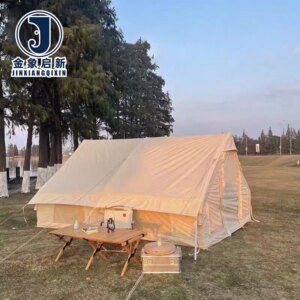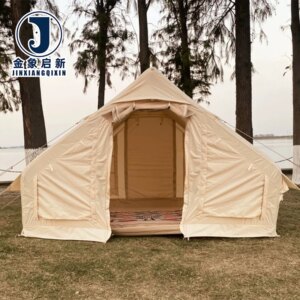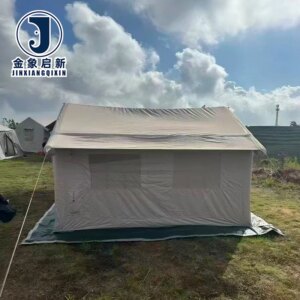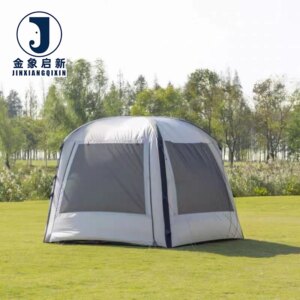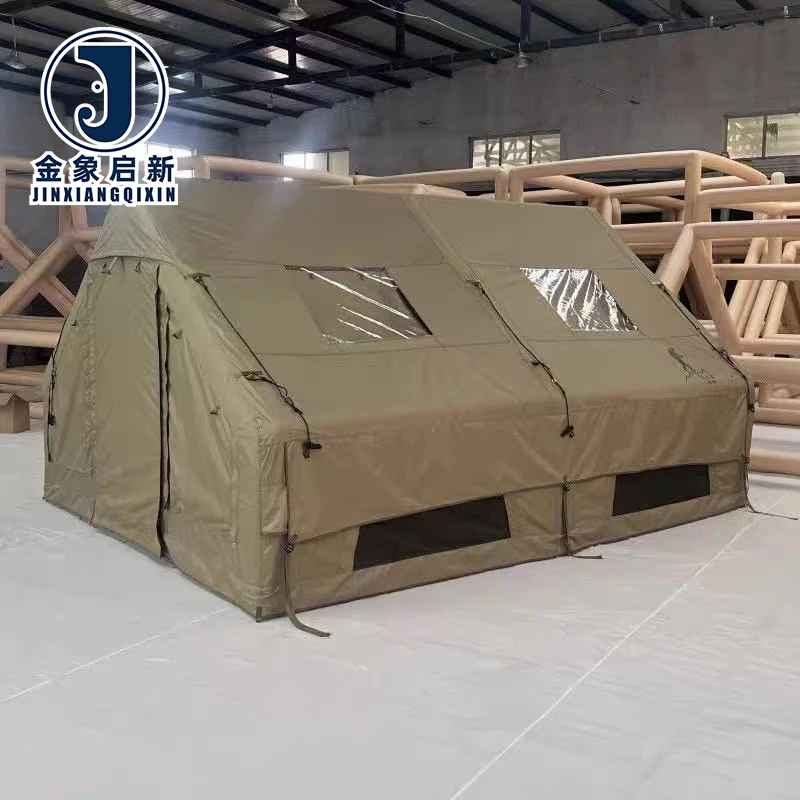
Proven coating control — Nearly three decades of PVC tarpaulin production yield consistent adhesion and weight accuracy across every roll destined for inflatable structures.
Technical Specifications
| Parameter | Value |
|---|---|
| Product Type | Inflatable Tent |
| Core Material | PVC Tarpaulin |
| Product Forms | Inflatable structure |
| Key Performance | Waterproof, UV-resistant (test basis not stated), Tear-resistant |
| Customization Service | OEM & ODM (sample customization, pattern printing) |
| Production Facility Area | 9,180 square meters |
| Production Lines | 3 full production lines |
| Processing Equipment | 36 sets of professional processing equipment |
| R&D Team Scale | 10 technicians |
| Quality Control System | Full-process QA & QC with 100% pre-shipment inspection |
| Certifications | ISO 9001, ISO 14001, ISO 45001, CE |
Application Suitability
| Application | Exposure & Requirement |
|---|---|
| Commercial camping gear manufacturing | Repeated inflation-deflation cycles, outdoor weather, UV exposure, seam integrity under air pressure |
| Outdoor activity organizers | Rapid deployment, transport abrasion, wind loading on inflated beams |
| Industrial event suppliers | High-frequency setup and teardown, ground contact wear, branded surface printing |
| Camping equipment wholesalers | Shelf-ready consistency across batches, compliance documentation for retail markets |
| Inflatable structure fabrication | Air-holding beam construction, welded joint reliability, fabric flexibility at fold points |
Why Welded Seams Fail Before the Fabric Does in Inflatable Tent Production
Seam failure in inflatable air-beam structures traces back to coating adhesion and heat-weld compatibility, not fabric tensile strength alone.
When an inflatable tent beam flexes under wind load or during packing, the welded joint endures concentrated stress that the surrounding fabric never sees. I have watched heavy-grade coated rolls fail at the weld line while the body of the fabric remained intact — the coating peeled from the base fabric at the seam, creating an air leak that rendered the entire beam useless [NEED_CITE: weld peel strength test methods for PVC coated fabrics per ISO 1421]. For manufacturers producing Inflatable Tent Fabric for commercial outdoor lines, this means the weld zone is the true weak point, and material selection must account for coating-to-yarn adhesion as much as base fabric denier.
Air-Beam Integrity Starts with Coating Adhesion
Inflatable tent structures depend entirely on the air-holding capacity of welded beam channels. The PVC tarpaulin used here must bond coating to base fabric tightly enough to resist peel forces at every welded seam. When coating adhesion is weak, repeated inflation cycles gradually separate the PVC layer from the yarn, starting at the weld edge and spreading along the seam. This is why Inflatable Tent Fabric sourced for commercial production must undergo peel-strength verification before fabrication begins, not just tensile testing of the flat material.
Batch Consistency Across Production Runs
Commercial camping gear manufacturers running continuous production lines cannot afford colour shifts or weight variation between rolls. A batch that arrives lighter than the quoted specification produces thinner weld zones, while colour differences show immediately when two rolls are cut into adjacent tent panels [NEED_CITE: colour consistency standards for coated textiles in batch production]. The 10-technician R&D team and dedicated QA staff at this facility inspect every roll before dispatch, targeting the batch-to-batch repeatability that wholesale buyers demand when integrating inflatable tents into catalogues.
Reading the Specification Sheet Beyond the GSM Number
GSM tells you the total weight per square metre, but it does not tell you how that weight is distributed between base fabric and coating. A PVC tarpaulin with a high GSM achieved through heavy coating but a sparse base fabric will tear easily once a puncture starts, because the yarn density is too low to arrest tear propagation. For inflatable tent beams, the base fabric denier and weave density determine how well the structure resists tearing at stress points — around valve holes, at beam junctions, and along fold lines. Coating weight matters for waterproof integrity and weld quality, but buyers specifying inflatable tent fabric should request the base fabric weight and coating weight separately to understand what they are actually purchasing.
The Hidden Cost of Specifying on Price Per Kilogram
Buyers who select Inflatable Tent Fabric based on the lowest cost per kilogram often receive material with reduced coating thickness or a lighter base fabric than the sample showed. The finished inflatable tent may pass initial quality checks, but field failures follow — air leaks at seams, colour fading across a single season, or beam collapse under moderate wind [NEED_CITE: field failure rates for inflatable structures linked to material substitution]. Returns and warranty claims then erase any savings from the cheaper roll, while damaging the brand reputation of the camping equipment wholesaler or event supplier who sold the finished product.
What This Facility Brings to Inflatable Tent Fabric Orders
Three full production lines and 36 sets of processing equipment give this factory the capacity to handle bulk inflatable tent orders without splitting production across incompatible machines. The 10-person R&D team develops custom samples within days, allowing buyers to test weld parameters and print registration before committing to a full run. Full-process QA and QC inspection covers coating weight, colour match, and weld peel strength at each stage, with 100% pre-shipment inspection ensuring no roll leaves the facility outside tolerance. ISO 9001, ISO 14001, ISO 45001, and CE certifications support market entry requirements across regions. OEM and ODM services extend to pattern printing and custom sizing, so manufacturers can source finished, branded inflatable tent components rather than managing print and cut operations in-house.
Documentation & Verification
- Material specification sheet stating base fabric denier, coating type, and confirmed GSM for inflatable tent rolls
- Pre-shipment inspection record covering weight, colour, and weld compatibility per roll
- UV and flame-retardant test reports provided where treatment grade is confirmed at order
- ISO 9001, ISO 14001, ISO 45001, and CE certificates included with every shipment
- Roll packing list with batch traceability for production-line reconciliation
- Certificate of origin and customs documentation for cross-border delivery
Fabrication, Handling & Storage
- Heat-weld temperature and dwell time must be calibrated to the PVC coating thickness of each roll batch
- Store rolls upright on pallets to prevent flat-spot creasing that weakens the coating at fold lines
- Cut patterns should account for fabric grain direction to maximise tear resistance along inflatable beam lengths
- Clean printed surfaces with mild detergent only; solvents may degrade the PVC coating finish
- Allow cold-stored rolls to reach ambient temperature before unrolling to avoid coating micro-cracking
Requesting a Quotation for Inflatable Tent Fabric
Provide your target GSM range, required roll width, and annual volume so the specification can be matched to your production line. Confirm whether your market requires flame-retardant or UV-resistant treatment and which certification grade applies. Specify any pattern printing or colour matching requirements, and indicate whether you need sample rolls for weld testing before bulk commitment.
Frequently Asked Questions
Q: How do I verify the GSM and coating weight on arrival for inflatable tent fabric?
A: Request a pre-shipment inspection record that documents per-roll weight verification. On receipt, cut a measured sample from each roll and weigh it to confirm the stated GSM. The supplier provides a material specification sheet listing base fabric weight and coating weight separately, so you can verify both components rather than relying on total weight alone.
Q: What test basis supports the UV-resistant treatment for this inflatable tent material?
A: UV-resistant treatment is available, but the specific test standard must be confirmed at the inquiry stage. Ask for the test report that matches your market requirements — different regions accept different exposure protocols. The supplier will provide documentation tied to the treatment grade you specify, ensuring your finished inflatable tents meet the outdoor durability claims you make to end users.
Q: How does welded seam strength compare to fabric strength in inflatable air-beam structures?
A: In inflatable beams, the welded seam is typically the failure point, not the fabric body. Coating adhesion to the base fabric determines how well the weld holds under repeated inflation cycles. Requesting weld peel-strength data alongside tensile test results gives a complete picture of how the material will perform once fabricated into air-holding structures.
Q: Can batch colour consistency be guaranteed across multiple rolls for uniform tent appearance?
A: The facility runs dedicated QA inspection for colour match across every roll in a production batch. Rolls are compared under controlled lighting before dispatch to catch shade variation early. For large orders split across multiple production runs, specify a colour reference standard at the sample approval stage to maintain consistency over time.
Q: What customization options are available for inflatable tent fabric orders?
A: OEM and ODM services cover custom roll widths, pattern printing, colour matching, and sample development. The 10-person R&D team can produce samples within days for weld testing and print registration checks. Minimum order quantities and lead times depend on the level of customization — confirm your requirements during the inquiry to receive an accurate specification and timeline.