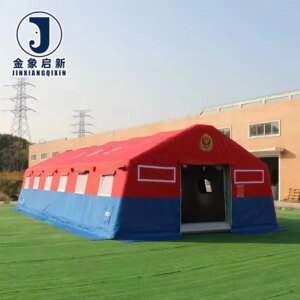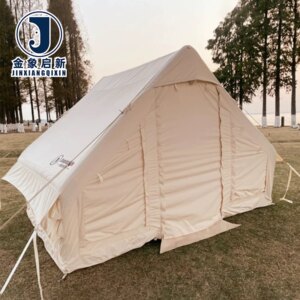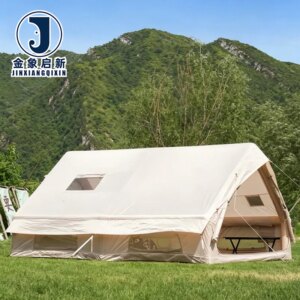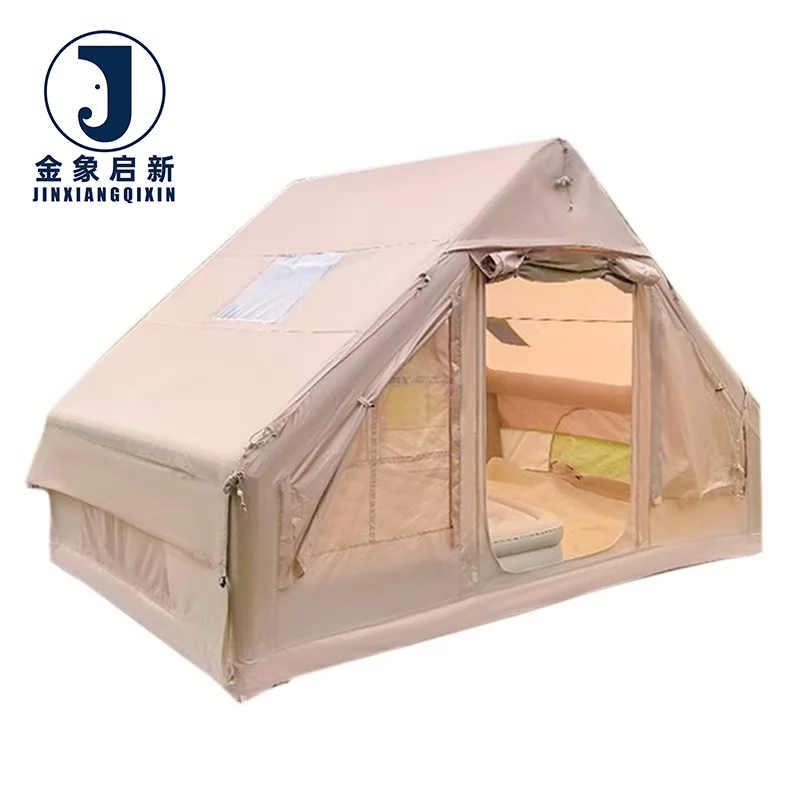
Coated Fabric Integrity — Every inflatable camping tent roll undergoes in-process adhesion and coating weight checks before leaving the production floor, ensuring the PVC tarpaulin meets the durability demands of repeated deployment and breakdown cycles.
Technical Specifications
| Parameter | Value |
|---|---|
| Product Type | Inflatable Tent |
| Core Material | PVC tarpaulin |
| Coating Material | PVC |
| Key Performance | Waterproof, tear-resistant, lightweight |
| UV Resistance | Available — confirm test basis required for your market |
| Product Form | Inflatable structure with quick automatic opening |
| Capacity | 1–2 person |
| Customization Service | OEM & ODM (sample customization, pattern printing) |
| Quality Standards | ISO 9001, ISO 14001, ISO 45001, CE |
Application Suitability
| Application | Exposure & Requirement |
|---|---|
| Temporary site offices at construction projects | Dust, rain, daily UV exposure, frequent relocation between zones |
| Mobile storage units for outdoor events | Short-term weather exposure, rapid assembly and teardown, foot traffic abrasion |
| Emergency response shelters for disaster relief operations | Unpredictable weather, minimal ground preparation, immediate deployment required |
| Auxiliary facilities for outdoor logistics hubs | Wind load, vehicle proximity, repeated inflation cycles at staging areas |
Why Coated Fabric Choice Determines Inflatable Shelter Lifespan
A tent that fails at the weld before the fabric itself wears out is a specification problem, not a material problem.
When buyers evaluate inflatable tents for commercial or logistics use, the focus tends to fall on weight and packed size. Yet field failures consistently trace back to coated-fabric behaviour under repeated inflation cycles — seams splitting at flex points, PVC delamination where the air beam meets the canopy, and coating surface degradation that accelerates once the first micro-crack appears [NEED_CITE: tensile and tear test methods for coated fabrics per ISO 1421]. For transport-adjacent and site operations, these failures mean downtime and replacement cost that dwarfs the initial material saving.
Air Beam and Canopy Fabric Interaction
In an Inflatable Tent for Truck and Transport applications, the air beam structure places continuous outward pressure on the canopy fabric. The PVC tarpaulin must maintain dimensional stability across temperature swings encountered during roadside deployment or event setup. Our in-house R&D team of 10 technicians evaluates base fabric behaviour under inflation pressure to match canopy tension with beam geometry, reducing stress concentration at bonded seams.
Rapid Deployment Without Compromising Fabric Integrity
The quick automatic opening mechanism is engineered around the specific weight and flexibility of the PVC tarpaulin used in the canopy. A heavier coating may improve waterproof performance but increases the force needed for reliable inflation. Our production process balances coating weight against deployment speed, with sample testing conducted before bulk production to validate that the automatic opening performs consistently across the temperature range the Inflatable Structure Fabric for Commercial Deployment will encounter.
How PVC Coating Adhesion Affects Long-Term Air Retention
The bond between the PVC coating and the base fabric directly controls whether the air beam holds pressure through repeated cycles. Poor adhesion leads to internal delamination, which is invisible from the outside until the beam loses rigidity mid-use. Our coating process includes adhesion verification at defined intervals during production, checking peel strength at the coating-to-substrate interface to catch variance before it reaches the finished tent [NEED_CITE: peel strength testing for PVC coated textiles].
The Hidden Cost of Underspecified Welded Seams
Buyers sourcing inflatable tents for site or logistics use often discover too late that seam strength was not specified relative to the canopy fabric’s tear resistance. When the weld line fails before the PVC tarpaulin itself, the entire structure becomes unrepairable in the field. This pattern shows up repeatedly in commercial deployments where tents are inflated and deflated dozens of times per season — the flex fatigue concentrates at exactly the bonded joint [NEED_CITE: welded seam performance in flexible PVC structures].
Why Procurement Verification Matters Here
Our QA and QC protocol covers every production stage for the Inflatable Tent product line, from incoming base fabric inspection through pre-shipment roll examination. The 9,180-square-metre facility with 3 full production lines and 36 sets of processing equipment supports consistent output across batches, and each order ships with documentation tied to the specific production run. Sample development is completed within days when OEM or ODM customization is requested, allowing buyers to validate material and structural design before committing to bulk volumes.
Documentation & Verification
- Material specification sheet stating PVC coating type, base fabric construction, and stated weight
- Batch-specific pre-shipment inspection record with waterproof and tensile data
- ISO 9001, ISO 14001, ISO 45001, and CE certificates for commercial tender compliance
- UV and flame-retardant test reports provided where applicable grades are specified
- Roll packing list with production batch reference for traceability
Fabrication, Handling & Storage
- Heat-weld parameters must match the PVC tarpaulin coating thickness to prevent seam delamination at air beam joints
- Store rolls flat and avoid stacking heavy loads on top to prevent permanent creasing in the coated surface
- Use mild, non-solvent cleaners on the canopy surface to preserve the PVC coating finish and waterproof integrity
- Allow the inflatable structure to reach ambient temperature before inflating in cold conditions to avoid coating stiffness cracking
- Pattern printing should be confirmed on sample panels before full-run production to verify adhesion to the PVC surface
Requesting a Specification Match
Provide your typical deployment environment, expected inflation frequency per season, and any compliance requirements your market mandates. If you need custom dimensions, pattern printing, or specific PVC tarpaulin grades, include the target width and annual volume so we can confirm lead time and sample availability for the Inflatable Tent configuration you require.
Frequently Asked Questions
Q: How is the PVC tarpaulin weight and coating verified upon arrival?
A: Each shipment includes a pre-shipment inspection record with batch-specific weight data. We recommend buyers conduct a spot-check weighing of a defined sample area against the specification sheet. Discrepancies should be reported with photos and weight readings before the material is cut or fabricated.
Q: What UV-resistance test basis supports the stated outdoor durability?
A: UV-resistance treatment is available in varying grades depending on market requirements. Confirm the test standard your region or project specifies — such as ISO 4892 or equivalent — so the appropriate grade is selected and documented with a corresponding test report.
Q: Can tent dimensions and printing be customized to fit specific transport or site requirements?
A: OEM and ODM customization covers sizing, pattern printing, and structural adjustments. A sample is developed and shipped for buyer approval before bulk production begins, ensuring the Inflatable Tent for Truck and Transport meets the exact dimensional and branding requirements of the project.
Q: How are welded seams tested to prevent failure at high-flex points during setup and teardown?
A: Welded seams on inflatable structures undergo peel and shear checks during in-process QA inspections. Test parameters are set relative to the PVC tarpaulin’s tear strength so the seam does not become the structural weak point under repeated inflation cycles.
Q: What documentation accompanies each batch for commercial project compliance?
A: Each order ships with a material specification sheet, pre-shipment inspection record, ISO and CE certificates, and a roll packing list with batch references. Additional test reports for UV or flame-retardant grades are included where those treatments have been specified and confirmed.