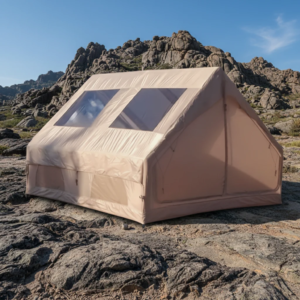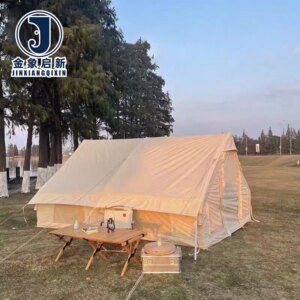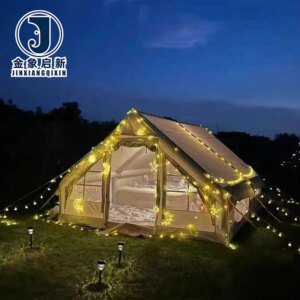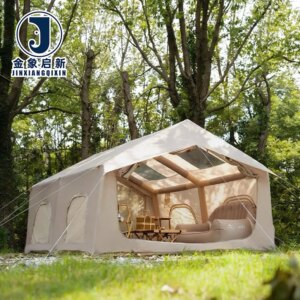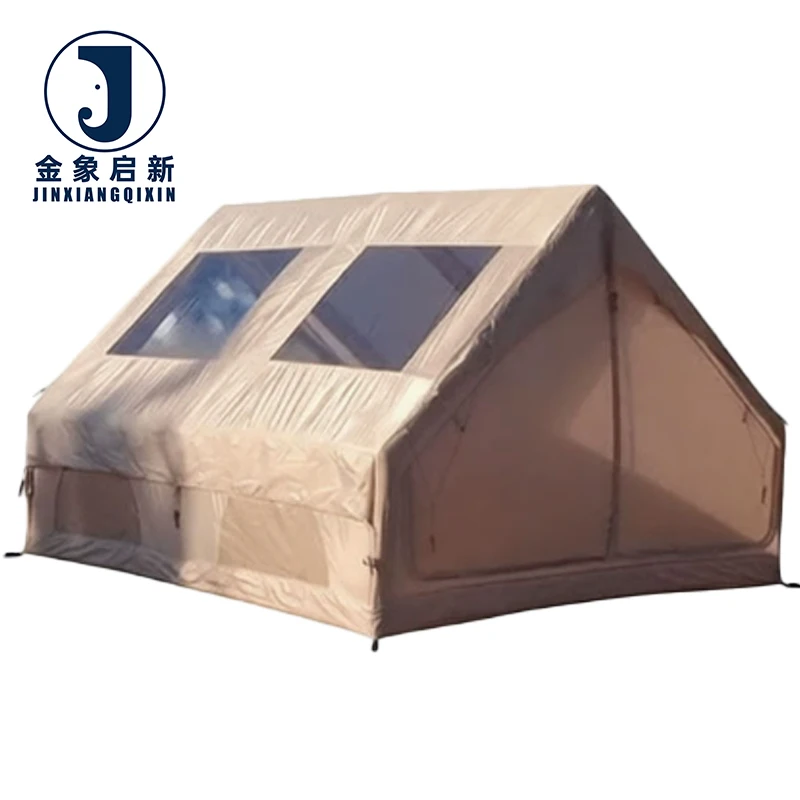
Coating Adhesion Control — PVC coating applied uniformly across the base fabric ensures consistent waterproof integrity across every inflatable tent panel produced on our three dedicated lines.
Technical Specifications
| Parameter | Value |
|---|---|
| Product Type | Inflatable Tent |
| Core Material | PVC tarpaulin |
| Construction | Single-layer PVC |
| Key Performance | Waterproof, UV-resistant, tear-resistant, fire-retardant, anti-static |
| Capacity | 6–8 Person |
| Features | Skylight, Quick Automatic Opening |
| Customization | OEM & ODM, sample customization, pattern printing, material selection, product design |
| Standards | ISO9001, ISO14001, ISO45001, CE |
Note: Fire-retardant and anti-static grades are available — confirm the specific grade and test standard required for your market and application.
Application Suitability
| Application | Exposure & Requirement |
|---|---|
| Outdoor glamping | Continuous UV exposure, rain and wind loading, repeated inflation and deflation cycles |
| Emergency response command centers | Rapid deployment, all-weather sealing, structural stability under pressure |
| Temporary commercial storage | Prolonged outdoor exposure, dust and moisture ingress prevention |
| Mobile marketing installations | Brand visibility, structural shape retention, frequent transport and re-setup |
| Outdoor event management | Crowd shelter requirements, weather resistance, visual presentation quality |
Why Batch-to-Batch Waterproof Consistency Matters More Than the Spec Sheet
A single weak panel compromises the entire inflatable structure.
When sourcing an Inflatable Tent aftermarket supplier, buyers often discover that the PVC fabric delivered in production does not match the coating weight or waterproof performance of the pre-production sample. Panels cut from different rolls within the same order may show visible differences in coating thickness, leading to uneven seam welding and premature air leakage at stress points. For inflatable structures that depend on internal pressure to maintain shape, this inconsistency is not a cosmetic issue — it is a structural failure waiting to happen [NEED_CITE: air retention testing methods for inflatable PVC structures].
Matching Fabric Weight to Inflation Pressure and Panel Geometry
Inflatable tent structures rely on internal air pressure to maintain rigidity, and the PVC fabric must resist that pressure across every seam and panel without stretching beyond its elastic limit. Selecting an Inflatable Tent aftermarket supplier who understands the relationship between coating weight, base fabric denier and panel curvature is essential. Heavier-grade coated fabrics hold pressure more effectively on large-span panels, while lighter grades may suffice for smaller auxiliary chambers — but the wrong choice at the specification stage leads to bulging, seam creep or catastrophic blowout under wind load.
Seam Welding Behaviour Under Repeated Inflation Cycles
An inflatable tent is inflated, deflated, transported and re-insembled repeatedly. Each cycle places flex stress on welded seams, particularly where panels curve or where the skylight aperture is cut. The welding temperature, dwell time and pressure must be matched to the specific PVC coating formulation — a mismatch causes the weld to become brittle over time or, conversely, to delaminate under load [NEED_CITE: heat welding parameters for PVC coated fabrics in inflatable structures]. Your Inflatable Tent aftermarket supplier should provide pre-production welded samples so you can verify seam integrity before committing to bulk fabrication.
Reading the Specification: What Coating Weight and Base Fabric Actually Tell You
PVC tarpaulin performance in an inflatable tent depends on two interacting variables: the base fabric weave and the PVC coating applied to both sides. The base fabric — typically polyester — provides tensile and tear strength, while the coating delivers waterproofing, UV protection and surface characteristics. A high GSM reading alone does not guarantee strength; a thick coating on a loosely woven base fabric may crack under flex, while a moderate coating on a dense, high-denier weave can outperform it in real-world conditions. Coating method matters as well: knife-over-roll coating produces a more uniform film with better adhesion than calendered laminates, which directly affects how well seams hold under repeated pressure cycling [NEED_CITE: coating methods and adhesion performance for PVC tarpaulin fabrics].
For fire-retardant and anti-static requirements, the treatment must be integrated into the coating formulation rather than applied as a surface spray, which wears off after limited use. Confirm with your Inflatable Tent aftermarket supplier whether these properties are compound-integrated and request test documentation referencing the applicable standard for your target market.
The Hidden Cost of Specifying Without Verified Test Data
Buyers who accept fire-retardant or UV-resistant claims without supporting test reports frequently face rejection at site inspection or premature material degradation in the field. A tent panel that passes visual inspection on arrival may fail a flame-spread test months later when the surface treatment has degraded, or the fabric may become brittle and crack after a single season of UV exposure if the stabiliser package was insufficient. For inflatable structures used in commercial or emergency settings, these failures carry liability implications far beyond the cost of replacement fabric [NEED_CITE: fire safety compliance requirements for temporary inflatable structures].
Why Sourcing From a Coating Specialist Changes the Outcome
Jinan Jinxiang operates three full production lines with dedicated process control over coating weight and adhesion, ensuring that every roll meets the specified parameters before dispatch. A ten-person R&D team handles material selection and sample development, allowing you to test the exact fabric formulation against your inflation pressure and panel geometry before production begins. Every roll undergoes 100% pre-shipment inspection, and documentation including material specification sheets, test reports and certificates of origin travels with each shipment — giving you verifiable evidence for compliance and quality assurance.
Documentation & Verification
- Material specification sheet stating base fabric construction, coating type and weight reference per roll
- Test report for UV-resistant and fire-retardant grades referencing applicable international standards
- ISO9001, ISO14001, ISO45001 and CE certificates included with shipment documentation
- Pre-shipment inspection record confirming dimensional accuracy and visual quality
- Roll packing list with individual roll identification for traceability
- Certificate of origin and customs support documentation for international procurement
Fabrication, Handling & Storage
- Store PVC tarpaulin rolls upright on pallets in a shaded, ventilated area to prevent coating adhesion between layers
- Allow fabric to acclimatise to site temperature before unfolding to avoid coating micro-cracking in cold conditions
- Weld seams using temperature and pressure settings matched to the specific PVC coating formulation supplied
- Clean surfaces with mild detergent only — solvent-based cleaners degrade the UV stabiliser package in the coating
- Inspect skylight aperture edges and reinforcement points before each inflation cycle for coating wear or seam separation
Preparing Your Inquiry for Accurate Specification
To receive a precise quotation and sample from your Inflatable Tent aftermarket supplier, provide the intended application environment, expected inflation pressure range, panel dimensions and any fire-retardant or anti-static compliance requirements for your target market. Specify whether you require finished fabricated panels or raw material by the roll, along with colour and branding print requirements. Pre-production samples are available for evaluation before bulk production commitment.
Frequently Asked Questions
Q: What customization options are available for inflatable tent dimensions and branding?
A: Full OEM and ODM services are supported, including custom panel dimensions, skylight positioning, colour selection and pattern printing. A ten-person R&D team develops samples based on your design specifications, allowing you to verify fit and finish before bulk production. Material selection guidance is provided to match the fabric grade to your structural and environmental requirements.
Q: How does the UV-resistant formulation compare to standard PVC fabrics?
A: UV-resistant grades incorporate stabilisers integrated into the PVC coating compound rather than applied as a surface treatment, providing consistent protection throughout the material life. Test reports referencing applicable standards are available to verify performance. Confirm the specific UV exposure conditions and expected service duration for your application so the appropriate formulation can be recommended.
Q: What certifications and documentation are included with shipment?
A: Each shipment includes ISO9001, ISO14001, ISO45001 and CE certificates, a material specification sheet, pre-shipment inspection record, roll packing list and certificate of origin. Test reports for fire-retardant and UV-resistant grades are provided where applicable. Customs support documentation is available for international procurement compliance.
Q: Can independent third-party testing be arranged before bulk production?
A: Pre-production samples are developed for client evaluation, and third-party testing can be coordinated to verify material properties against your specified standards. This includes fire-retardant classification, UV resistance and tensile strength testing. Sample lead times are short, enabling rapid verification before committing to full production volumes.