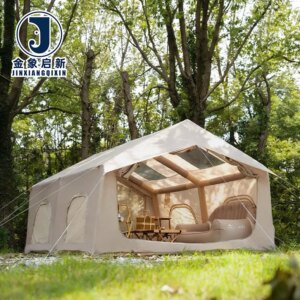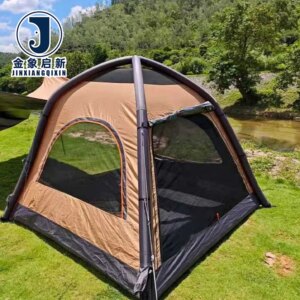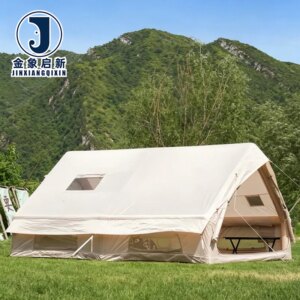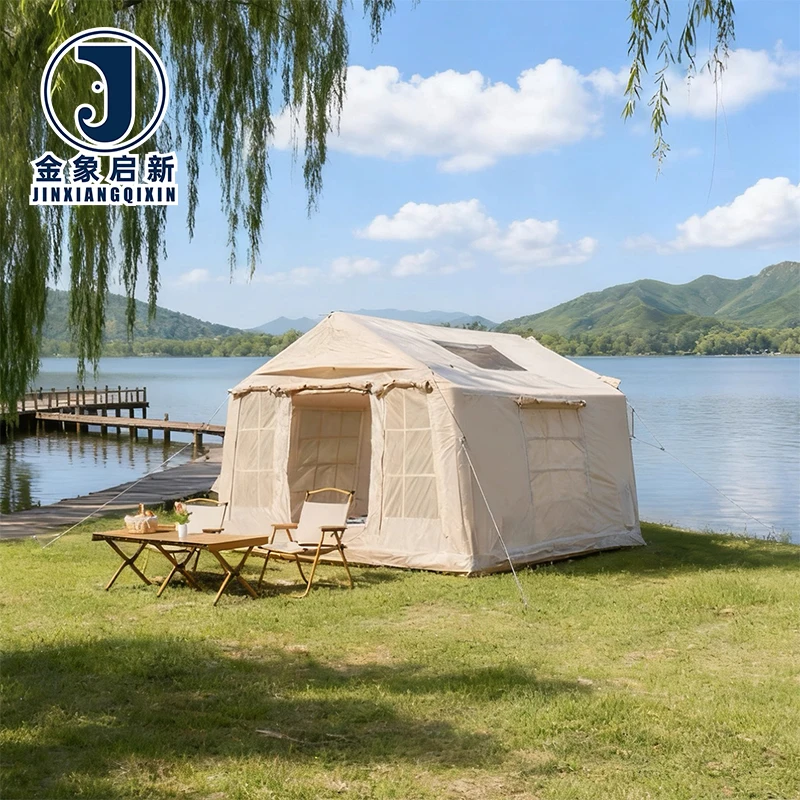
Process-Controlled Fabric Sourcing — Every roll is thickness-tested to ±0.02mm tolerance and density-verified before cutting, ensuring the PVC membrane you specify is exactly what arrives at your production floor.
Technical Specifications
| Parameter | Value |
|---|---|
| Product Type | Inflatable Tent |
| Core Material | Waterproof PVC Fabric |
| Water Resistance | ≥10,000mm water column |
| UV Resistance | UV-resistant formulation with stabilized additives (test basis not stated) |
| Tear Strength | ≥300N warp/weft (standard not stated) |
| Material Thickness Tolerance | ±0.02mm |
| Construction | Single-layer |
| Inflation Method | Inflatable structure with pump (automatic opening) |
| Pressure Test | 24-hour pressure testing for air leakage detection |
| Customization | OEM & ODM, sample customization, pattern printing, custom dimensions, color matching, logo application |
| Sample Lead Time | 7-10 days |
| Production Lead Time | 15-20 days for standard orders |
| Production Facility | 9,180 m² with 3 full production lines and 36 sets of professional processing equipment |
| R&D Team | 10 technicians |
| Standards | ISO 9001, ISO 14001, ISO 45001, CE |
Application Suitability
| Application | Exposure & Requirement |
|---|---|
| Commercial glamping resorts | Four-season weather exposure, repeated inflation/deflation cycles, guest-facing surface aesthetics |
| Event venues and hospitality setups | Rapid deployment demands, high foot traffic abrasion, temporary structural loads |
| Adventure tourism operators | Remote site installation, variable climate conditions, transport and storage stress |
| Outdoor gear manufacturing | Batch-to-batch material consistency, branded surface printing, seam integrity under sustained air pressure |
Why Coated Fabric Quality Determines Inflatable Tent Longevity
The membrane is the structure — when the fabric fails, the tent fails.
Glamping operators and tent manufacturers frequently trace premature inflatable tent failures back to the coated fabric itself, not the design. Inconsistent coating weight across a roll produces weak zones that leak under sustained pressure. UV treatment that degrades after one season leaves the PVC brittle and prone to cracking at fold lines. Welded seams that separate before the fabric tears indicate poor fusion compatibility between the coating layers [NEED_CITE: heat-seal performance variables in PVC coated fabrics per ISO 1421 test methods]. These are material problems, and they surface most visibly in commercial operations where inflatable glamping tent units are deployed, inflated, and deflated hundreds of times per season.
How Base Fabric Construction Affects Air-Holding Performance
The single-layer PVC construction used in this inflatable glamping tent relies entirely on coating integrity and base fabric density to maintain internal pressure. The ≥300N warp/weft tear strength ensures that small punctures or abrasion marks do not propagate into structural failures during operation. When the base weave is too open or the denier too low, the coating bridges the gaps without adequate mechanical anchoring, leading to delamination under repeated flex cycles.
Coating Consistency Across the Roll Stock
An inflatable glamping tent manufacturer must source PVC fabric where coating weight holds steady from the first meter to the last. Thickness tolerance of ±0.02mm across the roll means that heat-seal parameters set on the first panel will produce identical fusion results on the final panel of the production run. This consistency is what separates a tent that holds pressure for 24 hours from one that develops slow leaks at seams within the first week of deployment [NEED_CITE: roll-to-roll coating consistency standards for inflatable membrane structures].
Reading the Specification Sheet Beyond the Headline Numbers
Water resistance rated at ≥10,000mm water column confirms the fabric will withstand sustained rainfall and ground moisture contact without water transmission through the membrane. However, waterproofing alone does not predict how the material behaves under structural load — tear strength and coating adhesion together determine whether a tent survives a wind event or a rough setup on uneven ground. The UV-resistant formulation with stabilized additives addresses surface degradation from seasonal sun exposure, though the specific test basis should be confirmed against the climate zone where the tent will operate. Thickness tolerance at ±0.02mm is tighter than typical industrial PVC tarpaulin tolerances, reflecting the precision needed for heat-sealed inflatable structures where seam uniformity directly affects air retention.
What Happens When Material Specifications Are Not Verified
A batch of inflatable tent fabric that arrives lighter than quoted means the coating layer is thinner than designed, reducing both water resistance and weld strength at seams. Color variation between rolls in the same order becomes visible once multiple tent units are installed side by side at a glamping site, forcing operators to reject or replace panels. Heat-sealed seams that fail before the fabric itself tears point to fusion temperature inconsistencies during production — a problem that originates in the coating formulation, not the welding equipment [NEED_CITE: seam failure modes in PVC-coated inflatable structures]. These are the hidden costs of sourcing inflatable tent membrane fabric without verified batch documentation.
Production Capability Behind This Inflatable Glamping Tent Fabric
Three full production lines and 36 sets of professional processing equipment support bulk orders with consistent output quality across every roll. The 10-person R&D team handles material selection, pattern printing development, and custom sizing from initial inquiry through sample approval. Dedicated quality control monitors fusion temperatures during heat sealing and conducts 24-hour pressure testing on every finished inflatable unit before dispatch. Samples are developed within 7–10 days for custom requirements, allowing buyers to verify material hand, color accuracy, and seam performance before committing to production. Every shipment is accompanied by batch-specific inspection records covering thickness, water resistance, and seam strength data.
Documentation & Verification
- Batch-specific inspection report detailing water resistance results, thickness measurements, and seam strength data
- Material specification sheet confirming coating composition, performance parameters, and storage guidelines
- ISO 9001, ISO 14001, ISO 45001, and CE certificates included with shipment documentation
- Pre-shipment inspection record covering every unit from the production run
- Material composition certificates and production process records supplied on request for custom orders
Fabrication, Handling & Storage
- Heat-seal parameters must account for the ±0.02mm thickness tolerance to ensure uniform fusion across all seams
- Single-layer PVC construction requires consistent pressure and temperature settings during welding to prevent air leakage paths
- Store rolls vertically in climate-controlled conditions to prevent permanent creasing that compromises coating integrity
- Clean surfaces with pH-neutral agents only to protect the UV-resistant stabilized additive layer
- Inspect weld seams after every inflation cycle during initial deployment to confirm long-term air retention
Requesting a Quotation for Your Inflatable Tent Project
Provide your target tent dimensions, expected deployment climate, and annual unit volume so we can recommend the appropriate PVC grade and coating weight. If your market requires specific fire classification or UV performance documentation, include the relevant standard so we can confirm compliance before sampling. Specify whether you need finished inflatable units with pump systems or roll stock for your own fabrication line.
Frequently Asked Questions
Q: What customization options are available for dimensions, color, and branding on inflatable tent fabric?
A: Full OEM and ODM services are available, including custom dimensions, color matching to your reference, and pattern or logo printing directly on the PVC surface. The R&D team develops samples within 7–10 days, allowing you to verify material appearance, coating hand, and print clarity before approving bulk production.
Q: How is air leakage tested before inflatable tent units are shipped?
A: Every finished inflatable unit undergoes 24-hour pressure testing to detect air leakage before dispatch. In-line quality control monitors fusion temperatures during heat sealing to ensure seam consistency, and batch-specific inspection reports document the pressure test results alongside thickness and water resistance data.
Q: How is batch-to-batch color and material consistency maintained across roll stock?
A: Coating weight and color formulation are controlled within ±0.02mm thickness tolerance across every roll. Pre-shipment inspection verifies consistency against the approved sample, and batch-specific quality reports accompany each shipment so you can confirm the material received matches your original specification.
Q: Which certifications accompany the inflatable tent and its PVC fabric?
A: Production is certified to ISO 9001, ISO 14001, and ISO 45001 standards, with CE certification for applicable markets. Material composition certificates, test documentation, and production process records are supplied on request to support import compliance in your destination market.
Q: What is the sample development timeline and approval process?
A: Samples for custom inflatable tent specifications are developed within 7–10 days from confirmed requirements. Once you approve the sample for material quality, color, and construction, standard production orders are completed within 15–20 days depending on order volume and customization scope.