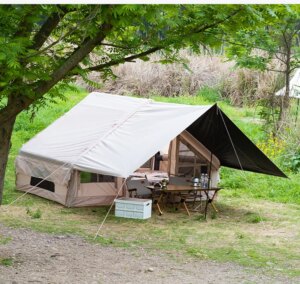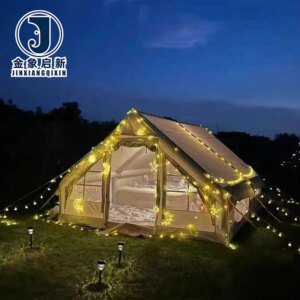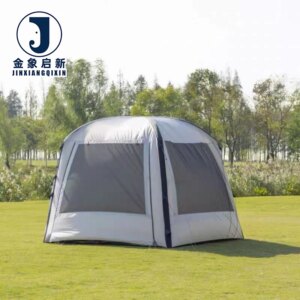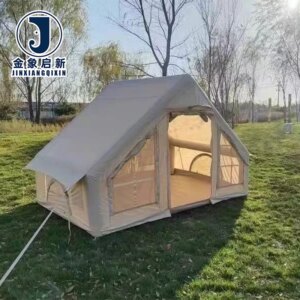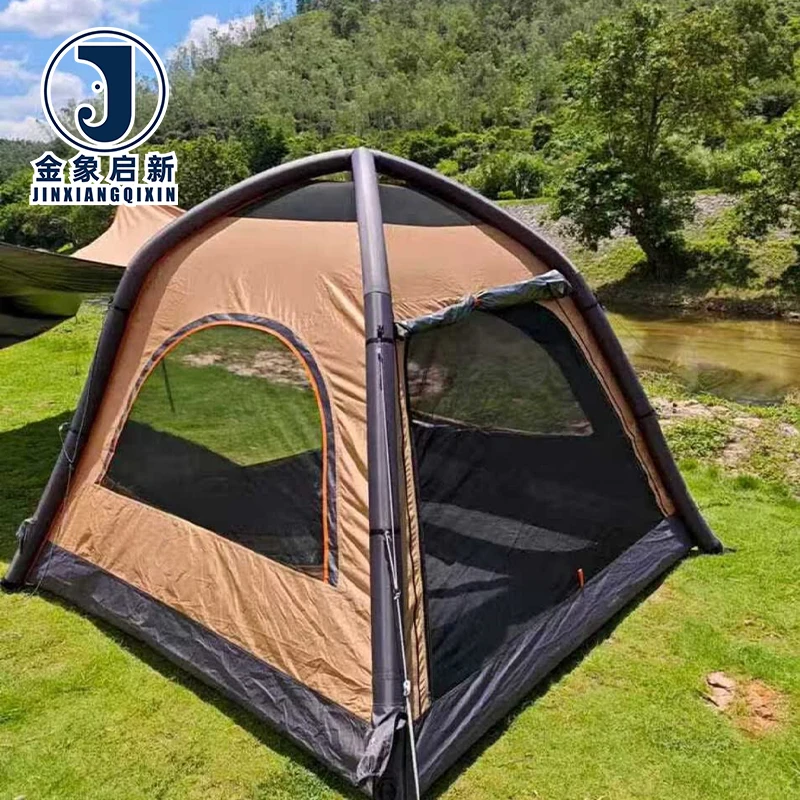
Proven process control — nearly 30 years of coating weight and adhesion expertise applied to every inflatable tent fabric roll we produce, validated at each stage before it leaves the line.
Technical Specifications
| Parameter | Value |
|---|---|
| Product Type | Inflatable Tent Fabric |
| Core Material | PVC tarpaulin |
| Coating Method | Knife coated |
| Construction | Single-layer |
| Capacity | 8-10 person |
| Season Rating | 4 season |
| Waterproof Rating | ≥2000mm water column (source value — verify against manufacturer catalog) |
| Tensile Strength | ≥300N/5cm (source value — verify against manufacturer catalog) |
| Flame Retardant | MEFB 1-1997 standard (grade not stated in source) |
| UV Treatment | Anti-UV (test basis not stated in source) |
| Anti-Static | Anti-static (standard not stated in source) |
| Key Features | Waterproof, UV-resistant, tear-resistant, fire-retardant, anti-static |
| Customization | OEM & ODM (sample customization, pattern printing) |
| Certifications | ISO9001, ISO14001, ISO45001, CE |
Application Suitability
| Application | Exposure & Requirement |
|---|---|
| Fleet maintenance yards | Rapid shelter deployment, repeated inflation cycles, vehicle clearance fitment |
| Logistics staging areas | Weather-protected cargo holding, wind load resistance, ground abrasion contact |
| Transport contractor fieldwork stations | Multi-site transport and redeployment, road exposure during transit, quick teardown |
| Emergency response command posts | Immediate deployment in unprepared terrain, all-season weather exposure, personnel shelter |
| Construction site temporary shelters | Prolonged UV and rain exposure, equipment protection, site safety compliance |
Why Weld Seams Fail First on Inflatable Transport Shelters
Seam integrity determines service life more than fabric weight ever will.
When an inflatable tent is deployed at a logistics yard or roadside job site, the flex points around the air beams undergo repeated stress every time the structure is inflated, deflated, folded and reloaded onto a truck. I have seen heavy-grade coated fabric panels outlast their welded seams by a significant margin, with the weld line cracking or peeling while the surrounding material remains intact [NEED_CITE: tensile and peel test methods for welded coated fabrics per ISO 1421]. This is not a material failure — it is a fabrication control failure. The Inflatable Tent Fabric for truck and transport applications must hold together at the seam through hundreds of deployment cycles, and that requires production-stage weld validation, not just a fabric spec sheet.
Structural Stability Under Repeated Inflation and Transport
The knife-coated PVC tarpaulin construction provides dimensional stability that inflatable structures demand. When the air beams pressurize, the fabric must resist stretching unevenly — any localized deformation creates stress concentrations that accelerate seam fatigue. Our coating process locks the base fabric weave in place, so the Inflatable Tent Fabric for truck and transport use maintains its shape through the inflation cycle and holds that shape under wind loads at exposed staging areas.
Weather Protection That Meets Fleet Operating Conditions
Transport contractors work in environments where a failed shelter means delayed loads and exposed cargo. The waterproof construction, rated at ≥2000mm water column, keeps equipment and personnel dry during sustained rainfall at job sites. Combined with anti-UV treatment — available in grades confirmed to your market’s test standard — the fabric resists degradation from prolonged sun exposure at open logistics yards and highway-adjacent staging zones.
Fire Safety Compliance Across Jurisdictions
Site safety officers at construction and industrial locations require documented flame retardancy. Our inflatable tent fabric is treated to the MEFB 1-1997 standard, though the specific grade achieved should be confirmed against your local fire code before specifying [NEED_CITE: MEFB 1-1997 classification scope for temporary structures]. For transport operators moving shelters across regional or national boundaries, verifying the applicable grade prevents costly rejections at site inspection.
How Coating Method and Base Fabric Interact to Determine Real Strength
A common mistake in specifying inflatable tent fabric is looking at tensile strength in isolation. The ≥300N/5cm value reflects the combined performance of the base fabric weave and the knife coating that encapsulates it. Knife coating forces PVC paste into the weave interstices under blade pressure, creating a mechanical lock that improves both peel strength and tear propagation resistance compared to simpler lamination methods. The base fabric denier and thread count determine how the load distributes before the coating even enters the equation — a tightly woven high-denier base with a lighter coat can outperform a loosely woven base buried under heavy PVC. For inflatable structures, peel strength at the weld matters as much as tensile strength in the panel field, and knife coating delivers superior weld adhesion because the coating penetrates the fabric rather than sitting on top of it. Anti-static treatment is also available — confirm the standard required for your operating environment, particularly if the shelter will house sensitive electronic equipment or operate in dusty conditions.
What Happens When Flame Retardant Grade Is Assumed but Not Verified
A transport contractor specifying inflatable shelters for a mining or construction client may receive fabric labelled "flame retardant" without a test report tied to a recognized standard. The consequence is not always immediate — it surfaces when the site safety auditor requests documentation and the supplied certificate references a different classification system or a grade that does not satisfy local regulation [NEED_CITE: fire safety classification requirements for temporary site structures]. The entire shelter order may be rejected, forcing emergency re-procurement at premium lead times. This is why we treat MEFB 1-1997 as a starting point for discussion, not a blanket claim, and why we encourage buyers to state the exact grade their project requires before production begins.
Why Fleet Operators Source Inflatable Shelter Fabric Through Us
Deep process control over knife coating means every roll leaving our facility carries consistent coating weight and adhesion — critical when multiple inflatable units must perform identically across a fleet’s depot network. Three full production lines and 36 sets of processing equipment support volume orders without compressing lead times on custom widths or colours. Our 10-technician R&D team develops pre-production samples within days, so fleet operators can validate fitment on a specific vehicle or shelter frame before committing to bulk. Dedicated QA/QC at every stage includes weld seam checks, coating adhesion verification and dimensional accuracy confirmation, with 100% inspection completed before any shipment leaves the floor.
Documentation & Verification
- Material specification sheet stating base fabric type, knife coating method and waterproof rating
- Flame retardancy test documentation referencing MEFB 1-1997 for site safety submissions
- UV and anti-static test reports available upon request matching your market requirements
- Pre-shipment inspection record covering seam weld integrity and dimensional accuracy
- ISO9001, ISO14001, ISO45001 and CE certificates for international procurement compliance
- Roll packing list and certificate of origin for customs clearance
Fabrication, Handling & Storage
- Heat-weld seams using temperature and dwell settings matched to knife-coated PVC for full peel adhesion
- Reinforce high-stress beam anchor points with additional fabric layers before welding
- Store rolls upright on pallets to prevent permanent creasing in the coated surface
- Allow fabric to acclimatize before unfolding in cold conditions to avoid coating micro-cracking
- Use PVC-compatible cleaners only — solvent-based products degrade the knife-coated surface
- Repair field damage with compatible PVC patch material heat-bonded to the coated face
What to Include in Your Inflatable Tent Fabric Inquiry
Provide the intended deployment environment, including typical wind exposure and whether the shelter will remain static or be relocated frequently. State your target market’s fire safety classification so we can match the correct flame retardant grade. Specify required dimensions, colour references and whether pattern printing or branding is needed. Indicate your annual volume and whether you require finished cut-and-welded panels or roll stock for in-house fabrication.
Frequently Asked Questions
Q: How is seam weld integrity tested on inflatable tent structures before shipment?
A: Every welded seam on our inflatable tent structures undergoes peel strength testing during production and a final visual and mechanical check at pre-shipment inspection. We verify that the weld holds at or above the base fabric strength, so the seam does not become the failure point during repeated inflation and transport cycles. Inspection records accompany each shipment.
Q: What flame retardant grade applies and does it meet my target market’s fire safety code?
A: Our inflatable tent fabric is treated to MEFB 1-1997, but the specific grade required varies by jurisdiction and application. We recommend sharing your project’s fire safety specification at inquiry stage so we can confirm the correct treatment level, provide matching test documentation and avoid compliance gaps at site inspection.
Q: Can the tent size, color and branding be customized to match fleet livery?
A: Yes. Our R&D team handles custom sizing, colour matching and pattern printing for inflatable tent fabric orders. We develop pre-production samples for your approval before bulk manufacturing begins, ensuring the finished shelter matches your fleet identity and fits the intended frame or vehicle dimensions precisely.
Q: How is the tent packed and protected during container transport to prevent fabric damage?
A: Rolls are packed with protective interleaving to prevent surface abrasion and stored upright on pallets to avoid permanent creasing. Each roll is individually labelled with specification details and included on a packing list for easy verification upon receipt at your facility or job site.
Q: What is the minimum order quantity for custom-size inflatable tents?
A: Minimum order quantities vary depending on the degree of customization — standard widths and colours carry lower minimums, while bespoke widths, matched colours or printed branding require a production run that supports efficient line setup. Share your specification at inquiry and we will confirm the applicable minimum alongside lead time.