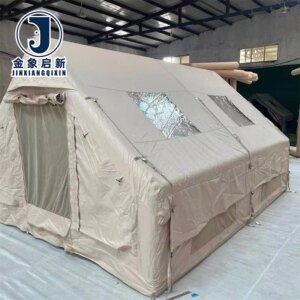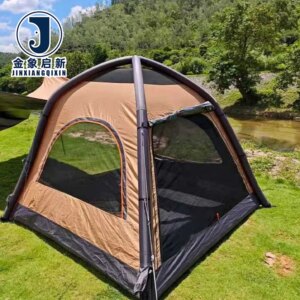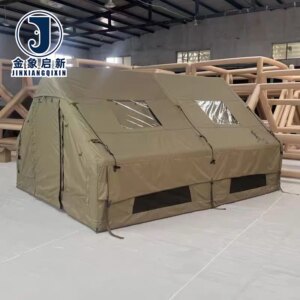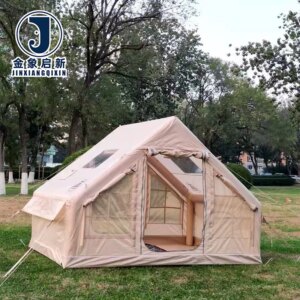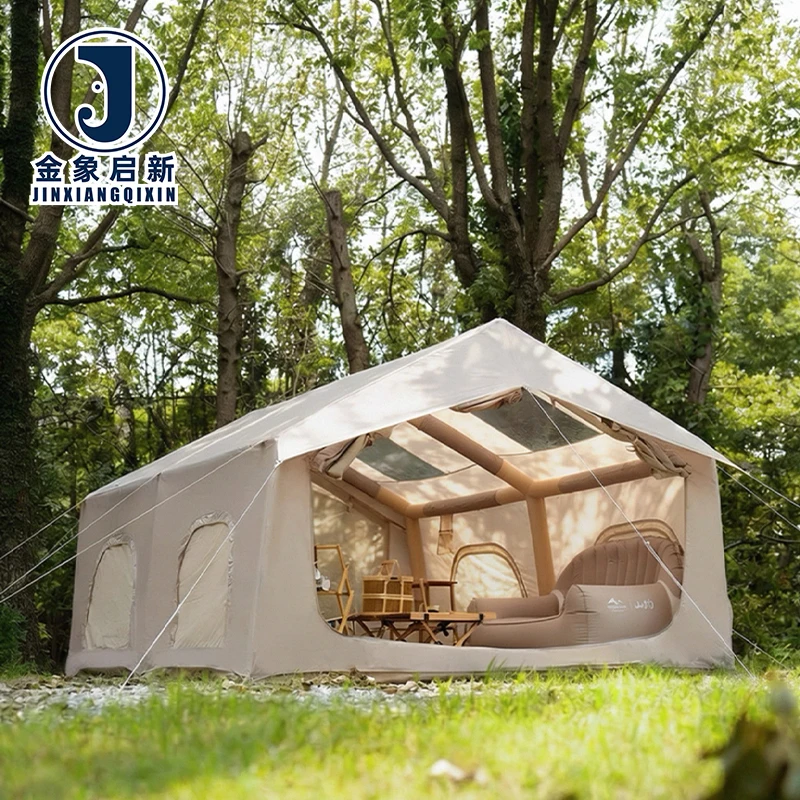
Custom Fitment Engineering — Our R&D team develops inflatable tent fabric samples within days, validating dimensions against specific trailer models and field structure requirements before bulk production begins.
Technical Specifications
| Parameter | Value |
|---|---|
| Product Type | Inflatable Tent |
| Core Material | PVC tarpaulin |
| Coating Material | PVC |
| Product Forms | 2-3 Person Quick Automatic Opening |
| Waterproof Performance | Fully waterproof coated construction |
| UV-Resistant Treatment | Available in UV-resistant grades — confirm test basis required for your market |
| Fire-Retardant Treatment | Available in flame retardant grades — confirm the grade required for your market |
| Anti-Static Treatment | Available in anti-static grades — confirm standard required for your compliance |
| Tear Resistance | Tear-resistant PVC coated construction |
| Customization Service | OEM & ODM (sample customization, pattern printing) |
| Quality Control System | Strict full-process quality inspection with dedicated QA&QC staff |
| Certifications | ISO9001, ISO14001, ISO45001, CE |
Application Suitability
| Application | Exposure & Requirement |
|---|---|
| Fleet loading dock shelters | Constant inflation cycles, forklift contact abrasion, weather exposure during cargo transfer |
| Transit point temporary covers | Rapid deployment requirement, wind load on inflatable structure, UV exposure during staging |
| Roadside emergency response units | Quick automatic opening under field conditions, waterproofing against rainfall, visibility in low light |
| Transport equipment integrated shelters | Fitment to specific trailer dimensions, repeated pack-and-deploy cycles, road vibration stress |
| Mobile field operations workspace | Extended outdoor exposure, temperature fluctuation, requirement for fire-retardant compliance on site |
Why a Generic Inflatable Tent Fails the Transport Industry
PVC Inflatable Tent for truck and transport cover applications must be engineered around the vehicle, not cut from a standard pattern.
I have watched fleet operators receive inflatable shelters that looked right on paper but collapsed at the seams the first week on a loading dock. The problem was never the fabric itself — it was the mismatch between a generic cut and the actual geometry of the trailer, combined with inflation stresses that consumer-grade tents never face [NEED_CITE: tensile and tear test methods for coated fabrics per ISO 1421]. Transport and logistics environments demand inflatable structures that survive forklift proximity, diesel exhaust exposure, and the repetitive stress of daily deployment and pack-down. When the Inflatable Tent fabric is specified without considering these operational realities, the failure point is almost always a welded seam or an unreinforced stress concentration.
Fitment to Specific Trailer and Vehicle Geometry
Every trailer model presents a different profile, and an inflatable tent deployed at a loading dock or transit point must match that profile precisely. Our 10-technician R&D team works from your vehicle dimensional drawings to develop a PVC Inflatable Tent pattern that accounts for door clearances, ramp angles, and tie-down positions. The sample development phase confirms fitment before any bulk fabric is cut, eliminating the costly scenario where a container of shelters arrives and none of them seal properly against the trailer opening. This application-driven approach to the Inflatable Tent aftermarket supplier workflow ensures that each unit performs as a system, not just a material.
Seam and Stress Point Engineering for Inflation Cycles
Inflatable structures concentrate mechanical stress at beam junctions and base anchor points every time they are inflated and deflated. A PVC tarpaulin that performs well in static applications can delaminate at the weld line when subjected to repeated pressure cycling [NEED_CITE: seam strength testing for inflatable coated fabric structures]. We address this through reinforced weld patterns at identified stress zones and by specifying base fabric denier and weave density that support the inflation pressure without over-stretching. The PVC Inflatable Tent material is evaluated for peel strength at the coating-to-fabric interface, because a seam that fails before the fabric does is a design failure, not a material failure.
Inflatable Tent Material Specification Decoded
The performance of PVC tarpaulin in inflatable applications depends on the interaction between base fabric construction and coating weight. A heavier base fabric with higher denier yarns provides the dimensional stability needed to hold inflation pressure without distortion, while the PVC coating thickness determines waterproofing integrity and resistance to abrasion from ground contact during deployment. The weave density of the base fabric directly controls tear propagation — a loose weave allows a puncture to spread rapidly under inflation stress, whereas a tight weave contains damage locally. Surface finish selection matters too: a matte finish reduces glare for roadside emergency shelters and provides better adhesion for printed fleet branding, while a glossy finish supports easier cleaning in environments where diesel residue and road dust accumulate on the shelter exterior.
The Cost of Wrong Specification in Transport Shelters
I have seen inflatable transport shelters fail site safety inspection because the fire-retardant grade was assumed rather than verified against the local compliance standard [NEED_CITE: fire classification standards for temporary transport shelters]. Batch colour inconsistency across a multi-unit fleet order becomes immediately visible when six shelters are deployed side by side at a logistics hub, undermining the professional appearance the fleet operator intended. Welded seams that separate during the third inflation cycle of the day create downtime that cascades through loading schedules. These failures trace back to procurement decisions made on price per square metre without verifying the material specification sheet or requesting pre-production samples cut to actual vehicle dimensions.
Why Source Inflatable Tent Fabric From Jinan Jinxiang
Our three full production lines and 36 sets of professional processing equipment provide the capacity to deliver consistent PVC tarpaulin for inflatable tent orders at fleet scale, with batch-to-batch colour and weight control that prevents visible mismatch across units. The dedicated QA and QC inspection at every production stage means that each roll of Inflatable Tent material is checked for coating adhesion, base fabric integrity, and treatment verification before it reaches the fabrication stage. Sample development within days allows transport equipment builders to validate fitment and inflation performance against specific trailer models before committing to full production runs. Our 10-technician R&D team handles the pattern engineering, custom sizing, and pattern printing specifications that turn raw PVC tarpaulin into a transport-ready inflatable shelter system. Documentation accompanies every shipment, providing the verification trail that fleet compliance officers and procurement teams require.
Documentation & Verification
- Material specification sheet confirming base fabric denier, PVC coating weight, and colour reference for each Inflatable Tent batch
- UV and flame-retardant test reports matched to the specific grade supplied, available on request for your market compliance
- Pre-shipment inspection record documenting 100 percent QA/QC check results before dispatch
- Roll packing list with batch identification enabling traceability across multi-unit fleet orders
- Certificate of origin and customs documentation supporting international transport shelter shipments
Fabrication, Handling & Storage
- Heat welding parameters must be calibrated to the specific PVC coating weight to achieve full peel strength at inflatable beam junctions
- Store PVC tarpaulin rolls upright on padded racking to prevent permanent creasing that compromises inflation pressure retention
- Reinforce all anchor points and valve openings with additional PVC layers before final seam welding
- Clean inflatable tent surfaces with mild detergent only; solvent-based cleaners degrade the PVC coating surface
- Allow cold-stored rolls to reach ambient temperature before unrolling to prevent coating micro-cracking
What to Include in Your Inflatable Tent Enquiry
To specify the correct PVC Inflatable Tent for your transport or logistics application, provide your trailer model dimensions, the inflation pressure range your structure requires, and the fire-retardant or anti-static compliance standard applicable at your operating sites. Include your target colour reference and whether fleet branding or pattern printing is required across the shelter surface. Confirm whether you need finished inflatable units or roll stock for your own fabrication facility, and indicate your projected annual volume so we can align production scheduling with your deployment timeline.
Frequently Asked Questions
Q: How is fire-retardant grade verified for transport and roadside shelter use?
A: Fire-retardant treatment is applied at the coating stage and verified through testing aligned to the standard required by your operating jurisdiction. We supply test reports specific to the grade of Inflatable Tent material shipped. Confirm the exact classification your site compliance officer requires — such as B1, M2, or NFPA 701 — so we match the correct formulation and provide supporting documentation with your shipment.
Q: Can inflatable tent fabric be custom-sized to fit specific trailer or vehicle dimensions?
A: Yes. Our R&D team develops PVC Inflatable Tent patterns from your vehicle dimensional drawings, producing samples for fitment validation before bulk production. This ensures the inflatable structure seals correctly against your specific trailer model, accounting for door clearances, ramp geometry, and tie-down positions that generic sizing cannot accommodate.
Q: What UV treatment test basis supports extended outdoor road exposure?
A: UV-resistant treatment options are available for Inflatable Tent fabric intended for prolonged roadside or dockside deployment. The appropriate test basis depends on your market and exposure conditions. Request the specific UV test report applicable to your region so you can verify performance claims against your operational requirements before placing a bulk order.
Q: How is batch colour consistency maintained across multiple inflatable tent orders?
A: Each production batch of PVC tarpaulin is monitored for colour consistency using controlled reference standards throughout the coating process. Pre-shipment inspection includes visual comparison against your approved colour sample. For fleet orders requiring multiple shelters deployed together, we recommend ordering the full quantity in a single production run to eliminate any roll-to-roll variation.
Q: What reinforcement options are available at stress and flex points for inflatable structures?
A: Inflatable beam junctions, base anchor points, and valve openings receive additional PVC layers and reinforced weld patterns to withstand repeated inflation cycles. The specific reinforcement specification depends on your structure’s inflation pressure and deployment frequency. Provide your engineering requirements during the sample phase so we can validate the reinforcement design before full production of your Inflatable Tent units.