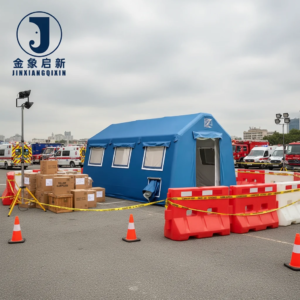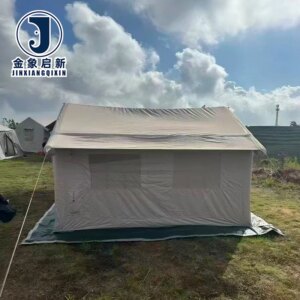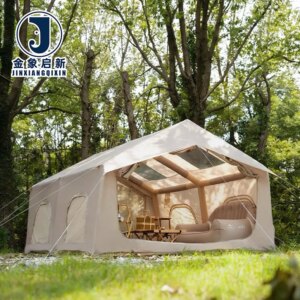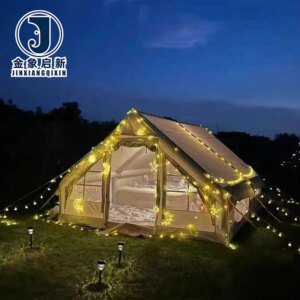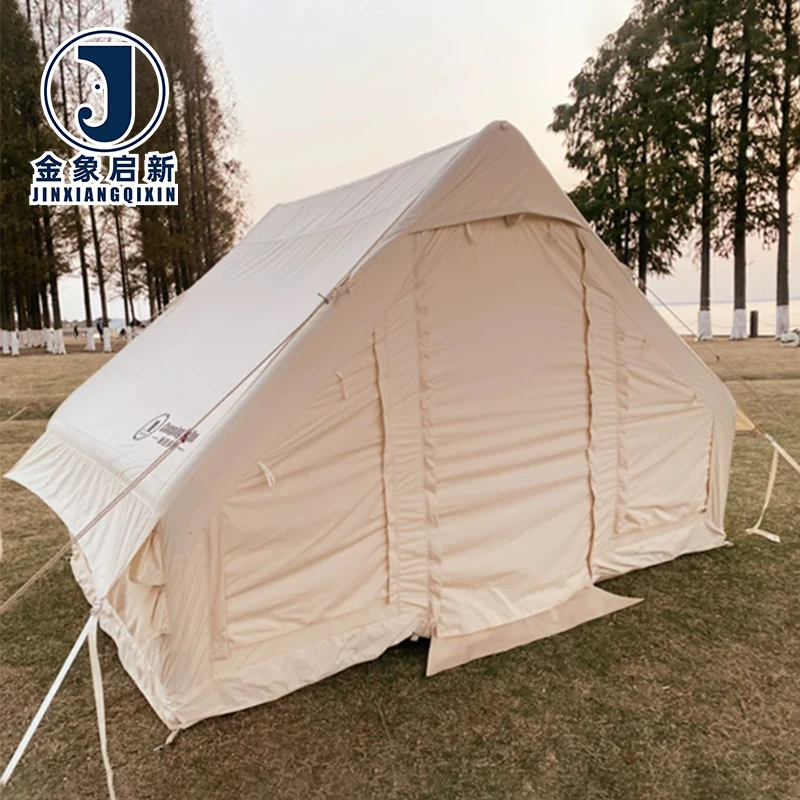
Technical Specifications
| Parameter | Value |
|---|---|
| Product Type | Inflatable Tent |
| Core Material | PVC tarpaulin |
| Capacity | 2–8 person configurations |
| Season Rating | 4-season design |
| Waterproof Rating | 3000mm water column |
| UV Resistance | 4000 hours accelerated aging test |
| Tear Strength | Tested per ASTM D751 standard |
| Seam Construction | Heat-sealed airtight seams |
| Pressure Retention | 24-hour pressure retention testing |
| Setup System | Quick automatic opening |
| Customization | OEM & ODM, sample customization, pattern printing |
| Certifications | ISO 9001, ISO 14001, ISO 45001, CE |
Application Suitability
| Application | Exposure & Requirement |
|---|---|
| Industrial fieldwork base camps | Continuous outdoor exposure, wind loading, rapid deployment and relocation cycles |
| Construction site temporary storage shelters | Abrasion from equipment movement, dust ingress prevention, weather shielding for materials |
| Outdoor event management mobile facilities | Frequent inflation and deflation, public safety compliance, branding and visual consistency |
| Year-round commercial outdoor deployment | Seasonal temperature fluctuation, sustained UV exposure, precipitation and humidity resistance |
Why Batch Consistency Matters More Than Stated Specifications for Inflatable Tent Fabric
A specification sheet only proves what was promised — batch inspection proves what was actually delivered.
Fleet operators and transport equipment builders sourcing an Inflatable Tent for truck and transport applications often discover that material arriving on site behaves differently from the approved sample. Seam porosity varies. Coating adhesion weakens at the fold lines where the structure flexes during inflation. Colour shifts between rolls become visible once multiple units are deployed side by side at a base camp or event venue [NEED_CITE: batch-to-batch coating weight variation in PVC tarpaulin production]. These inconsistencies do not show up in a single-sample approval process. They emerge only when volume production meets real field conditions, and by then the project timeline is already compromised.
Airtight Seam Integrity Under Repeated Inflation Cycles
The structural reliability of any inflatable shelter depends on its seams holding pressure through hundreds of inflation and deflation cycles. Heat-sealed airtight seams on this Inflatable Tent are subjected to 24-hour pressure retention testing, confirming that the bond between coated fabric panels maintains its seal under sustained internal pressure. For commercial operators deploying units across multiple sites, this testing protocol reduces the risk of mid-operation deflation that would otherwise require emergency repair and project downtime.
Fabric Performance Across Seasonal Extremes
A 4-season Inflatable Tent for truck and transport or field camp use must tolerate both high-temperature softening and low-temperature brittleness without losing structural coherence. The PVC tarpaulin used here carries a waterproof rating tested to 3000mm water column and UV resistance verified through 4000 hours of accelerated aging. These documented metrics allow procurement teams to evaluate suitability against their specific climate data rather than relying on generic durability claims [NEED_CITE: accelerated UV aging test correlation with real-world exposure for PVC coated fabrics].
Reading the Specification Sheet Beyond the Headline Numbers
Tear strength tested per ASTM D751 provides a standardized measure of how the fabric resists the propagation of a tear once initiated — a critical factor for inflatable structures where a small puncture from site debris can escalate under internal pressure. The 3000mm water column rating addresses hydrostatic pressure from sustained rainfall and ground moisture contact. The 4000-hour accelerated aging result indicates how the PVC compound resists degradation from solar radiation over extended deployment. Together, these three data points give technical buyers a basis for comparing this Inflatable Tent manufacturer’s output against project-specific environmental loads, rather than evaluating each metric in isolation.
The Hidden Cost of Specifying on Price Alone
When procurement decisions focus primarily on unit cost, the consequences surface in the field. Coating adhesion that barely passes minimum thresholds fails at the heat-sealed seams after a few inflation cycles, because the bond line is where flexing concentrates [NEED_CITE: seam failure mechanics in heat-welded PVC inflatable structures]. Fabric that tests adequately on a single roll but drifts below specification across a production run leaves some units underperforming while others hold up — an inconsistency that undermines fleet-wide reliability and forces selective replacement at significant logistical expense.
What This Supply Chain Delivers for Commercial Buyers
Three full production lines and 36 sets of professional processing equipment provide the capacity to fulfil volume orders for commercial inflatable tent deployments without compressing lead times. A 10-technician R&D team handles custom dimensions, pattern printing, and sample development, enabling OEM and ODM configurations to be validated before bulk production commits. Dedicated QA and QC staff conduct full-process inspection, with 100% pre-shipment checks against the order specification. Nearly 30 years of focused coated fabric production underpins process control over coating weight consistency and heat-seal parameters. ISO 9001, ISO 14001, ISO 45001, and CE certifications support compliance documentation for international market entry.
Documentation & Verification
- Material specification sheet confirming PVC tarpaulin composition, capacity rating, and coating parameters per order
- Batch-specific test report covering waterproof rating, UV aging results, and tear strength data
- Heat-seal inspection record documenting 24-hour pressure retention test results per production batch
- ISO 9001, ISO 14001, ISO 45001, and CE certificates matching the shipment documentation package
- Sample approval record confirming custom dimensions and branding before bulk production release
Fabrication, Handling & Storage
- Heat-sealed seams require calibrated temperature and dwell time settings matched to the PVC tarpaulin coating thickness
- Store rolls and finished units flat or loosely rolled to prevent permanent creasing in the coated fabric
- Avoid dragging units across abrasive surfaces during deployment to protect the PVC coating layer
- Clean with mild detergent only; solvent-based cleaners may compromise the coating surface and seam adhesion
- Field repairs should use compatible PVC adhesive and patch material matching the base fabric specification
Before You Request a Quote
Provide your deployment environment details — climate zone, expected wind loads, and seasonal temperature range — along with the required capacity and unit dimensions. Specify any pattern printing, branding, or colour requirements for your fleet or event identity. Confirm whether your target market mandates specific fire safety or compliance certifications, so the correct documentation can be prepared with your Inflatable Tent manufacturer quotation.
Frequently Asked Questions
Q: How is UV resistance verified for this inflatable tent fabric?
A: The PVC tarpaulin undergoes 4000 hours of accelerated aging testing to evaluate resistance to UV degradation. This laboratory protocol simulates extended solar exposure and provides a documented basis for assessing outdoor durability. For projects in extreme radiation environments, request the specific test report to evaluate suitability against your local conditions.
Q: How is batch-to-batch colour consistency controlled across a multi-unit order?
A: Each production batch is monitored for colour consistency against the approved reference standard. Pre-shipment inspection includes visual comparison across rolls to detect variation before dispatch. For fleet deployments where units are positioned side by side, request the batch inspection record to confirm colour uniformity across your order.
Q: Can I order custom dimensions and branding for my commercial deployment?
A: OEM and ODM customization is supported, including custom capacity configurations, pattern printing, and branding. A sample is developed and submitted for your approval before bulk production begins. Provide your dimensional requirements and artwork files during the inquiry stage to receive a design verification report with your quotation.
Q: What documentation accompanies each commercial shipment?
A: Every order ships with a material specification sheet, batch-specific test reports covering waterproof rating and UV aging data, a heat-seal pressure retention inspection record, and the applicable ISO and CE certificates. Additional compliance documentation can be prepared to meet specific market entry requirements upon request.