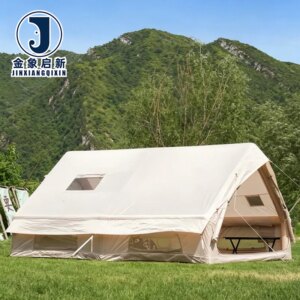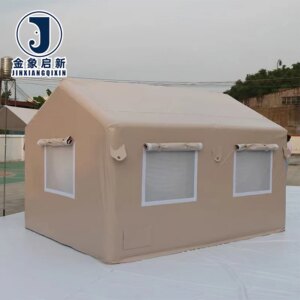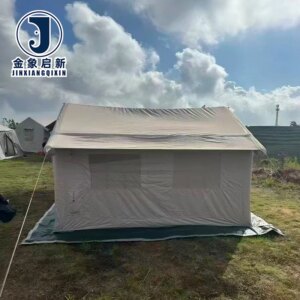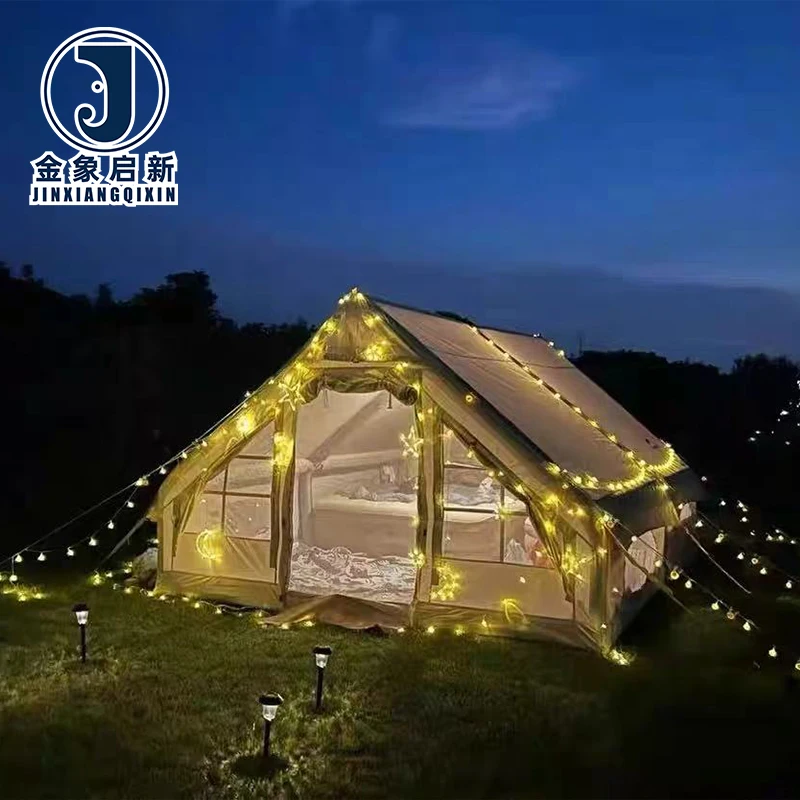
Coating Weight Control — our Inflatable Camping Tent uses PVC coated fabric with strict GSM verification at every production stage, matching the coating weight to the quick-deploy structural demands of rapidly inflated shelters.
Technical Specifications
| Parameter | Value |
|---|---|
| Product Type | Inflatable Tent Fabric |
| Core Material | PVC coated fabric |
| Capacity | 4-6 Person |
| Key Performance | Waterproof, tear-resistant |
| Fire-Retardant Treatment | Available in fire-retardant grades — confirm the grade required for your market |
| Anti-Static Treatment | Anti-static treatment available — verify the standard required for your site |
| UV Resistance | UV-resistant treatment applied — test basis available on request |
| Customization | OEM & ODM, sample customization, pattern printing |
| Production Lines | 3 full production lines |
| Processing Equipment | 36 sets of professional processing equipment |
| R&D Team | 10 technicians |
| Standards | ISO9001, ISO14001, ISO45001, CE |
Application Suitability
| Application | Exposure & Requirement |
|---|---|
| Commercial outdoor events | Repeated inflation/deflation cycles, public foot traffic, UV exposure, rapid deployment between venues |
| Construction site temporary housing | Dust, debris impact, prolonged sun exposure, wind loading on inflated beams |
| Disaster relief temporary shelters | Immediate deployment under adverse weather, waterproof integrity, transport abrasion during logistics |
| Emergency response facilities | Quick automatic opening requirement, fire safety compliance on site, frequent relocation |
| Equipment storage near vehicle staging | Puncture risk from stored machinery, moisture ingress, thermal fluctuation across seasons |
Why "Quick Deploy" Fails When the Fabric Cannot Keep Up
An inflatable tent is only as fast as its weakest seam under inflation pressure.
Fleet operators and emergency response teams specify Inflatable Tent Fabric for truck and transport scenarios where minutes matter. Yet a recurring failure pattern appears: the fabric body holds, but welded seams at the inflation beams split under repeated pressurisation cycles. The root cause is often a mismatch between the coating adhesion strength and the cyclic stress the beam joints endure [NEED_CITE: tensile and tear test methods for coated fabrics per ISO 1421]. When the coating does not bond fully to the base fabric at the weld zone, the seam delaminates long before the main panel shows any sign of wear. This is not a design flaw — it is a material specification gap that only surfaces after the third or fourth deployment.
Seam Integrity Under Cyclic Inflation Pressure
Inflatable beam structures place concentrated stress at every welded junction. Each inflation cycle flexes the PVC coated fabric at these points, demanding coating adhesion that survives repeated bending without micro-cracking. Our Inflatable Camping Tent manufacturer approach controls coating weight and adhesion at the production stage, so the weld zone receives the same bond strength as the main panel. This matters most when ambient temperature swings cause the air pressure inside the beams to fluctuate, adding fatigue cycles beyond what the initial inflation alone would produce.
Weather Resistance Across Four-Season Deployment
Outdoor commercial events and construction sites do not pause for seasonal change. The PVC coated fabric used in these inflatable shelters must resist UV degradation during summer exposure while remaining flexible enough for inflation in cold conditions. The UV-resistant treatment applied to this fabric addresses prolonged sun exposure, though the specific test basis should be confirmed against your regional compliance requirements [NEED_CITE: UV degradation test protocols for PVC coated technical textiles]. Fire-retardant grades are available for sites where safety regulations demand certified materials, and the applicable grade must be matched to the jurisdiction enforcing the project.
Reading the Specification Sheet Beyond the Headline Numbers
GSM alone tells you how much coating is on the fabric, not how well it is bonded to the base yarn. A heavier coating can actually reduce tear resistance if the base fabric denier and weave density are not proportionally increased. The relationship between coating weight, base fabric construction and finished tensile strength determines whether an inflatable beam will hold pressure or stretch and deform over time. Similarly, the coating method — whether knife-over-roll, laminating or calendering — directly affects peel strength at welded seams, which is the most common failure point in inflatable tent structures [NEED_CITE: coating method impact on peel strength in PVC technical fabrics]. Surface finish selection, glossy or matte, influences cleaning ease after site use and the adhesion quality of any pattern printing applied for branding. Fire-retardant chemistry must be selected to match the classification system enforced at the deployment site, as different markets reference different test standards.
What Happens When the Wrong Grade Ships to Site
Receiving inflatable tent fabric that looks correct on the roll but fails site inspection because the fire-retardant grade does not match local building safety codes is a recurring procurement problem. The cost is not limited to the material itself — it includes the delayed event schedule, the emergency re-order at premium freight rates and the reputational damage with the end client [NEED_CITE: fire classification standards for temporary structures in commercial venues]. Similarly, UV treatment claimed without a verifiable test result can lead to premature fabric degradation, showing as surface chalking or loss of tensile strength after only one season of outdoor deployment. Batch colour inconsistency across rolls becomes visible only when multiple inflated units stand side by side at an event, turning a material issue into a client-facing embarrassment.
Why Procurement Teams Source This Fabric Here
Deep process control over coating weight and adhesion means the PVC coated fabric arriving on your dock matches the specification agreed at the sample stage — verified through dedicated QA/QC inspection at every production step. Three full production lines and 36 sets of professional processing equipment provide the capacity to fulfil bulk orders for large-scale event fleets or multi-site construction deployments without sacrificing lead time reliability. The 10-person R&D team handles material selection, custom sizing and pattern printing development, producing samples within days so you can validate performance before committing to mass production. Every shipment undergoes 100% pre-shipment inspection, catching seam weakness or coating inconsistency before the rolls leave the facility. ISO9001, ISO14001, ISO45001 and CE certifications are not wall decorations — they govern the documentation and traceability that accompany every order.
Documentation & Verification
- Material specification sheet stating coating type, base fabric construction and treatment claims per roll
- Fire-retardant and anti-static test reports provided when the applicable grade is specified at order
- Pre-shipment inspection record confirming seam strength and fabric integrity before dispatch
- ISO9001, ISO14001, ISO45001 and CE certificates included in the standard documentation package
- Roll packing list with individual roll identification for traceability through deployment
- Certificate of origin and customs documentation to support international shipment clearance
Fabrication, Handling & Storage
- Heat weld parameters must match the PVC coating formulation — request the recommended temperature and dwell time before fabrication
- Reinforce inflation beam junctions with additional PVC coated fabric patches to distribute cyclic stress
- Store rolls vertically on pallets to prevent permanent creasing that weakens the coating at fold lines
- Allow cold-stored rolls to reach ambient temperature before unrolling to avoid coating micro-cracking
- Use only PVC-compatible cleaners on the coated surface to preserve the treatment layer integrity
- Field repairs require compatible PVC adhesive and patch material matching the original coating weight
Before You Send the Inquiry
Provide the deployment environment — whether the inflatable tent will serve a recurring event circuit, a fixed construction site or an emergency stockpile — along with the expected inflation frequency and ambient temperature range. Specify the fire-retardant grade or anti-static standard enforced at the target site, as this determines the treatment formulation applied during coating. Indicate whether you require rolls for your own fabrication or finished custom-cut panels with pattern printing, and confirm the colour consistency tolerance across the total order quantity. A sample approval step is available to validate dimensions, coating feel and treatment performance before production begins.
Frequently Asked Questions
Q: What fire-retardant grade applies to inflatable tents used at commercial events?
A: The required grade depends on the jurisdiction governing the event site. Our PVC coated inflatable tent fabric is available in multiple fire-retardant grades, and the applicable test standard must be confirmed before production. Provide your local code reference so we match the treatment and supply the corresponding test report with your shipment.
Q: How is the anti-static treatment verified before the fabric ships?
A: Anti-static treatment is applied during the coating process based on the surface resistance or standard specified at order. We provide the relevant test documentation with each shipment. Confirm the exact standard your site safety plan references so the correct formulation is selected during sample development.
Q: What evidence supports the UV-resistant claim for prolonged outdoor use?
A: UV-resistant treatment is applied to the PVC coated fabric, and the test basis supporting this claim is available on request. We recommend reviewing the test report against your expected deployment duration and regional solar exposure conditions before approving the specification for bulk production.
Q: What are the minimum order requirements for custom dimensions and pattern printing?
A: Custom sizing and pattern printing on inflatable tent fabric carry minimums that vary by colour, print complexity and total area. Share your project dimensions, print artwork and total quantity so we can confirm the applicable minimum and provide a sample for your approval before mass production begins.
Q: How are welded seams validated at high-flex inflation points?
A: Welded seams at beam junctions undergo inspection during the 100% pre-shipment quality check. The PVC coating adhesion and weld parameters are controlled to ensure seam durability matches the main panel strength. Sample approval includes seam testing so you can verify performance at high-flex points before committing to the full order.