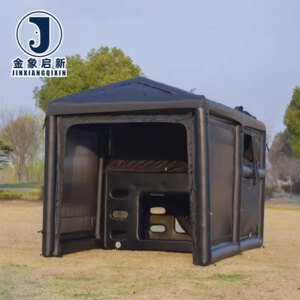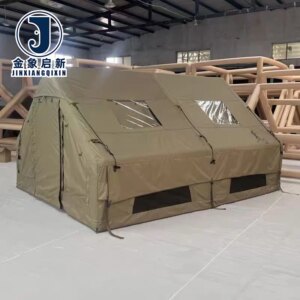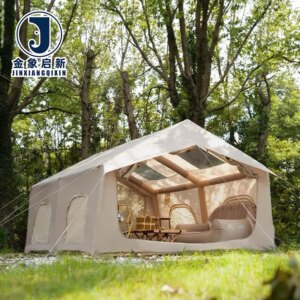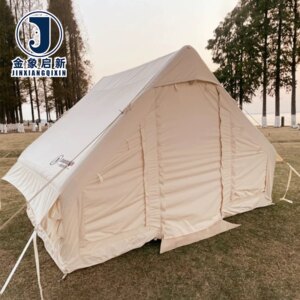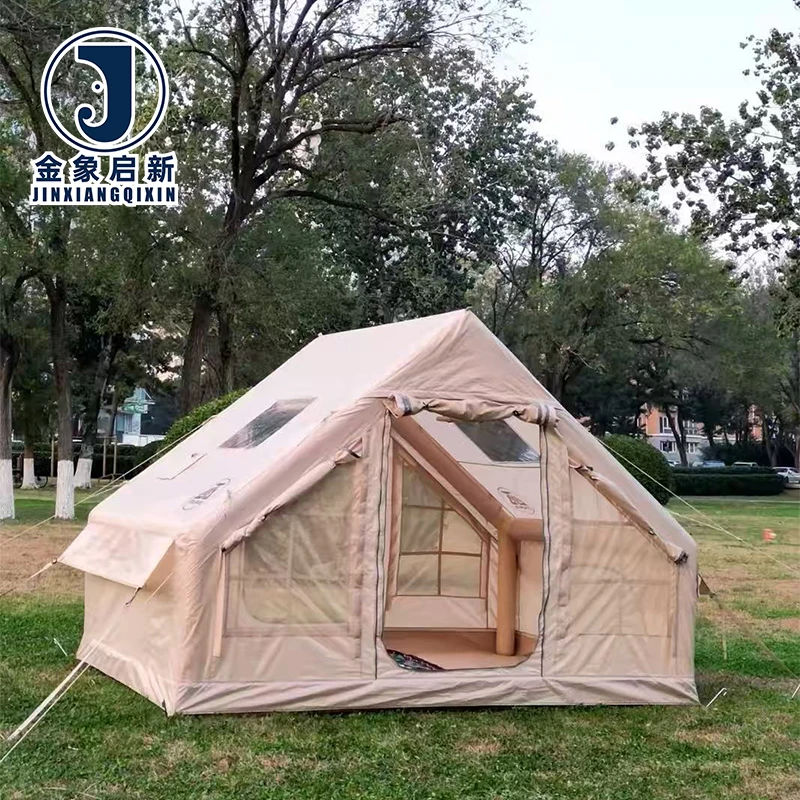
Production Line Capacity — 3 full production lines and 36 sets of equipment supporting bulk inflatable tent fabric orders with reliable delivery schedules.
Technical Specifications
| Parameter | Value |
|---|---|
| Product Type | Inflatable Tent |
| Core Material | PVC tarpaulin |
| Waterproof | Yes |
| UV-Resistant | Available with UV treatment — confirm test basis required for your deployment environment |
| Tear-Resistant | Yes |
| Flame Retardant | Available in flame retardant grades — confirm the grade required for your market |
| Anti-Static | Available with anti-static treatment — confirm standard required for your application |
| Product Forms | Single layer construction, extended type |
| Deployment Method | Quick automatic opening |
| Customization Service | OEM & ODM, sample customization, pattern printing |
| Standards | ISO9001, ISO14001, ISO45001, CE |
Application Suitability
| Application | Exposure & Requirement |
|---|---|
| Temporary site offices on transport corridors | Constant weather exposure, wind loading on inflatable frame, rapid deployment between sites |
| Mobile command centers at logistics hubs | UV exposure on open tarmac, frequent inflation and deflation cycles, interior equipment staging |
| Storage shelters for transport equipment | Rain and dust ingress prevention, abrasion from handling machinery, extended outdoor standing |
| Emergency response staging areas | Immediate deployment under adverse weather, fire-retardant compliance for occupied spaces |
| Outdoor industrial events | High visibility branding requirements, crowd safety compliance, repeated setup and teardown |
Why Inflatable Tent Fabric Selection Determines Deployment Reliability
The difference between a structure that holds pressure on a windy site and one that sags before the shift ends comes down to fabric specification, not marketing claims.
Fleet operators and transport contractors often specify inflatable tent fabric based on a single data point — weight per square meter — and then discover on site that the material cannot sustain internal pressure under wind load or that welded seams part before the fabric itself shows wear. A PVC inflatable tent aftermarket supplier that documents base fabric denier, coating adhesion, and seam test results eliminates this uncertainty. When the fabric arrives without verified material data, the structure may inflate correctly in the yard but fail at the flex points once exposed to crosswinds or temperature swings [NEED_CITE: tensile and tear test methods for coated fabrics per ISO 1421].
Pressure Retention and Coating Adhesion on Moving Operations
Inflatable structures depend on sustained air pressure to maintain their shape. The PVC tarpaulin core used in this inflatable tent fabric provides a continuous coated barrier that limits air migration through the fabric body. Single layer construction reduces total weight, making the structure practical for transport between job sites on flatbed trailers or within fleet vehicles. The extended type configuration adds interior volume without requiring additional support frames, which matters when contractors deploy temporary shelters at loading docks or staging areas where floor space is constrained.
Custom Sizing for Fleet and Trailer Integration
Transport equipment builders integrating inflatable shelters into trailer-mounted operations need dimensions that match specific vehicle platforms. This PVC inflatable tent fabric supports OEM and ODM customization, including sample development and pattern printing for fleet identification. When a transport hub requires a mobile command center that fits between existing infrastructure, generic sizing creates gaps at anchor points. Custom sizing ensures the inflatable structure seats correctly against the trailer deck or ground surface, reducing the load on tie-down points during wind events.
Material Behavior Under Repeated Inflation Cycles
Each inflation and deflation cycle flexes the PVC coating at fold lines and weld seams. The coating method and weight determine how well the fabric resists micro-cracking along these stress concentrations [NEED_CITE: coating adhesion and peel strength testing for PVC tarpaulin]. Single layer extended type construction concentrates flex at fewer points compared to multi-layer assemblies, which simplifies inspection and repair in the field. Contractors deploying these structures across multiple sites within a season benefit from a fabric that can be folded, transported, and re-inflated without requiring seam re-welding after each move.
Reading the Specification Sheet Beyond Weight
Base fabric denier and weave density interact with coating weight to produce the final tear and tensile values. A lighter base fabric with a heavier coating may show acceptable stiffness but tear more easily once a puncture initiates, because the yarn density is insufficient to arrest tear propagation. Coating adhesion — the bond between the PVC layer and the base fabric — governs whether the material delaminates under the cyclic pressure of inflation. Surface finish affects both cleaning in dusty transport environments and the adhesion of printed branding. Fire-retardant grades vary by market, and specifying without confirming the required test standard leads to compliance failures at the site inspection stage [NEED_CITE: DIN 4102 fire classification for building materials].
The Cost of Undocumented Material Claims
When UV-resistant treatment is stated on the quotation but arrives without a supporting test report, the fabric may degrade after a single season of open-road exposure, losing tensile strength at the surface before the base fabric is affected. Flame-retardant claims without a documented grade mean the structure cannot pass the fire safety inspection required for occupied temporary facilities on regulated sites. Batch color variation across multiple tent units within one order becomes visible once structures are deployed side by side at a transport hub, forcing replacement or accepting a mismatched fleet appearance [NEED_CITE: color fastness and batch consistency standards for coated textiles].
Why Procurement Teams Source This Fabric Here
Three full production lines and 36 sets of professional processing equipment handle bulk orders without sacrificing per-roll consistency. A 10-technician R&D team develops samples within days for custom sizing and pattern printing requirements specific to fleet branding. Dedicated QA and QC staff inspect at every production stage, with 100 percent pre-shipment inspection verifying material thickness and waterproof integrity. Nearly 30 years of coated fabric process control governs coating weight accuracy and adhesion reliability. Documentation accompanies every dispatch, including material specification sheets and test reports aligned to the standards your site requires.
Documentation & Verification
- Material specification sheet stating base fabric denier, coating weight, and color reference per roll
- Waterproof test report confirming coating integrity before dispatch
- UV-resistant and flame-retardant test documentation matching the grade specified at inquiry
- Pre-shipment inspection record verifying dimensions and surface quality per unit
- Certificate of origin and customs documentation for cross-border transport deployments
Fabrication, Handling & Storage
- Heat welding parameters should match the PVC coating weight to prevent seam failure at inflation pressure points
- Store rolled fabric upright in dry conditions to avoid permanent creasing that weakens the coating bond
- Use compatible PVC adhesive for field repairs on single layer construction to maintain pressure retention
- Clean with neutral pH detergent to preserve surface finish and printed pattern adhesion
- Allow fabric to reach ambient temperature before unfolding in cold conditions to prevent coating crack
What to Include in Your Inquiry
Provide the specific trailer model or ground footprint dimensions so custom sizing matches your deployment platform. State the fire-retardant or anti-static standard your site requires, along with the expected duration of outdoor exposure. Indicate whether you need finished units with pattern printing for fleet branding or roll stock for in-house fabrication. Specify your annual volume and required lead time to align production scheduling with your deployment calendar.
Frequently Asked Questions
Q: How do I specify exact dimensions for my trailer model or mobile unit?
A: Provide the make, model, and year of the trailer or vehicle platform along with the desired shelter footprint and height. Our R&D team develops a dimensional sample for fitment verification before production begins, ensuring the inflatable structure seats correctly against your specific equipment without gaps at anchor points.
Q: What test basis supports the UV-resistant claims for outdoor exposure?
A: UV-resistant treatment is available with documented test reports. Specify the exposure duration and climate zone for your deployment so we can confirm the appropriate treatment level and provide the corresponding test documentation with your shipment for site compliance review.
Q: How does the pattern printing and sample approval process work for fleet branding?
A: Submit your artwork files and color references at the inquiry stage. We produce a printed sample section for your approval of color accuracy, logo placement, and resolution before full production proceeds, ensuring brand consistency across all inflatable tent units in your order.
Q: How is batch color consistency maintained across multiple tent units?
A: All units within a single order are produced from the same coating batch with color reference checks at each production stage. Pre-shipment inspection includes a side-by-side visual comparison to confirm uniform appearance before dispatch.
Q: What tie-down and anchor point options are available for road and wind loads?
A: Anchor point configuration depends on your deployment surface and expected wind conditions. Specify whether the structure mounts to a trailer deck, concrete pad, or bare ground, and we configure reinforcement at stress points accordingly during the sample approval phase.