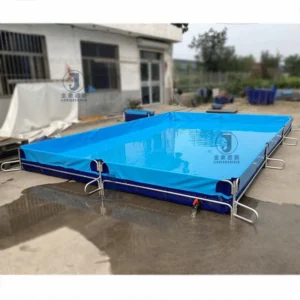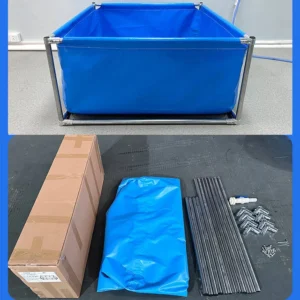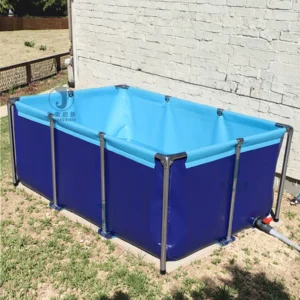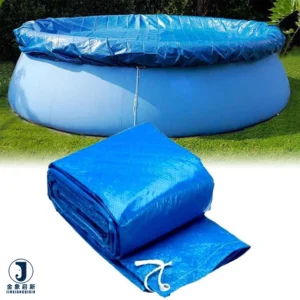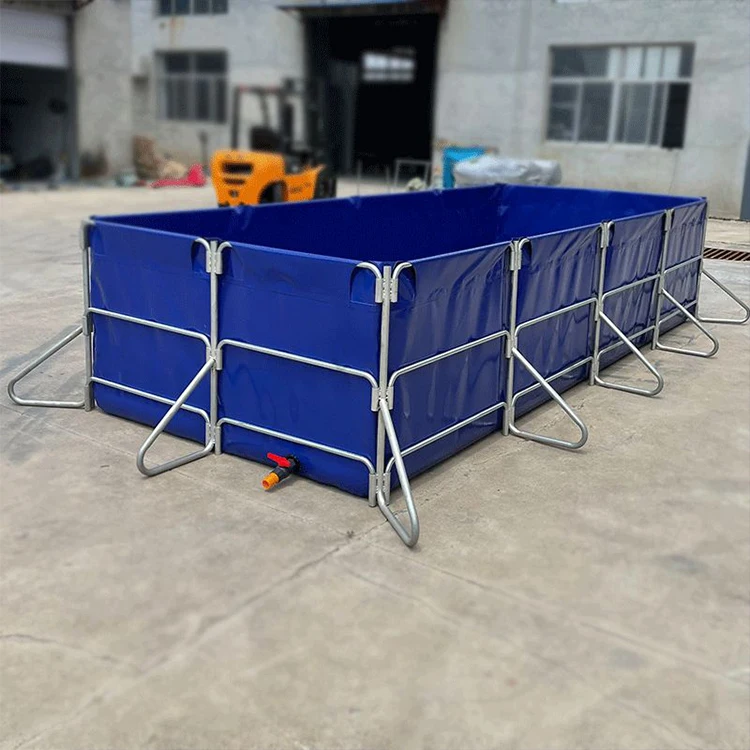
Custom-fit pond containment — every foldable PVC fish pond liner we ship passes a 100% pre-shipment seam integrity check before leaving our facility, ensuring watertight performance from the moment you fill it.
Technical Specifications
| Parameter | Value |
|---|---|
| Product Type | PVC Fish Pond |
| Material | PVC coated tarpaulin |
| Shape Options | Circular / Rectangular |
| Structure | Foldable |
| Application | Fish tank / Fish pond / Aquaculture |
| UV Treatment | Available with anti-UV treatment — confirm grade required for your climate (test basis not stated) |
| Flame Retardant | Available in flame retardant grades — confirm the grade required for your market |
| Certifications | ISO, CE |
Application Suitability
| Application | Exposure & Requirement |
|---|---|
| Commercial fish farming ponds | Continuous water immersion, hydrostatic pressure, algae and biological growth resistance |
| Shrimp and prawn aquaculture | Saline water contact, substrate abrasion, frequent drain-and-clean cycles |
| Hatchery and nursery tanks | Portable foldable containment, water quality sensitivity, rapid deployment |
| Backyard and hobbyist fish tanks | UV exposure in open-air settings, frame anchoring, aesthetic consistency |
| Agricultural water storage | Seasonal filling and draining, soil chemistry contact, puncture from ground debris |
Why Seam Integrity Decides Whether Your PVC Fish Pond Liner Survives Season One
Heat-welded seams, verified under sustained water load, are what separate a liner that holds from one that drains your pond overnight.
A pond liner failure rarely starts in the middle of the fabric. It starts at the weld line — the point where hydrostatic pressure concentrates and the material flexes against the ground or frame. Operators who have lost an entire stock of fish to a slow overnight leak know that the seam is the weakest link in any containment system. [NEED_CITE: hydrostatic pressure distribution on flexible pond liner seams]
When a PVC fish pond tarpaulin is cut, folded, and joined, the heat-welding parameters must match the coating weight and base fabric denier exactly. Too little heat and the bond peels; too much and the PVC degrades, creating a brittle zone that cracks when the pond is drained and refilled. We have seen heavy-grade coated rolls fail at the weld line long before the fabric body shows any wear, which is why our QA process inspects every seam before dispatch. [NEED_CITE: thermal welding parameters for PVC coated fabric per ISO standards]
Containment That Ships Flat and Sets Up Fast
A foldable PVC fish pond liner collapses for compact container loading, reducing freight volume compared to rigid tank alternatives. On site, two workers can unfold and position the liner over a prepared base or inside a frame structure without heavy equipment. The foldable design also means replacement liners can be kept in storage and deployed within hours if an existing pond needs emergency relining.
Shape Configurations Matched to Stocking Plans
Circular ponds distribute water pressure evenly around the perimeter, reducing stress concentration at corners — a practical advantage for deeper water columns. Rectangular configurations maximise ground coverage on flat sites and align with row-based feeding and aeration layouts common in commercial shrimp farming. Both shapes are available in custom dimensions, cut and welded to the exact measurements your site requires.
Reading the Spec Sheet Beyond the GSM Number
GSM tells you the total weight per square metre of the PVC coated tarpaulin, but it does not isolate how much of that weight comes from the base fabric versus the coating. A liner with a heavier coating but a lighter base fabric may feel substantial yet tear more easily under substrate abrasion than a balanced construction. The base fabric denier and weave density determine tensile and tear strength, while the coating thickness governs waterproofing and chemical resistance. [NEED_CITE: relationship between base fabric denier and tear strength in coated fabrics per ISO 1421]
For pond liners, the coating must fully encapsulate the base yarns to prevent water wicking through exposed fibres at cut edges. The heat-welding process fuses the PVC coating layers across the seam, creating a homogeneous bond that holds under continuous hydrostatic load — a critical difference from stitched seams where needle holes become leak paths.
The Cost of Overlooking Weld Quality Before Installation
Operators who specify material grade carefully but skip seam inspection often discover failures only after filling the pond. A micro-gap in the weld, invisible to the eye, opens under water pressure and creates a slow leak that drops water levels over days. By the time the loss is noticed, fish stress from declining oxygen levels and temperature instability has already compounded the damage. [NEED_CITE: leak detection challenges in large-volume flexible pond liners]
Colour variation between liner panels is another sourcing risk. If two rolls from different production batches are welded together, the colour difference becomes visible once the pond is installed and viewed in direct sunlight — a particular concern for operations where aesthetic consistency matters for buyer-facing facilities.
Why Buyers Source Their Pond Liners Here
Our three full production lines and dedicated PVC coating control give us command over coating weight consistency across every metre of tarpaulin produced, so the GSM you see on the material spec sheet is the GSM that arrives at your dock.
The 10-person R&D team develops custom pond dimensions and weld patterns based on your site drawings, producing sample panels within days for your on-site water-holding trial before you commit to a full order.
Every pond liner undergoes dedicated QA at each production stage, with 100% pre-shipment inspection focused on seam integrity — the single most common failure point in flexible containment.
ISO and CE certifications underpin our production documentation, giving you traceable quality records for import compliance and buyer audits.
Sample development covers custom circular and rectangular dimensions, allowing you to verify fit against your frame structure or excavated pond base before bulk production begins.
Documentation & Verification
- Material specification sheet stating GSM, base fabric denier, and coating weight for every liner produced
- Pre-shipment inspection record with seam integrity verification before dispatch
- UV and flame retardant test reports provided for treated grades where applicable
- Roll packing list with individual liner dimensions and batch traceability
- Certificate of origin included for customs clearance at destination port
Fabrication, Handling & Storage
- Heat-weld all seams using temperature settings matched to the PVC coating weight for full bond penetration
- Store foldable liners flat or loosely rolled to avoid permanent crease marks in the coated surface
- Unfold at ambient temperature to prevent cracking of the PVC coating in cold conditions
- Avoid dragging liners across sharp substrate — puncture repair requires PVC-compatible adhesive patches
- Clean biological growth with mild detergent; solvent-based cleaners may degrade the PVC coating layer
- Inspect reinforced edges and anchoring points after each drain-and-refill cycle for stress fatigue
What to Include When You Request a Quote
Tell us the pond shape — circular or rectangular — along with the exact diameter or length-by-width measurements, plus the intended water depth so we can recommend the appropriate PVC coated tarpaulin grade. If your site has specific UV exposure conditions or requires flame retardant compliance for local regulations, note that in your inquiry. We also need to know whether you are lining an excavated earth pond, fitting inside a rigid frame, or deploying as a standalone portable tank.
Frequently Asked Questions
Q: How do I verify the liner GSM matches the quoted specification on arrival?
A: Request the material specification sheet before production and use a calibrated scale to weigh a measured sample panel cut from the delivered liner. Divide the weight by the panel area in square metres to calculate actual GSM. Any discrepancy from the quoted value should be raised with the supplier against the pre-shipment inspection record.
Q: Heat-welded versus stitched seams — which holds water longer in a pond?
A: Heat-welded seams fuse the PVC coating layers into a continuous bond, eliminating the needle holes that stitched seams leave in the fabric. For pond liners under continuous hydrostatic load, welded construction prevents the slow leak paths that stitched seams develop over time, particularly at stress points where the liner flexes against the pond floor.
Q: Can I order a custom circular or rectangular pond size?
A: Yes, both circular and rectangular configurations are produced to your exact dimensions. Provide the required diameter or length-by-width measurements along with water depth. Sample panels are developed within days so you can verify fit against your frame or excavated base before committing to the full production run.
Q: What certifications are available for UV-treated pond liners?
A: Anti-UV treatment is available for pond liners destined for outdoor aquaculture exposure. Request the specific UV test report applicable to your market requirements when placing your inquiry. The test report documents the treatment grade and exposure classification to support your compliance documentation.
Q: How are foldable pond liners packed for container shipping?
A: Liners are folded to minimise shipping volume and packed with protective interleaving to prevent surface abrasion during transit. A detailed packing list accompanies each shipment, listing individual liner dimensions, batch numbers, and gross weight per package for receiving verification at your warehouse.