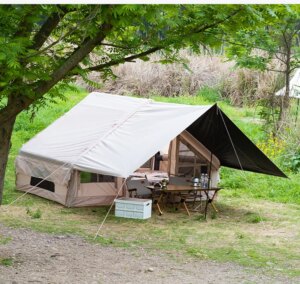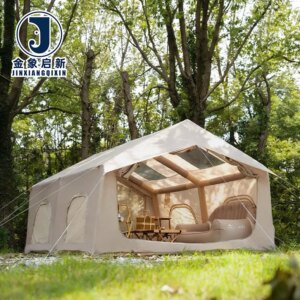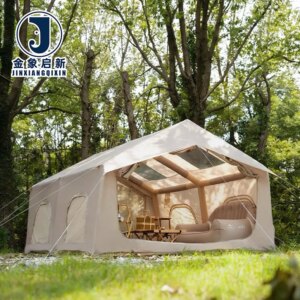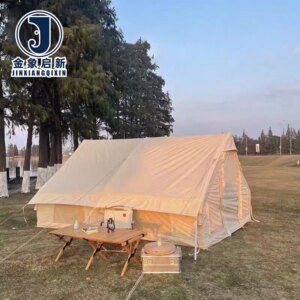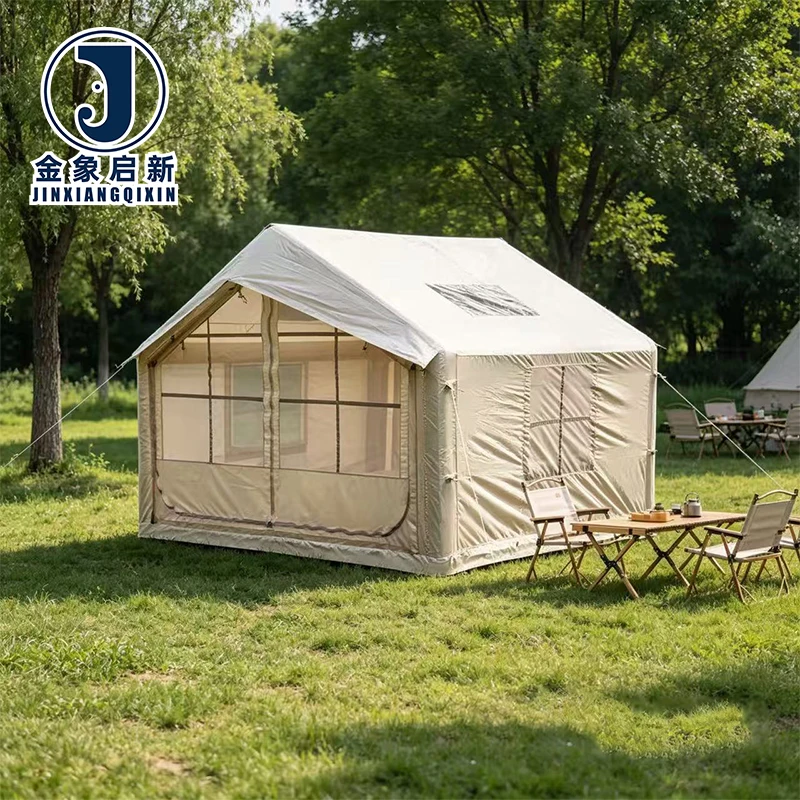
Precision-Coated Fabric Expertise — Deep control over PVC coating adhesion and seam integrity for inflatable tent structures used in commercial transport and outdoor deployment.
Technical Specifications
| Parameter | Value |
|---|---|
| Product Type | PVC Inflatable Camping Tent |
| Core Material | PVC tarpaulin |
| Key Performance | Waterproof, tear-resistant |
| Fire-Retardant Treatment | Available in flame retardant grades — confirm the grade required for your market |
| UV Resistance | Available with UV-resistant formulation — confirm test basis for your deployment environment |
| Anti-Static Treatment | Available in anti-static grades — confirm standard required for your site |
| Product Form | 4–6 Person Quick Automatic Opening Tent |
| Customization | OEM & ODM: sample customization, pattern printing, material selection, product design |
| Production Lines | 3 full production lines |
| Processing Equipment | 36 sets of professional processing equipment |
| Facility Area | 9,180 m² |
| R&D Team | 10 technicians |
| Certifications | ISO9001, ISO14001, ISO45001, CE |
Application Suitability
| Application | Exposure & Requirement |
|---|---|
| Fleet roadside emergency shelters | Constant road vibration, diesel particulates, repeated pack-and-deploy cycles, rain exposure |
| Transport yard loading bay covers | Forklift abrasion, wind uplift, standing water, dust and gravel impact |
| Commercial event pavilions | Crowd wear, UV exposure over multi-day installations, branded print visibility |
| Mining and field service base camps | Remote deployment, abrasive soil contact, compliance with site safety protocols |
Why PVC Inflatable Tent Fabric for Transport and Outdoor Cover Demands More Than a Brochure Claim
A tent fabric that fails at the seam after two deployments is not a material failure — it is a specification failure.
When fleet operators source inflatable shelters for roadside crew rest or emergency staging, the material spec sheet often reads perfectly while the welded seams split under real-world flex loads. The fabric holds, but the heat-welded joints separate at the exact stress point where the inflatable tube bends during inflation and deflation. Generic inflatable tent suppliers quote PVC tarpaulin without distinguishing the weldability of the coating formulation from its tensile rating, leaving buyers to discover seam failures in the field. [NEED_CITE: coated fabric seam strength test methods per ISO 2411]
How Rapid Deployment Demands Shape Material Selection
Fleet and transport operations do not have the luxury of slow assembly. A PVC Inflatable Camping Tent must inflate to full structural rigidity within minutes, meaning the fabric must hold air pressure uniformly across every welded panel without micro-leaks at the seam lines. The coating formulation directly influences how reliably heat-welded joints bond under inflation stress, and inconsistent coating weight across a production roll leads to panels that inflate unevenly.
For transport yard applications where temporary loading bay covers must deploy before a rain front arrives, the automatic opening mechanism places sudden tensile load on the base fabric. Material selection at the inquiry stage — specifying the correct base fabric denier and coating weight for the intended inflation pressure — prevents field failures that no amount of on-site repair can address.
Matching Fire-Retardant and Anti-Static Grades to Site Compliance
Mining camps, aviation maintenance zones, and construction sites each enforce different fire safety and static dissipation standards. A PVC Inflatable Tent Fabric for Transport and Outdoor Cover deployed in a mining ventilation corridor requires documentation that the material meets the specific flame-retardant classification demanded by the site safety officer, not a generic "fire-retardant" label. [NEED_CITE: fire classification standards for temporary structures in mining environments]
Similarly, anti-static treatment matters where combustible dust or fuel vapours are present. The grade of anti-static formulation must align with the site’s electrostatic discharge limits, and the test report must travel with the shipment so that compliance verification happens at the gate, not weeks after installation when an audit is overdue.
Reading the Specification Sheet Beyond the Surface Weight
Coated fabric performance depends on the interaction between base fabric construction and coating weight, not on GSM alone. A heavy coating applied over a low-denier, loosely woven base fabric will crack at the fold points during repeated pack-down cycles, while a lighter coating over a high-density weave delivers better tear propagation resistance. For inflatable tent tubes that undergo constant inflation-deflation flexing, the base fabric’s warp and weft density determines how well the structure resists creasing and permanent deformation.
The coating method — whether knife-over-edge, dip, or calender — affects peel strength at welded seams. Knife-coated fabrics typically deliver stronger weld bonds because the coating penetrates the base fabric weave more uniformly, creating a consistent melt zone during heat welding. Surface finish also plays a role: a glossy finish sheds dirt and water more readily for easier field cleaning, while a matte finish reduces glare for event pavilions where visual comfort matters.
What Happens When the Weld Fails Before the Fabric Does
The most common failure in inflatable tent structures is not fabric puncture or UV degradation — it is seam separation at the inflation tube joints. When the coating formulation does not match the heat-welding parameters used during fabrication, the weld line becomes the weakest point in the entire structure. Under inflation pressure, stress concentrates at tube bends and valve attachment points, and an under-performing weld splits open while the surrounding fabric remains intact.
For fleet operators who depend on these shelters for roadside emergencies, a seam failure during deployment turns a quick-setup solution into an unusable liability. Batch inconsistency in coating weight across a production run compounds the problem: panels welded with identical machine settings behave differently because the coating thickness varies from roll to roll. [NEED_CITE: peel adhesion and weld strength variability in PVC coated fabrics]
Why Procurement Teams Source Inflatable Shelter Fabric Here
The 10-person R&D team develops samples within days for custom inflatable tent dimensions, pattern printing, and material selection — critical when a fleet needs shelters sized to a specific trailer footprint and rigging configuration.
Three full production lines and 36 sets of professional processing equipment support bulk capacity with consistent coating weight across every roll in an order, reducing the seam variability that causes weld failures in the field.
Dedicated QA and QC staff inspect at every production stage with 100% pre-shipment verification, catching coating inconsistencies and dimensional deviations before they reach the buyer’s warehouse.
Custom sizing and printing are handled in-house, so inflatable shelters arrive patterned to the exact footprint, inflation port locations, and branding requirements specified at the inquiry stage — not adapted from a generic catalogue size.
Full documentation packages accompany every dispatch, including material specification sheets, test reports for applicable treatments, and customs support paperwork for cross-border procurement.
Documentation & Verification
- Material specification sheet stating base fabric construction, coating type, and colour reference per roll
- Test report for UV-resistant and flame-retardant grades where specified in the purchase order
- Pre-shipment inspection record signed by dedicated QA/QC staff confirming dimensional accuracy
- Certificate of origin and customs documentation for international inflatable tent fabric shipments
- Roll packing list with batch traceability for warranty and re-order reference
Fabrication, Handling & Storage
- Heat-weld parameters must match the specific PVC coating formulation to maintain seam integrity across inflatable tube joints
- Store rolls vertically on pallets to prevent flat-spot creasing that weakens the coating at fold lines
- Use compatible PVC adhesive for field repairs on punctured inflatable panels to preserve coating bond
- Allow cold-stored fabric to reach ambient temperature before inflation to avoid coating crack at low-temperature flex points
- Cut pattern pieces accounting for weld seam allowance to maintain airtight inflation chamber dimensions
- Clean with non-solvent detergent to protect the PVC surface treatment and printed branding layers
Start Your Inflatable Shelter Fabric Inquiry
Specify the deployment environment — roadside, transport yard, event site, or industrial camp — along with the expected frequency of inflation and pack-down cycles. State the fire-retardant classification and anti-static standard required by your site safety regulations, and confirm whether you need finished tents sized to a specific footprint or roll stock for your own fabrication line. Include your colour reference, printing requirements, and annual volume so that the quotation reflects production scheduling and material availability accurately.
Frequently Asked Questions
Q: What custom sizing and MOQ options are available for inflatable shelters?
A: Inflatable tents are produced to your specified dimensions, inflation port placements, and rigging configurations. Minimum order quantities vary depending on the level of customization — standard sizes in stock colours carry lower minimums, while fully custom patterns with branded printing require larger batch commitments to maintain coating consistency across the production run.
Q: Which fire-retardant grades are available, and how do they align with site regulations?
A: Flame-retardant treatment is available in multiple grades to match different market requirements. Specify the fire classification standard enforced at your deployment site — whether mining, aviation, or construction — and the relevant test report will be provided with the shipment documentation to support on-site compliance verification.
Q: What is the UV test basis, and what outdoor service life can be expected?
A: UV-resistant formulation is available for prolonged outdoor exposure. The specific test basis and expected performance duration depend on the grade selected for your climate zone and deployment pattern. Request the applicable test report during the sample approval stage to confirm suitability for your operating environment.
Q: How is colour matching handled for pattern printing and branding?
A: Pre-production samples are developed by the R&D team to confirm colour accuracy against your reference before full production begins. Roll-to-roll colour consistency is verified during in-process QA checks, and the 100% pre-shipment inspection catches any visible deviation before dispatch to prevent side-by-side mismatch on installation.
Q: What construction methods are used for inflatable tube seams?
A: Heat-welded seams are the primary joining method for inflatable tent tubes, with parameters calibrated to the specific PVC coating formulation in use. The base fabric density and coating weight together determine optimal weld temperature and pressure, and in-process QA verifies seam peel strength before the tent proceeds to final inspection and packing.