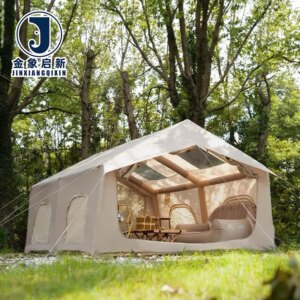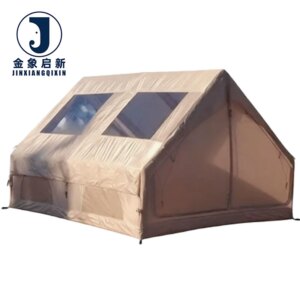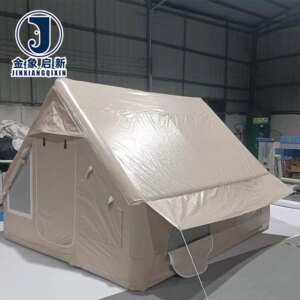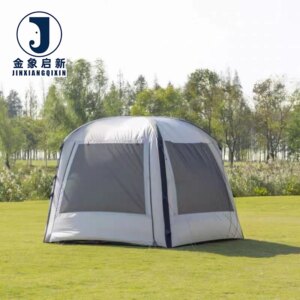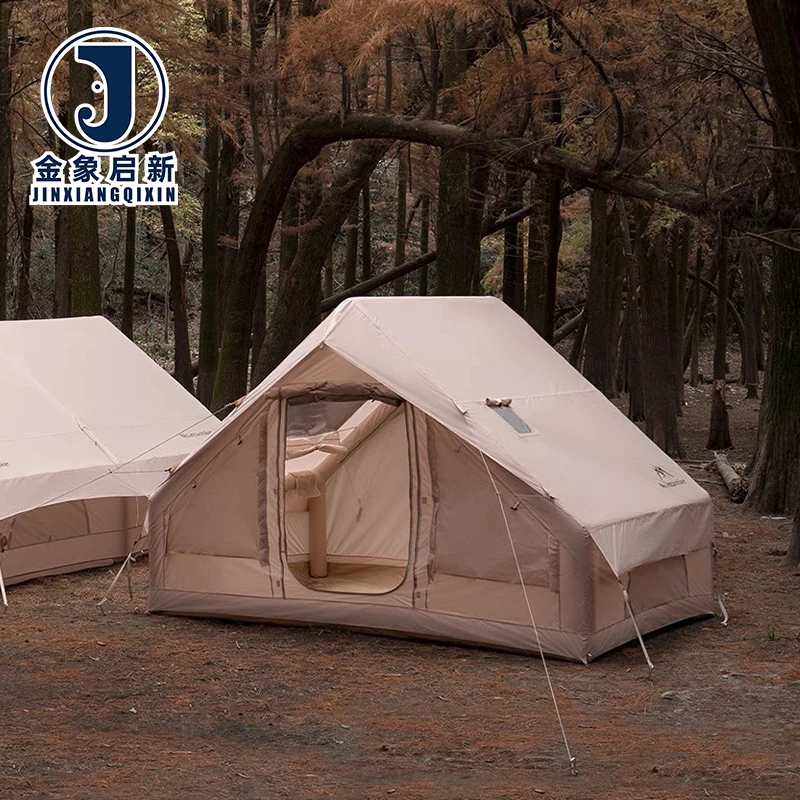
Precision seam engineering — Every welded joint on our inflatable structures is pressure-tested to prevent failures at the exact flex points where repeated inflation cycles concentrate stress.
Technical Specifications
| Parameter | Value |
|---|---|
| Product Type | Inflatable tent |
| Core Material | PVC tarpaulin (PVC knife-coated fabric) |
| Capacity | 4-6 Person |
| Product Form | Inflatable structure with automatic opening mechanism |
| Construction | Single layer |
| Waterproof Performance | Fully waterproof coated construction |
| UV Treatment | UV-resistant (test basis not stated in source) |
| Tear Resistance | Tear-resistant (test basis not stated in source) |
| Flame Retardant Grade | Available in flame retardant grades — confirm the grade required for your market |
| Customization Service | OEM & ODM, sample customization, pattern printing |
| Pressure Retention Testing | 24-hour before packaging |
| Quality Control System | Strict full-process quality inspection with dedicated QA & QC staff |
| Production Facility Area | 9,180 square meters |
| Production Lines | 3 full production lines |
| Processing Equipment | 36 sets of professional processing equipment |
| R&D Team Scale | 10 technicians |
| Standards | ISO9001, ISO14001, ISO45001, CE |
Application Suitability
| Application | Exposure & Requirement |
|---|---|
| Industrial camping accommodations for transport fleet crews | Remote site deployment, repeated inflation-deflation cycles, wind load resistance, rapid setup requirement |
| Temporary site offices for construction projects | Extended outdoor exposure, waterproof integrity, UV degradation risk, frequent relocation |
| Mobile exhibition spaces and equipment storage shelters | Abrasion from ground contact, weather cycling, dimensional stability during inflation |
| Work crew camping deployments in remote mining locations | Dust and particulate exposure, temperature fluctuation, structural fatigue from daily use |
Why Inflatable Tent Seams Fail Before the Fabric Does
When deploying a PVC inflatable tent for transport and outdoor deployment, the most common failure point is not the coated fabric itself but the welded seams where air beams flex under load. Structural integrity depends on seam engineering, not just material thickness.
Fleet operators and remote-site project managers often discover that standard inflatable shelters develop air leaks at beam junctions within the first few deployment cycles. The stress concentrates where the inflatable tube bends under wind load or when crew members lean against the structure. These micro-failures compound with each inflation cycle until the seam delaminates entirely, leaving the structure collapsed during critical operations. [NEED_CITE: typical failure modes in inflatable fabric structures under cyclic loading]
Beam Junction Reinforcement for Repeated Deployment Cycles
The PVC inflatable tent aftermarket supplier market often overlooks that inflatable structures require different seam engineering than static covers. Each air beam junction must distribute inflation pressure across a wider weld area to prevent peel forces from concentrating at a single point. Our approach uses overlapping reinforcement patches at every tube intersection, ensuring that the weld strength exceeds the base fabric tear strength.
Single-Layer Construction and Portability Trade-offs
For fleet crews who relocate weekly between remote project sites, the single-layer PVC knife-coated construction balances durability against pack weight. The material maintains structural rigidity when inflated while remaining manageable for two-person handling during deflation and transport. This eliminates the need for heavy ground sheets or separate inner tent components that slow down camp establishment on tight project schedules. [NEED_CITE: deployment time comparison between single-layer and dual-layer inflatable shelters]
Understanding the Material Specification Sheet
PVC knife-coated fabric differs fundamentally from laminated alternatives in how the coating bonds to the base scrim. The knife-coating process forces PVC paste into the weave interstices under controlled pressure, creating a mechanical lock that resists delamination during heat welding. This matters for inflatable tents because every weld must achieve full coating fusion without creating brittle spots that crack under repeated flexing.
The single-layer construction means the fabric must simultaneously provide waterproofing, UV resistance, and structural air retention. The GSM value and base fabric denier together determine how much inflation pressure the tube can sustain before stretching permanently. Higher denier base yarns resist elongation better under sustained pressure, while the coating weight determines abrasion resistance at ground contact points. Buyers should request the specific GSM and base fabric specification rather than relying on generic "heavy-duty" claims. [NEED_CITE: knife-coating adhesion test methods for PVC coated fabrics]
The Hidden Cost of Underspecified Inflatable Shelters
Procurement teams sourcing PVC inflatable tent aftermarket supplier options often focus on unit price without verifying the pressure retention specification. Units that pass a brief factory inflation test may develop slow leaks at beam junctions after three or four field deployments, forcing crews to carry backup shelter systems or abandon inflatable designs entirely.
Batch inconsistency in coating weight also creates problems when fleet operators order replacement units months later. A slightly lighter coating on the replacement tent may flex differently than the original, causing uneven stress distribution when multiple units are deployed together in a camp configuration. These mismatches accelerate wear at connection points and reduce the usable service life of the entire shelter inventory. [NEED_CITE: coating weight variance impact on inflatable structure performance]
Procurement Verification Beyond the Quotation
Our 9,180 square meter facility operates 3 full production lines dedicated to coated fabric applications, providing the throughput capacity to support fleet-scale deployments without compromising inspection rigor. Each PVC inflatable camping tent undergoes 24-hour pressure retention testing before packaging, catching seam defects that brief inflation checks would miss.
The 10-person R&D team handles dimensional customization and pattern printing for fleet branding requirements, developing samples within days rather than weeks. Dedicated QA/QC staff verify coating adhesion and weld integrity at every production stage, generating batch inspection records that travel with the shipment. This documentation trail supports site compliance audits and customs clearance across multiple jurisdictions.
Documentation & Verification
- Material specification sheet stating base fabric denier, coating weight, and GSM for each production batch
- 24-hour pressure retention test results documented per unit before packaging
- ISO and CE certificates with batch inspection report detailing tensile and waterproof performance data
- UV and flame retardant test reports provided where specific grades are requested and verified
- Certificate of origin and customs documentation package for international fleet deployments
Fabrication, Handling & Storage
- Heat welding parameters must account for PVC knife-coated fabric thickness to achieve full seam fusion without scorching
- Store deflated units in dry, ventilated conditions to prevent coating adhesion between folded layers during extended transport
- Avoid dragging inflated structures across abrasive ground surfaces that compromise the single-layer PVC coating at base contact points
- Clean with mild detergent solutions only — solvent-based cleaners degrade the waterproof coating surface
- Inspect beam junction welds before each inflation cycle to detect early delamination signs at stress concentration points
Requesting a Specification-Matched Quotation
To provide an accurate PVC inflatable tent aftermarket supplier quotation, we need your deployment environment details including typical wind loads, temperature ranges, and expected relocation frequency. Specify whether units require fleet branding or project-specific color coding for site identification purposes.
Confirm your target market’s fire safety classification requirements so we can match the appropriate flame retardant grade to your compliance obligations. Indicate whether you require sample units for field validation before committing to volume production, and provide your annual deployment volume to determine production scheduling.
Frequently Asked Questions
Q: How is seam integrity verified at inflation stress points before shipment?
A: Every inflatable structure undergoes continuous 24-hour pressure retention testing in our facility before packaging. This extended test duration reveals slow leaks at beam junctions and weld intersections that brief factory checks miss. Units failing to maintain specified pressure are rejected and reworked before shipment authorization.
Q: Can tent dimensions be customized to fit specific vehicle or site configurations?
A: Our R&D team develops custom dimensional specifications and pattern printing for fleet branding requirements. Sample units are produced within days for dimensional validation and field testing before bulk production commitment. Custom widths and beam configurations are available to match transport vehicle cargo dimensions.
Q: What UV-resistance test basis supports outdoor exposure claims?
A: UV treatment is applied during coating formulation, but specific test standards vary by target market requirements. Request the applicable UV degradation test report for your regional compliance framework when placing your inquiry. We provide test documentation matching the grade you specify.
Q: What documentation accompanies each batch for site compliance and customs clearance?
A: Each shipment includes material specification sheets, batch inspection reports with tensile and waterproof performance data, ISO and CE certificates, certificate of origin, and 24-hour pressure retention test records. Additional flame retardant or anti-static certifications are provided where specific grades are verified and documented.
Q: What is the minimum order and lead time for OEM color and pattern customization?
A: Minimum order quantities for custom colors and printed branding depend on the specific pattern complexity and production scheduling. Sample development occurs within days for color approval before bulk commitment. Contact our sales team with your color references and annual volume requirements to receive production timeline estimates.