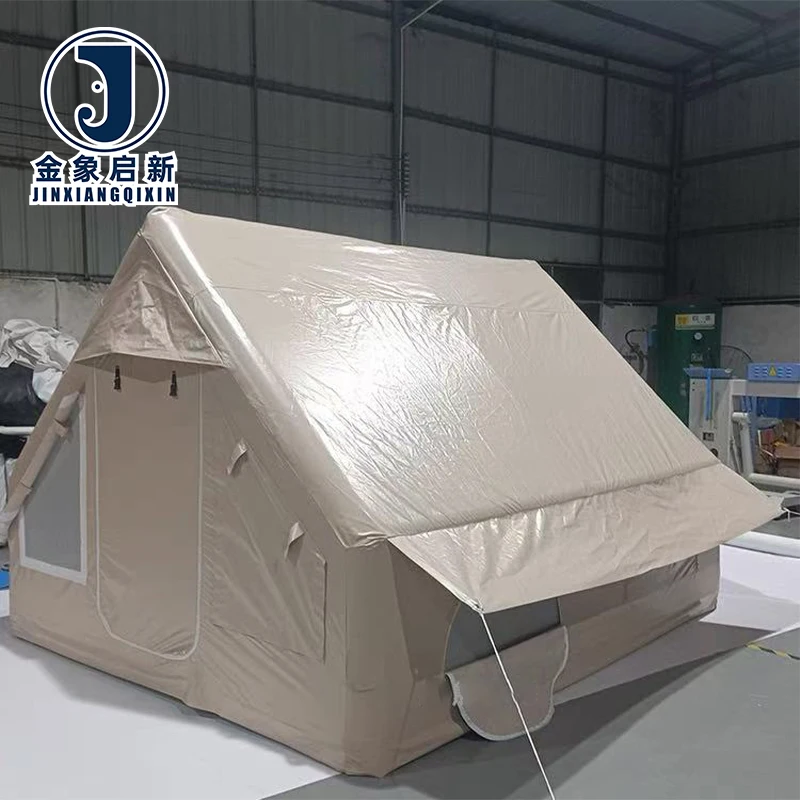
Deep Process Control Over Coated Fabric — verified through batch-specific inspection records and 100% pre-shipment QA on every PVC inflatable tent order leaving our Jinan facility.
Technical Specifications
| Parameter | Value |
|---|---|
| Product Type | Inflatable Tent |
| Core Material | PVC knife-coated tarpaulin |
| Coating Thickness | 0.4mm |
| Customizable Thickness Range | 0.3–0.6mm |
| Capacity | 5–8 person (customizable 3–10 person) |
| Seam Construction | Heat-sealed |
| Construction | Single layer |
| Waterproof | Yes, heat-sealed seams |
| Flame Retardant | EN 13501-1 |
| UV Resistance | Available with UV-resistant additive treatment — confirm the UV aging standard required for your market |
| Anti-static | Available — confirm the surface resistance grade required for your market |
| Color Matching | Pantone codes supported |
| Printing Option | Custom pattern printing for branding |
| Production Facility | 9,180 m² |
| Production Lines | 3 full production lines |
| Processing Equipment | 36 sets |
| R&D Team | 10 technicians |
| Quality Control | 7-point inspection protocol |
| Certifications | ISO 9001, ISO 14001, ISO 45001, CE |
Application Suitability
| Application | Exposure & Requirement |
|---|---|
| Commercial camping gear OEM production | Batch-to-batch material consistency, EN 13501-1 fire compliance for European retail distribution, Pantone-matched branding |
| Outdoor equipment rental fleets | Repeated inflation/deflation cycles, abrasion from ground contact, UV exposure across seasons |
| Expedition and guided adventure operators | Rapid deployment in remote terrain, single-layer waterproof integrity, branded visual identity for tour packages |
| Inflatable tent manufacturing (private label) | Fabric thickness and color customization per SKU, heat-sealed seam durability, full documentation for end-market audits |
Why Coating Thickness Matters More Than Stated Weight for Inflatable Tent Fabric
The structural rigidity of a PVC inflatable tent depends on coating adhesion and thickness consistency, not just the base fabric GSM printed on the data sheet.
When sourcing PVC inflatable tent aftermarket supplier fabric, buyers frequently encounter a gap between the quoted material weight and the actual coated fabric arriving at the warehouse. A 0.4mm PVC knife-coated layer behaves differently from a laminated alternative of the same stated weight: knife-coating penetrates the base weave, locking the coating to the yarn and producing higher peel strength at the heat-sealed seams. Laminated fabrics of equivalent weight can delaminate at the inflation tube junctions after repeated pressurisation cycles [NEED_CITE: peel strength test methods for coated fabrics per ISO 2411]. For inflatable tent fabric used in commercial rental fleets or OEM production runs, the coating method determines whether seams fail before the fabric body does — a failure mode that generates returns, not just repair costs.
Heat-Sealed Seam Integrity Under Inflation Pressure
Every inflation cycle pressurises the seam network across the entire PVC inflatable camping tent structure. The 0.4mm knife-coated fabric specified here allows heat-sealed joints that fuse coating to coating, creating a continuous waterproof bond without stitch holes that admit moisture. For OEM manufacturers producing private-label inflatable tent lines, seam integrity directly affects the pass rate on air pressure retention tests during incoming quality inspection. The 7-point QA protocol includes air pressure retention verification before any unit leaves the production line, catching seal failures that would otherwise surface at the end customer’s campsite.
Fire Compliance Documentation for Cross-Border Equipment Sales
Commercial outdoor gear sold into European markets must carry verifiable flame retardancy data at the product level, not just a generic claim on the supplier’s website. The EN 13501-1 classification assigned to this PVC inflatable tent fabric provides the classification basis that EU-based distributors and safety auditors require. When an inflatable camping tent OEM ships finished goods through customs, the accompanying EN 13501-1 test report is what the compliance officer checks — not the marketing brochure. Buyers targeting other regional standards should confirm the specific fire classification their market demands before committing to a production run [NEED_CITE: EN 13501-1 reaction to fire classification for construction and outdoor products].
Reading the Specifications That Actually Determine Field Performance
Coating thickness, base fabric denier, and seam construction together define how a PVC inflatable tent performs across its service life. The 0.4mm coating thickness provides a rigid air-holding shell, but the underlying base fabric denier and weave density determine tear propagation resistance — a critical factor when a sharp ground surface or a stressed inflation tube initiates a small puncture. Knife-coating, as opposed to calendering or lamination, fills the interstices of the woven base, meaning the coating contributes to tear resistance rather than sitting on top of it as a separate layer. Customizable thickness from 0.3mm to 0.6mm allows OEM buyers to balance pack weight against structural rigidity depending on whether the end product targets backpacking users or base-camp installations. Heat-sealed seams, rather than stitched-and-taped alternatives, eliminate needle holes entirely — a detail that matters when the tent holds positive internal pressure for hours at a time. UV-resistant additive treatment, where specified, must be verified against a stated aging standard to correlate with actual field exposure duration in the target climate zone.
What Specification Gaps Cost After the Order Ships
Selecting PVC inflatable tent fabric on price per kilogram alone creates downstream costs that only surface after the product reaches the end user. Coating thickness that drifts below the specified 0.4mm reduces inflation rigidity and causes the structure to sag under wind load — a complaint that arrives as a warranty claim, not a line-item on the original purchase order. Batch-to-batch colour variation across a multi-SKU OEM order becomes visible when two tents from different production runs stand side by side at a trade show or retail display [NEED_CITE: colour consistency measurement methods for coated fabrics]. Fire-retardant treatment claimed without a batch-specific test report leaves the importer exposed when a market surveillance authority requests documentation. Heat-sealed seams executed at incorrect temperature or dwell time fail at the flex point nearest the inflation valve, where cyclic stress concentrates — and the failure appears identical to a material defect to the end customer [NEED_CITE: heat-seal parameter optimisation for PVC coated fabrics].
Why Production Control Matters for Inflatable Tent Orders
Deep process control over coating weight and adhesion means the 0.4mm PVC knife-coated fabric leaving the line matches the specification sheet submitted at the sample approval stage, roll after roll.
Three full production lines and 36 sets of processing equipment support container-volume orders of PVC inflatable tent fabric without splitting batches across different machines with different calibration histories.
A 10-technician R&D team handles custom sizing from 3-person to 10-person configurations, Pantone colour matching, and pattern printing development — producing pre-production samples within days rather than weeks.
Dedicated QA/QC at every production stage includes the 7-point inspection protocol covering raw material tensile testing, coating thickness verification, seam integrity checks, air pressure retention, UV aging simulation, flame retardancy confirmation, and dimensional accuracy before shipment.
Full documentation packages travel with each dispatch — ISO and CE certificates, material composition data, and batch-specific test reports — so customs clearance and end-market audits proceed without document-request delays.
Documentation & Verification
- Material specification sheet stating 0.4mm coating thickness, base fabric construction, and Pantone colour reference per order
- EN 13501-1 test report issued against the specific production batch, not a generic product family certificate
- ISO 9001, ISO 14001, and ISO 45001 certificates available for supply chain audit submissions
- Pre-shipment inspection record covering air pressure retention, seam integrity, and dimensional accuracy
- Certificate of origin and customs documentation prepared per destination country requirements
- Roll packing list with coating thickness verification recorded per roll before dispatch
Fabrication, Handling & Storage
- Heat-seal temperature and dwell time must be calibrated to the 0.4mm PVC knife-coated thickness; request the recommended parameter sheet before first production run
- Store rolls upright on padded racking to prevent compression marks on the knife-coated surface that transfer to the finished inflatable tent
- Custom Pantone-matched rolls should be stored away from direct sunlight to preserve colour consistency before fabrication
- Pattern printing adhesion should be verified on the specific 0.3–0.6mm coating thickness selected, as ink bonding varies with coating formulation
- Field repair kits should use compatible PVC adhesive matched to the knife-coated surface chemistry for lasting patch adhesion
What We Need to Quote Your Inflatable Tent Project
Provide the capacity range you are targeting — our standard covers 5–8 person units with customization from 3 to 10 person configurations. Specify the coating thickness within the 0.3–0.6mm range that matches your structural rigidity and pack-weight requirements. Confirm the fire classification standard your destination market requires so we align the test documentation accordingly. If your brand requires Pantone-matched colours or custom pattern printing, share the reference codes and print area dimensions with your initial enquiry so the R&D team can prepare accurate samples before bulk commitment.
Frequently Asked Questions
Q: What customization options are available for inflatable tent size, fabric thickness, and branding?
A: The standard configuration is a 5–8 person tent in 0.4mm PVC knife-coated fabric, with customization available from 3 to 10 person capacity and coating thickness between 0.3mm and 0.6mm. Pantone colour matching and custom pattern printing for brand logos or graphics are supported. OEM and ODM development covers size modification, material selection, and full product design through our 10-technician R&D team.
Q: Which fire-retardant standard does the tent fabric meet, and is it accepted in European markets?
A: The fabric meets EN 13501-1, which is the standard reaction-to-fire classification used across European Union member states for construction and outdoor products. If your target market requires a different classification — such as NFPA 701 for North America or a national variant — confirm the specific standard at enquiry stage so we arrange the correct test documentation before production begins.
Q: What UV-resistance test data is provided, and how does it relate to actual outdoor service life?
A: UV-resistant additive treatment is available, but the specific aging standard and exposure duration must be confirmed based on your target climate and intended deployment period. We recommend requesting batch-specific UV aging simulation results from the 7-point inspection protocol rather than relying on a general product claim. Your engineering team can then correlate the test data to the expected field conditions.
Q: How is batch-to-batch colour consistency maintained across large OEM orders?
A: Pantone code references are locked at the sample approval stage, and each production batch is checked against that reference during the 7-point QA protocol. Coating thickness and pigment loading are verified per roll to prevent visible variation when tents from different production runs are displayed or deployed side by side. Pre-production samples are provided for your approval before mass production commences.
Q: What is the sample policy, and can sample costs be credited against a bulk order?
A: Pre-production samples are developed within days for custom requirements including size, thickness, colour, and printing. The sample allows your engineering team to validate seam integrity, inflation performance, and material feel before committing to a batch order. Contact the sales team with your specification to receive the current sample arrangement and lead time for your configuration.