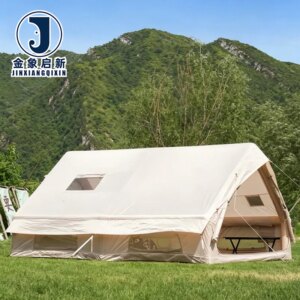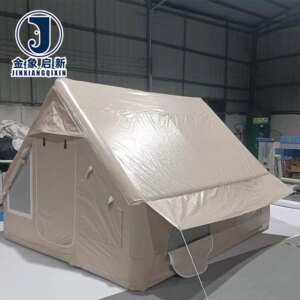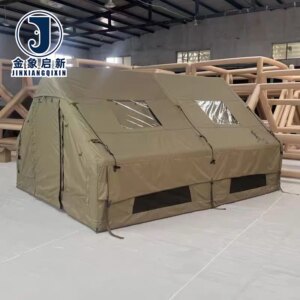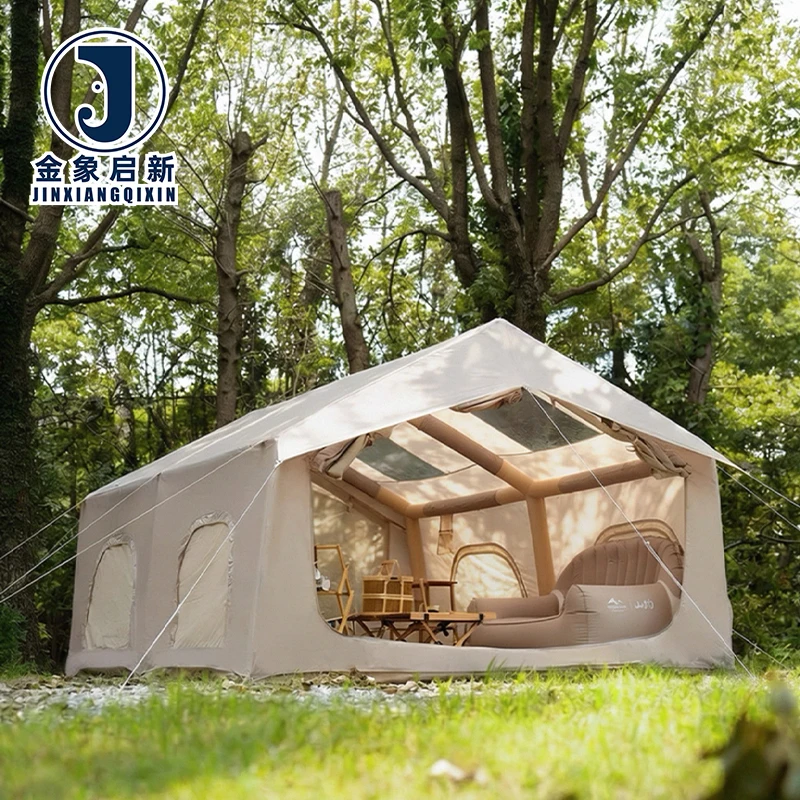
Process-Controlled Coating Expertise — Nearly 30 years focused on coated fabric ensures strict oversight of coating weight and adhesion for inflatable tent materials used in transport and emergency deployment.
Technical Specifications
| Parameter | Value |
|---|---|
| Product Type | Inflatable Tent |
| Core Material | PVC Tarpaulin |
| Product Forms | Quick Automatic Opening, Four-Season Design, Single Layer Construction, Extended Type |
| UV Resistance | Available — test basis available on request |
| Waterproof | Fully waterproof coated construction |
| Tear Resistance | Tear-resistant PVC tarpaulin construction |
| Flame Retardant | Available upon request (grade not stated — confirm the grade required for your market) |
| Anti-Static | Available upon request (standard not stated — confirm the standard required for your site) |
| Customization | OEM & ODM (sample customization, pattern printing) |
| Standards | ISO 9001, ISO 14001, ISO 45001, CE |
Application Suitability
| Application | Exposure & Requirement |
|---|---|
| Temporary site offices at construction projects | Constant UV exposure, wind loading, repeated inflation cycles, site dust and debris abrasion |
| Mobile storage shelters for logistics operations | Road-side weather exposure, frequent relocation, forklift and equipment contact damage risk |
| Emergency response facilities for disaster relief | Rapid deployment under time pressure, unpredictable weather, transport compression during transit |
| Equipment storage under transport fleet operations | Prolonged outdoor standing, moisture ingress prevention, structural integrity during inflation |
Why Tent Fabric Consistency Matters More Than Stated GSM for Fleet Deployments
A single roll that deviates from quoted weight can compromise an entire batch of inflatable shelters on a job site.
When sourcing PVC inflatable tent for truck and transport rapid deployment, procurement teams often anchor decisions on GSM alone. Yet field failures frequently trace back to coating weight variation between rolls rather than the nominal specification. A tent panel that inflates unevenly because one section is lighter than the adjacent panel creates stress concentration at the weld line, accelerating failure precisely where the structure flexes most. Fleet operators managing multiple vehicles or disaster relief coordinators deploying dozens of units cannot afford this inconsistency across a single order [NEED_CITE: tensile and tear test methods for coated fabrics per ISO 1421].
Rapid Inflation Demands Fabric That Holds Shape Under Pressure
The quick automatic opening mechanism places immediate load on every seam and weld point the moment inflation begins. PVC tarpaulin used in this Inflatable Tent for truck and transport rapid deployment must resist stretching beyond its elastic recovery threshold, otherwise the structure sags before it stabilizes. The single layer construction means there is no secondary membrane to compensate if the primary fabric deforms under internal air pressure. Four-season design requirements further demand that the material remains pliable in cold conditions without becoming brittle at the fold lines where the tent compresses during transport.
Sizing to Trailer Footprints and Site Constraints
Generic tent dimensions rarely align with the exact footprint of a specific trailer bed or the clearance envelope of a construction staging area. The OEM and ODM customization capability allows the inflatable tent to be produced in dimensions that match the deployment zone precisely, eliminating the gap between shelter edge and load perimeter where weather ingress typically occurs. Pattern printing and branding options extend beyond aesthetics — high-visibility markings on the exterior support rapid identification across a fleet yard or disaster response staging zone [NEED_CITE: DIN 4102 fire classification for building materials].
Reading the Specification Sheet Beyond the Headline Number
PVC tarpaulin performance in inflatable structures depends on how coating weight, base fabric denier, and weave density interact as a system. A heavier coating does not automatically mean higher tear strength if the base fabric uses a loose weave that allows the coating to crack at the yarn crossover points under repeated inflation stress. The coating method determines peel strength between layers — knife-coated fabrics generally achieve higher adhesion values than laminated alternatives, which matters when the air beam structure flexes continuously during wind events. Surface finish selection between glossy and matte affects more than appearance; glossy surfaces shed water and site dirt more readily but can show abrasion marks sooner, while matte surfaces diffuse light and mask handling scuffs during repeated setup and teardown cycles. Flame retardant grades, when specified, must align with the fire safety classification required by the deployment jurisdiction rather than a generic treatment claim.
The Hidden Cost of Overlooking Weld Integrity in Inflatable Structures
When welded seams fail before the fabric itself does, the root cause often traces to thermal parameter mismatch during fabrication rather than material deficiency. Inflatable tents concentrate stress at the junctions where air beams meet the base panel, and these T-joint welds experience cyclic loading every time wind gusts press against the structure. A batch where heat settings were optimized for a different PVC formulation can produce welds that peel apart under loads the parent fabric would withstand without damage. For fleet operators, this means a shelter that passes visual inspection at the warehouse fails within the first deployment cycle, forcing emergency replacement logistics and downtime at the site [NEED_CITE: hot air welding parameters for PVC coated fabrics].
Why Procurement Teams Specify From This Facility
Dedicated QA and QC staff inspect every production stage, with 100 percent pre-shipment inspection catching coating weight deviations before rolls leave the facility. Three full production lines and 36 sets of professional processing equipment support bulk inflatable tent orders without sacrificing batch-to-batch consistency across the PVC tarpaulin specification range. A 10-person R&D team develops samples within 10 to 15 business days for custom sizing, pattern printing, and opening mechanism adaptation. Material specification sheets accompany each order, documenting the exact coating weight, base fabric composition, and performance parameters against the original quotation. ISO 9001, ISO 14001, ISO 45001, and CE standards govern the production environment, providing traceable documentation for compliance audits.
Documentation & Verification
- Material specification sheet stating PVC tarpaulin composition, weight, and performance parameters per order
- Pre-shipment inspection record confirming 100 percent inspection before dispatch of inflatable tent units
- Batch-specific test data traceable by order number for UV and flame retardant verification where applicable
- ISO 9001, ISO 14001, ISO 45001, and CE certificates included in the shipment documentation package
- Certificate of origin and customs support documents for international freight clearance
Fabrication, Handling & Storage
- Heat weld parameters must be calibrated to the specific PVC tarpaulin coating formulation to prevent seam delamination under inflation pressure
- Store rolls vertically on pallets to prevent flat-spot creases that weaken the PVC tarpaulin at fold lines
- Use mild detergent solutions for cleaning; abrasive solvents can degrade the waterproof coating surface
- Allow the inflatable tent fabric to reach ambient temperature before unfolding in cold conditions to prevent cracking at compressed folds
- Repair minor punctures with compatible PVC adhesive patches matched to the coating weight of the parent material
What We Need to Quote Your Inflatable Shelter Project Accurately
Provide the deployment environment details including typical wind exposure, temperature range, and expected relocation frequency so we can recommend the appropriate PVC tarpaulin construction. Specify whether flame retardant or anti-static treatment is required and which certification standard your site mandates. Confirm the tent dimensions needed to match your trailer footprint or site clearance envelope, along with color and pattern printing requirements.
Frequently Asked Questions
Q: How do you verify PVC tarpaulin GSM and coating weight on arrival against the quotation?
A: Every order includes a material specification sheet documenting the stated GSM and coating composition. Our dedicated QA and QC team performs 100 percent pre-shipment inspection, and batch-specific test data is traceable by order number. If a discrepancy is found upon receipt, the inspection record provides the baseline for resolution against the original quotation.
Q: UV resistant claims — what test basis or hours are available for outdoor exposure validation?
A: UV resistance is available as a treatment option for this inflatable tent fabric. The specific test basis and exposure hours depend on the formulation selected for your order. We recommend requesting the applicable test report during the sampling phase so the data aligns with your market requirements before production begins.
Q: Can the inflatable tent be sized to fit specific trailer models or site footprints?
A: Yes. The OEM and ODM customization service covers size, color, pattern printing, and opening mechanism modification. Provide your exact trailer dimensions or site clearance requirements, and our 10-person R&D team will develop a sample within 10 to 15 business days for your approval before bulk production.
Q: Flame retardant and anti-static options — what certifications are available for industrial site compliance?
A: Both flame retardant and anti-static treatments are available upon request. The specific grade and certification standard depend on your site requirements and deployment jurisdiction. Confirm the standard required for your market during the inquiry stage so the correct treatment is applied and documented in your shipment package.
Q: Batch color consistency across multiple tent units in the same order?
A: Our 100 percent pre-shipment inspection process includes visual color verification across all units in a single order. The pre-shipment inspection record documents batch consistency before dispatch. For orders spanning multiple production runs, we recommend requesting a color reference sample during the approval stage to establish the baseline standard.