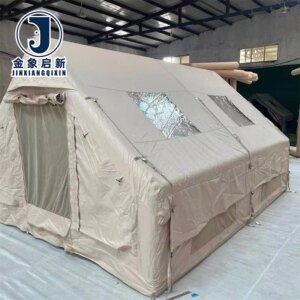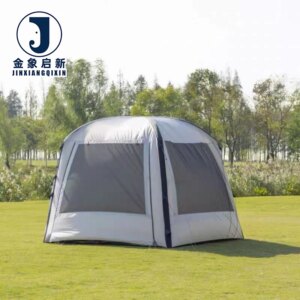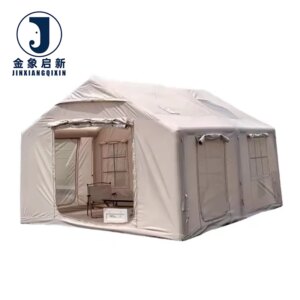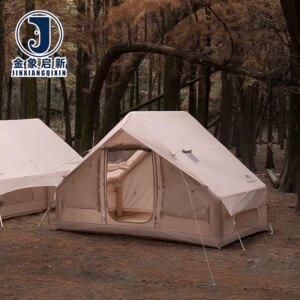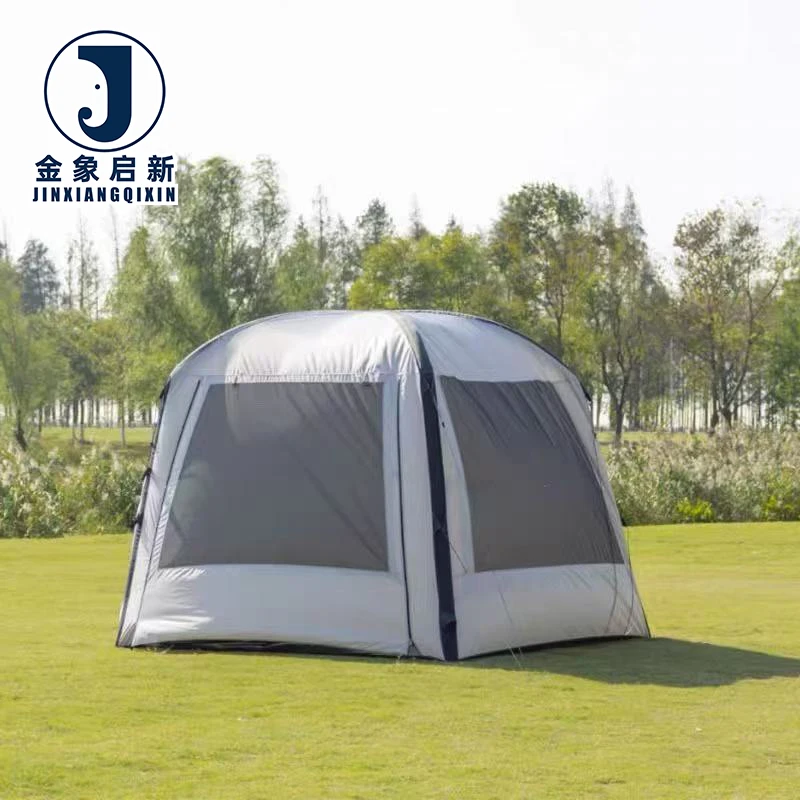
Rapid Deployment Design — engineered for transport and logistics operators requiring temporary shelters that withstand repeated setup cycles, road exposure, and site-level abrasion without seam failure.
Technical Specifications
| Parameter | Value |
|---|---|
| Product Type | Inflatable Tent |
| Core Material | PVC tarpaulin |
| Material Thickness Range | 0.3mm to 1.2mm |
| Capacity | 6-person |
| Key Features | Waterproof, UV-resistant (test basis not stated), tear-resistant, automatic opening mechanism |
| Customization | OEM & ODM, sample customization, pattern printing, size adjustments, logo integration |
| Certifications | ISO9001, ISO14001, ISO45001, CE |
Application Suitability
| Application | Exposure & Requirement |
|---|---|
| Fleet maintenance shelters | Repeated inflation cycles, ground abrasion, wind loading at seams |
| Roadside field offices | UV exposure, precipitation, thermal cycling, transport debris |
| Logistics staging covers | Cargo protection, tie-down stress at anchor points, site dust and moisture |
| Construction site break areas | Multi-season deployment, heavy foot traffic, equipment proximity puncture risk |
Why Inflatable Tent Seams Fail Before the Fabric Does
Seam integrity depends on weld temperature, dwell time, and material compatibility — not just fabric thickness.
When transport operators deploy temporary shelters across multiple job sites, the flex points and welded joints endure stress concentrations that exceed the base fabric load. I have seen heavy-grade PVC shelters fail at the inflation tube junctions while the main body remained intact. The failure typically traces back to inconsistent heat welding parameters or insufficient overlap at curved panel transitions [NEED_CITE: tensile and tear test methods for coated fabrics per ISO 1421]. Specifying a PVC inflatable tent for transport-adjacent operations requires verifying seam peel strength, not just base material tear resistance.
Rapid Deployment for Multi-Site Fleet Operations
Transport and logistics operators moving between job sites need shelters that inflate, anchor, and secure cargo or personnel within minutes. The automatic opening mechanism reduces on-site labor, which matters when a fleet maintenance crew sets up and breaks down the same structure across different yards. This PVC inflatable tent supports repeated deployment cycles without manual valve adjustments or partial inflation failures.
Weather and Road Exposure at Flex Points
Shelters positioned near loading docks, weigh stations, or roadside staging areas face continuous exposure to road spray, diesel particulate, and wind-driven debris. The tear-resistant PVC tarpaulin construction handles puncture risk from handling equipment and tie-down hardware. Material thickness options from 0.3mm to 1.2mm allow buyers to match abrasion resistance to their specific exposure conditions [NEED_CITE: coated fabric abrasion resistance standards for transport applications].
How Coating Weight and Base Fabric Denier Interact
Tear resistance in PVC tarpaulin depends on the interplay between coating adhesion and base fabric weave density. A higher GSM does not automatically deliver better tear performance if the base yarn denier is insufficient to arrest a tear propagation once initiated. The coating method — whether knife-over-roll, laminated, or calendered — affects peel strength at welded seams, which is where most inflatable structures experience early failure. Specifying PVC inflatable tent material requires reviewing both the coating weight and the base fabric specification sheet to confirm the combination suits your flex-cycle and wind-load requirements.
The Hidden Cost of Underspecified Material Thickness
Operators who select the minimum thickness to reduce unit cost often face higher total expenditure through premature replacement. A shelter that fails at the weld line after a single season of roadside deployment costs more in downtime and re-procurement than specifying the correct grade initially. I have seen transport operators reorder inflatable shelters annually because the original specification did not account for the cumulative UV and mechanical stress at anchor points [NEED_CITE: UV degradation mechanisms in PVC coated polyester fabrics]. Batch inconsistency in coating weight also leads to uneven inflation behavior across units deployed side by side.
Why Procurement Teams Specify From This Facility
The production process integrates QA checkpoints at every stage, with 100% pre-shipment inspection verifying material thickness, seam peel strength, and inflation valve integrity before dispatch. The 10-person R&D team handles pattern proofs, custom sizing, and sample development within days, allowing buyers to validate fitment before committing to bulk production. Three full production lines support consistent batch output, which matters when a fleet operator orders multiple identical units for standardized deployment protocols across regions.
Documentation & Verification
- Material specification sheet stating PVC tarpaulin grade, thickness, and coating weight per unit
- UV-resistance test report matched to your compliance jurisdiction (confirm test basis before order)
- ISO9001, ISO14001, ISO45001, and CE certificates referenced against shipment documentation
- Pre-shipment 100% inspection record covering seam strength, inflation mechanism, and panel dimensions
- Batch quality inspection report identifying coating weight verification per production run
Fabrication, Handling & Storage
- Heat weld parameters must match the selected PVC tarpaulin thickness to prevent delamination at inflation tube junctions
- Anchor points require reinforced webbing loops rated to the expected wind load for roadside deployment
- Store deflated units flat or loosely rolled to avoid permanent creasing in the PVC coating layer
- Clean with mild detergent only; solvent-based cleaners degrade the PVC surface and compromise UV treatment
- Inspect valve seals and inflation tubes before each deployment cycle to catch wear before field failure
What to Include in Your Enquiry
Specify your deployment environment (roadside, loading yard, construction site), expected setup frequency, and any compliance requirements for UV or fire performance in your jurisdiction. Confirm whether you need custom dimensions, pattern printing, or standard sizing, and indicate your annual volume to align production scheduling. Request a sample unit to validate inflation behavior, seam strength, and anchor point reinforcement before bulk commitment.
Frequently Asked Questions
Q: How is tear resistance and seam strength verified before shipment?
A: Every unit undergoes 100% pre-shipment inspection covering seam peel strength at welded joints, inflation tube integrity, and base fabric tear resistance. The inspection record ships with your order, documenting results against the stated material specification.
Q: What UV treatment test basis supports the anti-UV claim for prolonged outdoor exposure?
A: UV-resistant treatment is available — confirm the specific test standard required for your market (e.g., ISO 4892, ASTM G154) before production. The factory provides a test report matched to your compliance jurisdiction upon request.
Q: What customization options are available for size, thickness, and logo printing?
A: OEM and ODM services cover custom dimensions, material thickness from 0.3mm to 1.2mm, pattern printing, and logo integration. Pattern proofs and sample units are developed for buyer approval before mass production begins.
Q: How does the automatic opening mechanism perform under repeated setup and breakdown cycles?
A: The mechanism is designed for commercial multi-site deployment. Valve and inflation tube components are inspected during pre-shipment QA to confirm consistent performance across repeated inflation and deflation cycles.
Q: What documentation ships with each batch for customs and site compliance?
A: Each shipment includes a material specification sheet, certificate of origin, ISO and CE certificate references, batch inspection record, and packing list. Additional compliance documentation can be prepared to match your site safety or import requirements.