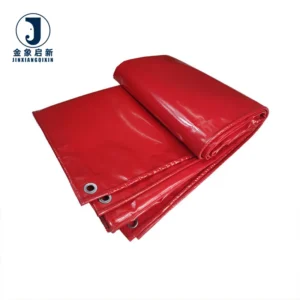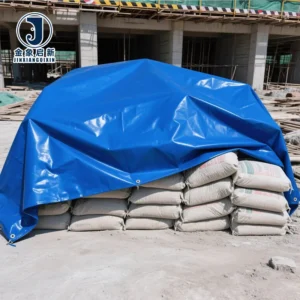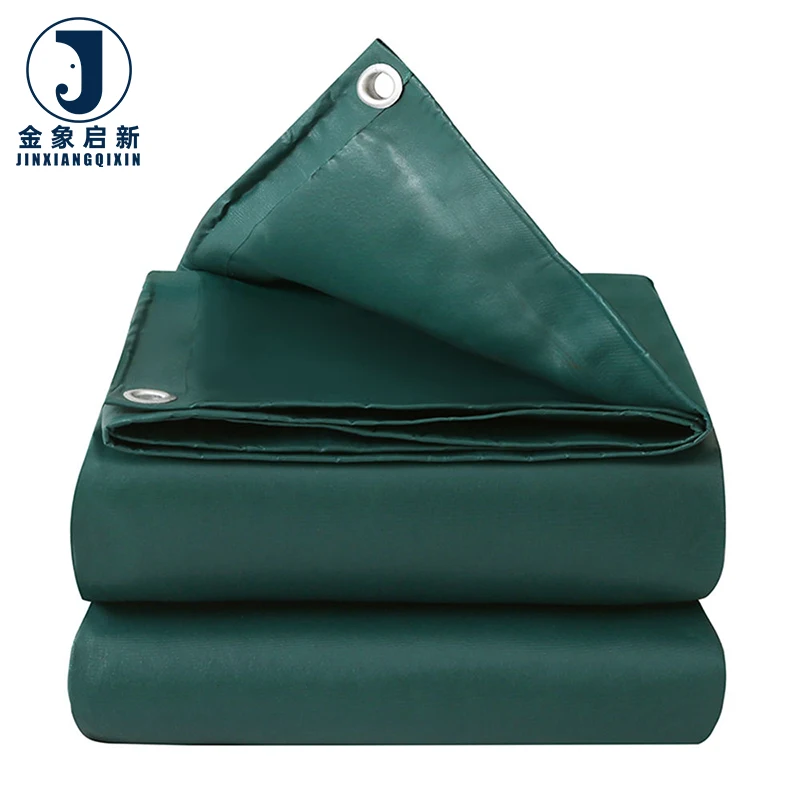
Process-Controlled Coating — Hot-melt and laminated coating lines producing PVC coated tarpaulin rolls with consistent adhesion verified at every stage, not just at final inspection.
Technical Specifications
| Parameter | Value |
|---|---|
| Product Type | PVC Coated Tarpaulin |
| Base Fabric | High-strength polyester mesh fabric |
| Coating Material | PVC |
| Coating Method | Laminated technology & Hot-melt coating technology |
| Weight (GSM) | 350gsm / 420gsm / 500gsm / 550gsm / 600gsm / 750gsm |
| Total Thickness | 0.32mm / 0.35mm / 0.4mm / 0.45mm / 0.5mm / 0.65mm |
| Roll Size | 2m × 75m / 2.1m × 50m |
| Finished Product Size | Custom cut to customer dimensions or sold from inventory |
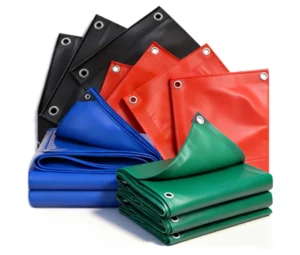
| Color Options | Blue / Red / Yellow / Light blue / Grey (custom colors available) |
| Waterproof | Yes |
| Anti-Mildew | Yes |
| Cold Crack Resistance | Yes |
| Flame Retardant | Available in flame retardant grades — confirm the grade required for your market |
| UV Treatment | Available with UV treatment — confirm test basis for your application |
| Anti-Static | Available with anti-static treatment — confirm surface resistance standard required |
| Certifications | ISO, CE |
Application Suitability
| Application | Exposure & Requirement |
|---|---|
| Truck side curtain fabric | Constant flexing at load shift points, road debris abrasion, UV and weather exposure across seasons |
| Flatbed and trailer covers | Tie-down strap friction, wind lift load, repeated folding and unfolding at depots |
| Fleet vehicle roof covers | Standing water, thermal cycling, long-term UV degradation on horizontal surfaces |
| Transport equipment builder OEM fitment | Dimensional accuracy to specific trailer models, batch colour matching across production runs |
| Curtain-side trailer replacement panels | Weld seam integrity at high-stress corners, colour match to existing fleet livery |
Why Welded Seams Fail Before the Fabric Does on Truck Covers
Seam failure on truck tarpaulins almost always traces back to coating adhesion, not fabric strength.
Fleet operators replacing worn covers often find the welded seams splitting while the body fabric still looks serviceable. The flex points on a moving load — where the tarpaulin bends over sharp cargo edges or vibrates against trailer ribs — concentrate stress at the heat-welded joints. When the PVC coating has poor adhesion to the base polyester mesh, the weld line delaminates under repeated cycling. I have seen transport fleets cycle through replacement PVC Coated Tarpaulin for Truck and Transport covers far sooner than expected because the specification focused on GSM alone, ignoring how the coating method affects peel strength at the seam [NEED_CITE: tensile and peel test methods for coated fabrics per ISO 1421]. The result is cargo exposure, load security failures, and unplanned downtime at the depot.
Coating Method Determines What Happens at the Weld Line
The hot-melt coating technology used on these PVC coated tarpaulin rolls forces molten PVC into the polyester mesh under heat and pressure, creating a mechanical bond between coating and yarn. Laminated technology bonds pre-formed PVC films to the base fabric through adhesive layers. Both methods produce waterproof, flexible covers, but they behave differently when a fabricator applies heat to join two panels. Hot-melt coated fabric tends to re-melt uniformly at the weld zone, producing a continuous bond. Laminated fabric depends on the adhesive layer’s thermal response, which can vary if the fabricator’s welding temperature does not match the adhesive’s activation range. Specifying the right PVC Coated Tarpaulin for Truck and Transport means telling your fabricator which coating method was used so they can dial in weld parameters.
Polyester Base Fabric and Tear Behaviour Under Road Vibration
The high-strength polyester mesh fabric provides the structural backbone. When a curtain-side trailer hits a pothole or a load shifts during cornering, the stress concentrates at tie-down points and any cut-outs for buckles or ratchets. Polyester yarn has high tensile modulus, meaning it resists stretching under sudden load rather than elongating and recovering slowly. This matters for truck covers because a fabric that stretches too much will sag between tie-downs, creating water pockets and flap-induced fatigue. The mesh weave density controls how a tear propagates — a tighter weave forces the tear to change direction at each yarn intersection, slowing the rip [NEED_CITE: tear propagation behaviour in woven coated fabrics]. Combined with PVC coating that locks yarns in place, the result is a cover that resists tear extension even when punctured by sharp cargo edges.
Reading the Specification Sheet Beyond GSM
GSM tells you the total weight of coating plus base fabric per square metre, but it does not tell you the ratio between them. A 550gsm fabric could use a heavier base mesh with thinner coating, or a lighter mesh with thicker coating — the tear resistance, weld behaviour, and flexibility will differ substantially. Thickness readings across the 0.32mm to 0.65mm range correlate with total coating build-up, which influences cold crack resistance and abrasion life at contact points. The six available weight grades — 350gsm through 750gsm — cover applications from light temporary covers to heavy-duty long-haul curtain-side fabric. Selecting the right grade means matching the expected mechanical abuse and service interval to both the base fabric density and the coating thickness, not just picking the heaviest option available. Roll widths of 2m and 2.1m affect how many panels must be welded together for wide trailer roofs, with fewer welds meaning fewer potential failure lines.
What Happens When Colour Consistency Fails Across a Fleet Order
Fleet operators ordering multiple rolls to cover or re-cover an entire trailer fleet expect uniform colour when the covers are installed side by side. When colour varies between rolls in the same shipment, the mismatch becomes visible immediately on the road — a rolling advertisement for poor procurement. This typically happens when rolls come from different production batches with separate pigment mixing runs, or when the coating line temperature fluctuated during one of the batches. For operators running branded fleets, colour drift between panels undermines the corporate livery and forces partial re-orders that delay vehicle return to service [NEED_CITE: colour consistency standards in batch-produced coated fabrics]. Verifying batch-to-batch colour reference before dispatch prevents this from reaching the depot.
Why Procurement Decisions Should Weigh More Than Quoted GSM
Our three full production lines and 36 sets of professional equipment run PVC coated tarpaulin with in-process coating weight checks, not just end-of-line sampling. The 10-person R&D team develops samples within days when fleet operators need to test weld parameters or colour matches before committing to bulk. Every roll undergoes 100% pre-shipment inspection with coating weight verification against the quoted GSM, eliminating the gap between quotation and arrival. Custom cutting to specific trailer models — rather than generic dimensions — reduces fabrication waste and ensures tie-down reinforcement lands at the correct stress points. Nearly 30 years of coating process control means the adhesion between PVC and polyester mesh is managed at the formulation level, not left to line operator judgement.
Documentation & Verification
- Material specification sheet stating GSM, base fabric construction, coating method, and colour reference for each roll
- Pre-shipment inspection record confirming actual coating weight per roll against quoted specification
- Colour batch reference card enabling visual match verification at receiving dock
- Test reports for flame retardant and UV grades where applicable — request before order confirmation
- ISO and CE certificates covering the production facility and product compliance
- Roll packing list with individual roll IDs traceable to production batch
Fabrication, Handling & Storage
- Hot-melt coated rolls require weld temperature calibration matching the PVC formulation — confirm parameters with fabricator before production
- Cold crack resistant fabric should be unrolled and allowed to reach ambient temperature before cutting in cold-weather workshops
- Store rolls upright on end cores to prevent flat-spot creasing that weakens coating adhesion at fold lines
- Cut panels from 2m or 2.1m roll widths with nested layouts to minimise offcuts and reduce weld seam count
- Anti-mildew treated surfaces tolerate mild detergent cleaning — avoid solvent-based cleaners that strip the treatment layer
- Finished truck covers should be folded along weld lines rather than across them to prevent repeated stress at joints
Before You Send the Enquiry
To specify the right PVC Coated Tarpaulin for Truck and Transport for your fleet, we need the trailer make and model or exact cover dimensions, the operating climate range, and whether your market requires flame retardant or anti-static certification. Tell us if you need rolls for your own fabrication line or finished covers cut and welded to vehicle dimensions. Colour requirements, custom printing of branding, and annual volume estimates help us confirm batch consistency and lead time before sampling begins.
Frequently Asked Questions
Q: How is GSM verified on arrival to match the quotation?
A: Every roll ships with a pre-shipment inspection record showing actual measured weight per square metre. We sample across the production run, not just from the first roll, so the documentation reflects the batch you receive. If the measured GSM falls outside tolerance against your purchase order, replacement rolls are dispatched before the original shipment reaches your depot.
Q: Can truck covers be cut to fit specific trailer models rather than generic sizes?
A: Yes. We cut to the exact dimensions of your trailer make and model, including panel shapes for curtain-side runners, roof curvature, and tail gate profiles. This eliminates the excess fabric that flaps in wind and causes premature abrasion at tie-down points. Provide the vehicle model or dimensional drawings, and we develop a cut pattern for your approval before production.
Q: How is colour consistency maintained across rolls in the same fleet order?
A: All rolls in a single order are produced from the same pigment batch on the same coating line run. We supply a colour reference card with the shipment so your receiving team can verify match against previous orders. For fleets adding vehicles over time, we retain the colour formulation record to reproduce the same shade on repeat orders.
Q: What test evidence supports flame retardant and UV treatment claims?
A: Where flame retardant or UV treatment is specified, we provide the relevant test report identifying the standard and the result achieved. We do not claim a treatment without documentation. Confirm the specific grade or standard your market or site requires — such as a building code classification or transport regulation — so we supply the correct certified grade.
Q: What reinforcement options are available at high-stress tie-down areas?
A: Reinforcement at tie-down points, buckle cut-outs, and corner patches can be added during fabrication to match the stress profile of your trailer type. The hot-melt and laminated coating both support heat-welded reinforcement patches that bond at the coating level. Specify the tie-down hardware type and strap routing so we place reinforcement where load forces actually concentrate.