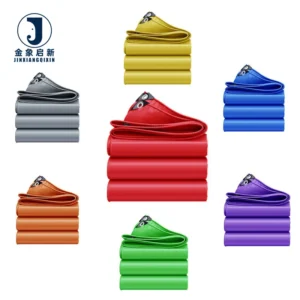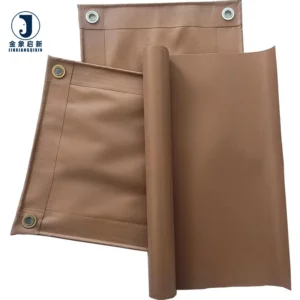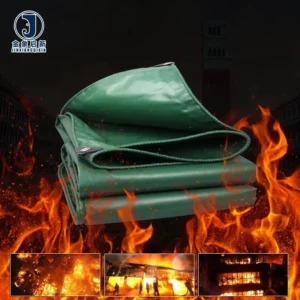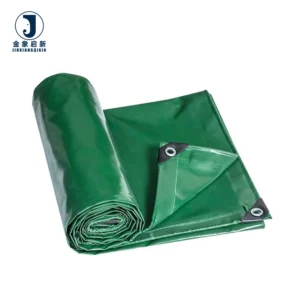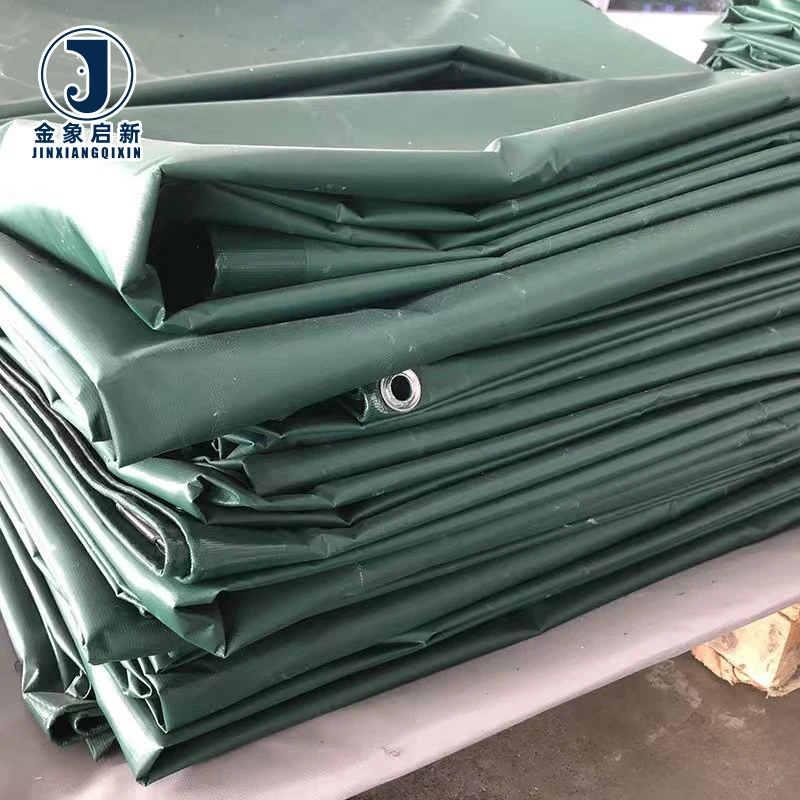
Process-Controlled Coating — 36 sets of professional equipment and dedicated QA at every stage ensure this 600gsm PVC coated tarpaulin for truck cover meets verified weight and adhesion standards before dispatch.
Technical Specifications
| Parameter | Value |
|---|---|
| Product Type | PVC Coated Tarpaulin |
| Material | 100% high toughness polyester yarn with PVC coating |
| Weight | 600 g/m² |
| Thickness | 0.70–1.0 mm (product family range — confirm grade for this item) |
| Base Fabric Denier | 1000D |
| Tensile Strength | Meridian 2000–2500 / Latitude 1800–2200 N/5cm (test basis not stated) |
| Coating Technology | Lamination and hot melt coating |
| Surface Treatment | Anti-UV, flame retardant, anti-static, cold resistant, mold proof (grades not stated — confirm standards required) |
| Custom Size | 6m × 15m (or customized to trailer dimensions) |
| Color | Customizable |
| Certification | ISO, CE |
Application Suitability
| Application | Exposure & Requirement |
|---|---|
| Heavy truck and trailer load covering | Road vibration, wind flap, flex-point abrasion, UV exposure |
| Side curtain fabric for transport equipment | Continuous folding and unfolding, lateral tension, weather sealing |
| Engineering and construction protective cloth | Dust containment, equipment weather protection, site handling abrasion |
| Farm machinery and large material pile covers | Standing water, soil contact, mold risk, seasonal UV load |
Why the Exact Trailer Dimension Decides Whether a PVC Coated Tarpaulin for Truck Cover Survives the First Month
A cover cut to generic dimensions shifts load onto the seams every time the trailer flexes, causing premature failure at the stress points.
Generic-sized tarps leave excess fabric that flaps in highway airflow, concentrating abrasion at folds and tie-down zones. When the trailer bed twists over uneven road surfaces, the cover stretches unevenly, pulling at welded seams and eyelet reinforcements until the weakest junction gives way. Fleet operators who replace covers every season often find the failure is dimensional, not material. [NEED_CITE: field reports on truck tarpaulin failure modes related to dimensional mismatch]
Cutting to Your Exact Trailer Model Eliminates Wind-Flap Abrasion
Highway speeds generate sustained airflow under any loose fabric edge, and the resulting vibration wears through PVC layers at contact points within weeks. When a PVC coated tarpaulin for truck cover is cut to the precise deck length and drop height of the specific trailer, the fabric sits under controlled tension rather than flapping freely. This controlled fit shifts the load from abrasion resistance alone to a combination of dimensional stability and tensile strength, both of which this 1000D base fabric is built to deliver.
Hot Melt Coating Delivers the Adhesion That Welded Seams Depend On
The bond between the polyester base fabric and the PVC coating layers determines whether a welded seam holds or peels apart under cyclic loading. Lamination and hot melt coating technology creates a mechanical and chemical bond that penetrates the yarn structure, giving the fabric the internal cohesion needed for heat-welded joints at eyelet and hem zones. Without this adhesion, the coating delaminates from the base at flex points long before the polyester yarn itself reaches its tensile limit. [NEED_CITE: coating adhesion test methods for PVC laminated fabrics]
How Weight, Denier, and Coating Method Work Together on the Road
A 600 g/m² weight reading only becomes meaningful when considered alongside the 1000D base fabric density and the hot melt coating process. The base yarn denier sets the tear propagation resistance — heavier denier means a cut or puncture spreads more slowly across the weave. Coating weight and method determine peel strength at welded seams, which is where most road tarpaulin failures originate. A lighter coating applied by knife-over-roll might save cost but compromises weld integrity under the cyclic stress of a loaded trailer in transit. Lamination technology addresses this by forcing coating compound into the fabric structure rather than laying it on top.
What Happens When Welded Seams Are Not Matched to the Flex Zone
Welded seams on a truck cover carry the highest cyclic stress of any point on the fabric, yet many covers are assembled with uniform weld parameters across all zones. At flex points — typically where the cover wraps around the trailer frame or meets tie-down straps — the weld line must absorb repeated bending without cracking or peeling. When the weld is too rigid for the flex zone, the coating cracks along the seam. When it is too soft, the layers peel under tension. [NEED_CITE: PVC tarpaulin weld seam fatigue testing standards]
Why Source This PVC Coated Tarpaulin for Truck Cover Here
Three full production lines and 36 sets of professional equipment provide the capacity to deliver fleet-volume orders on schedule without splitting production across external contractors. A 10-person R&D team handles custom sizing, pattern matching, and sample development within days, letting you confirm fit and colour before full production runs. Every roll passes through dedicated QA/QC at each production stage, with 100% inspection before shipment — not spot sampling. Coating weight and adhesion are controlled through deep process oversight developed over decades of coated fabric focus. Custom widths, colours, and cut sizes are produced in-house, avoiding the extended lead times and high minimums typical of outsourced finishing.
Documentation & Verification
- Material specification sheet listing 600 g/m² weight, 1000D base fabric, and hot melt coating method
- Pre-shipment weight verification record confirming GSM matches the quoted value per roll
- Test report documentation for UV and flame retardant grades where applicable to the order
- ISO and CE certificates supplied with dispatch documentation
- Roll packing list with individual roll identification for batch traceability
- Certificate of origin and customs documentation included for international shipment
Fabrication, Handling & Storage
- Hot weld temperature settings must match the 600 g/m² coating thickness to achieve full seam fusion without scorching the 1000D base yarn
- Reinforce eyelet zones with additional PVC patches bonded using the same hot melt method to distribute tie-down load across the weave
- Store rolls vertically on end caps to prevent flat-spot creasing that weakens the coating layer along the fold line
- Allow cold-stored rolls to reach ambient temperature before unrolling to prevent cracking of the cold-resistant PVC surface
- Clean with pH-neutral detergents only — solvents and alkaline cleaners degrade the anti-static and mold-proof surface treatments
- Repair field punctures using PVC-compatible adhesive patches heat-bonded to match the lamination coating structure
What to Include in Your Specification Request
Provide the exact trailer make, model, and deck dimensions so the cut size matches the load geometry rather than a generic template. Specify the fire safety or anti-static standards required at your destination market so the correct treatment grade is applied and documented. Indicate whether you need finished cut sizes with eyelets and reinforced hems or roll stock for in-house fabrication.
Frequently Asked Questions
Q: How is GSM verified before shipment to match the quoted weight?
A: Each roll is weighed and measured at the production stage, and the calculated GSM is recorded against the quoted 600 g/m² specification. A weight verification record accompanies the shipment, so you can confirm on arrival that the material matches what was agreed at the quotation stage.
Q: Can the tarpaulin be cut to a specific truck or trailer model dimension?
A: Yes. Provide the trailer make, model, deck length, and side drop height. The cover is then cut and finished to those exact dimensions with eyelet placement matched to your tie-down configuration, eliminating the excess fabric that causes wind-flap abrasion.
Q: What reinforcement options are available at eyelet and hem stress points?
A: High-stress zones receive additional PVC patches bonded through hot melt lamination, distributing tie-down load across a wider area of the 1000D base fabric. Hem construction uses folded and welded edges to prevent edge fraying under cyclic road vibration.
Q: What anti-UV or flame retardant documentation is supplied with the cover?
A: Where UV or flame retardant treatment is specified on the order, a test report documenting the grade and test standard is included with the shipment documentation. Confirm the specific standard required for your market at the inquiry stage so the correct grade is applied.
Q: What is the lead time for custom-sized truck covers?
A: Lead time depends on order volume, colour customisation, and finishing complexity. Standard cut sizes with stock colours move through production faster than fleet orders requiring colour matching across multiple rolls. Confirm timing at the quotation stage based on your specific configuration.