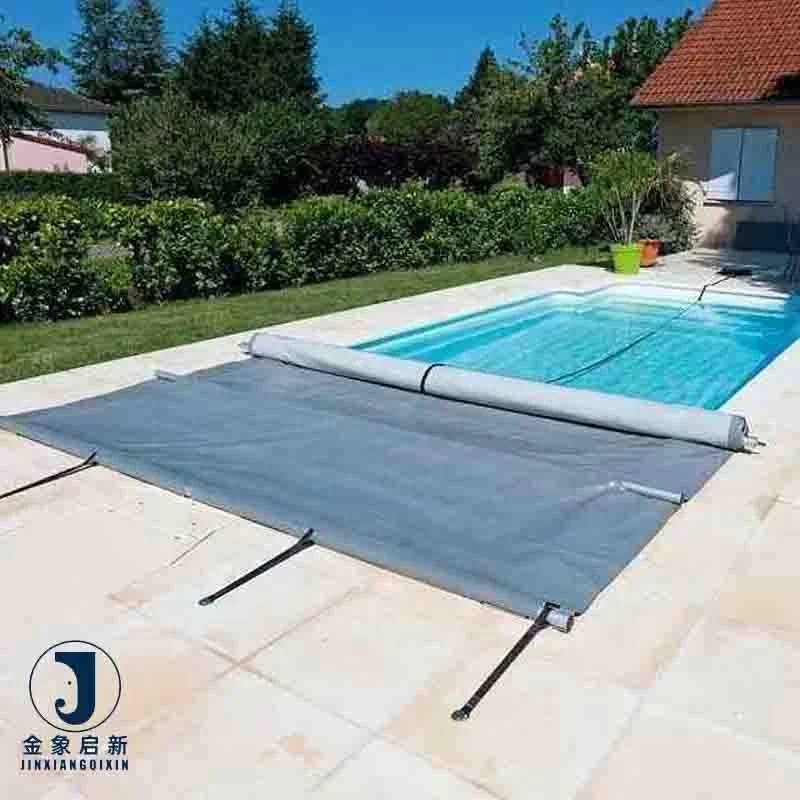
Deep process control over coating weight — every roll of PVC pool cover tarpaulin is verified against stated GSM before leaving our Jinan facility, eliminating the mismatch between quotation and arrival.
Technical Specifications
| Parameter | Value |
|---|---|
| Product Type | PVC Coated Tarpaulin for Pool Cover |
| Base Fabric | High-strength polyester mesh fabric |
| Coating Technology | Laminated technology & Hot-melt coating technology |
| Weight (GSM) | 350gsm / 420gsm / 500gsm / 550gsm / 600gsm / 750gsm |
| Total Thickness | 0.32mm / 0.35mm / 0.4mm / 0.45mm / 0.5mm / 0.65mm |
| Roll Width | 2m / 2.1m |
| Roll Length | 75m (2m width) / 50m (2.1m width) |
| Colour Options | Blue / Red / Yellow / Light blue / Grey (Customizable) |
| Key Features | Cold crack resistance, Anti-mildew, Anti-static treatment (grade not stated), Waterproof, UV resistant (test basis not stated), High colour fastness, Outstanding tearing strength for welding |
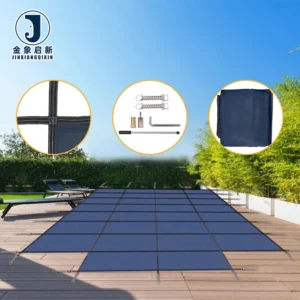
| Cover Fixing Method | Standard hook system (custom shaped pools) / Aluminium bar with ratchet tensioner (larger rectangular pools) |
| Standards | ISO, CE (referenced in company profile) |
Application Suitability
| Application | Exposure & Requirement |
|---|---|
| Residential swimming pool cover | Continuous UV and rain exposure, evaporation reduction, debris exclusion, tensioned fit over irregular contours |
| Commercial and resort pool cover | High-frequency deployment and retraction, wind uplift resistance, chemical splash from pool treatment |
| Aquaculture and fish tank cover | Permanent water contact, mildew and algae resistance, waterproof containment |
| Truck and trailer load cover | Road abrasion, constant flexing at tie-down points, weather exposure during transit |
| Pond and reservoir liner | Soil contact, puncture risk, long-term water immersion |
Why a Pool Cover That Fits Your Exact Dimensions Matters More Than the Fabric Grade Alone
A PVC pool cover cut to generic dimensions leaves gaps at the edges where debris enters and water evaporates, regardless of how heavy the fabric is.
Fleet operators and pool owners who buy off-the-shelf covers often discover that a few centimetres of overhang or shortfall creates flapping in wind, which accelerates wear at the hem and tie-down points. For transport loads, an ill-fitting PVC pool cover for truck and transport applications allows water ingress at the edges, defeating the purpose of a waterproof fabric entirely. The fabric itself may be perfectly specified for the environment, but the fit determines whether it performs in practice [NEED_CITE: field failure rates of generic-size vs custom-cut tarpaulin covers].
How Laminated Coating Technology Supports Pool Cover Performance
The PVC pool cover tarpaulin uses laminated technology combined with hot-melt coating on a high-strength polyester mesh base. This dual approach produces strong adhesion between the PVC layers and the base fabric, which directly affects how the material behaves at welded seams. When a cover is tensioned across a pool or secured over a transport load, the greatest stress concentrates at the seams and tie-down edges rather than the field of the fabric. Laminated construction resists delamination at these stress points, keeping the coating bonded to the mesh through repeated flexing and temperature cycles.
Securing the Cover: Hook Systems vs Aluminium Bar Tensioners
The fixing method determines how well the PVC pool cover for truck and transport or stationary pool applications maintains tension under wind load. For irregularly shaped pools and smaller installations, the standard hook system allows the cover to be anchored at multiple points around the perimeter, following the contour of the pool edge. For larger rectangular pools and transport applications where consistent tension across the full span is required, the aluminium bar method with ratchet tensioner provides even force distribution along the edge, reducing the risk of localised stress that leads to tearing.
Reading the GSM and Thickness Grades for Your Application
The available weight range from 350gsm to 750gsm corresponds to total thickness from 0.32mm to 0.65mm, but GSM alone does not define the cover’s real-world performance. The high-strength polyester mesh base fabric contributes to tensile and tear resistance independently of the coating weight. A lighter grade with a denser mesh weave can outperform a heavier grade with a looser base construction at tear propagation resistance [NEED_CITE: relationship between base fabric denier and tear strength per ISO 1421]. The coating weight primarily governs waterproofing integrity, abrasion resistance at contact surfaces, and the material’s ability to hold a welded seam without the coating cracking or peeling. Anti-mildew treatment and cold crack resistance are specified across the range, making the lighter grades viable for seasonal pool covers and the heavier grades suited to permanent installation and transport load cover applications that demand greater puncture resistance.
What Happens When the Weld Fails Before the Fabric Does
Pool covers and transport tarpaulins most commonly fail at the welded seams, not in the field of the fabric. When hot-melt coating adhesion is insufficient, the seam peels open under tension, particularly at the points where the load flexes most or where the cover is pulled tight over a pool edge. This turns a material investment into a recurring repair or replacement cycle. Batch inconsistency in coating weight compounds the problem — if one roll in a multi-roll order has lower GSM than the next, the welder’s temperature and speed settings that work on one panel may under-perform on the adjacent panel, creating weak seams that are invisible until the cover is under load [NEED_CITE: welded seam failure analysis in PVC coated tarpaulins].
Why Sourcing This PVC Pool Cover Tarpaulin Through Jinxiang
Three full production lines and 36 sets of professional equipment support bulk roll output with consistent coating weight across the production run. A 10-person R&D team handles custom sizing, pattern cutting plans, and sample development for pool covers shaped to specific contours. Dedicated QA/QC inspection at every production stage, with 100% inspection before shipment, catches GSM deviation and coating defects before dispatch. Samples for custom dimensions and colour requirements are developed within days, allowing verification of fit and appearance before full production commences.
Documentation & Verification
- Material specification sheet stating actual GSM and coating weight per roll for pool cover orders
- Test documentation for UV resistance and flame retardant grades where applicable to your market
- Pre-shipment inspection record confirming 100% check on coating adhesion and colour consistency
- Roll packing list detailing dimensions, weight, and colour reference for each roll in the shipment
- Certificate of origin and customs documentation for cross-border pool cover fabric delivery
Fabrication, Handling & Storage
- Set welder temperature and speed to match the specific GSM grade — laminated hot-melt coating requires calibrated heat input for full seam adhesion
- Reinforce tie-down and hook anchor points with additional fabric patches to distribute load across the polyester mesh base
- Store rolls horizontally on padded racks to prevent permanent creasing in the PVC coating layers
- Allow cold-stored rolls to reach ambient temperature before unrolling to avoid coating crack in cold crack resistant grades
- Clean with mild detergent only — harsh solvents degrade the anti-mildew treatment on the PVC surface
- Plan cutting layout from 2m or 2.1m roll widths to minimise offcuts and reduce seam count on large pool covers
What We Need to Quote Your Pool Cover Accurately
Provide the pool or load dimensions including any irregular contours, the local wind and UV exposure conditions, and whether you require the hook system or aluminium bar tensioner fixing method. Specify the GSM grade and colour from the available range, or request a sample in your preferred weight and finish. Confirm whether you need finished cut-to-size covers or roll stock for your own fabrication, and advise if your market requires flame retardant or anti-static certification — available in specific grades on request.
Frequently Asked Questions
Q: How do you measure and cut covers for irregularly shaped pools?
A: We work from your pool dimension drawings or on-site measurements to develop a cutting plan before production. The pattern accounts for perimeter overlap and fixing method allowance, whether hook or aluminium bar tensioner. A sample panel is produced for fit confirmation before the full order is cut from the specified GSM grade.
Q: What GSM grade is right for my pool size and local wind conditions?
A: Larger pools and sites with high wind exposure generally require heavier grades from the 550gsm to 750gsm range for adequate tension resistance. Smaller residential pools in sheltered locations can perform well with 350gsm to 500gsm grades. We recommend specifying based on your pool dimensions and local conditions rather than selecting the lightest available option.
Q: How is the cover secured — hook system vs aluminium bar tensioner?
A: The hook system suits custom-shaped and smaller pools where anchor points follow the pool contour. The aluminium bar method with ratchet tensioner is designed for larger rectangular pools and transport load applications where even tension across the full span prevents flapping and edge wear. We supply both systems matched to your cover specification.
Q: How do you verify GSM and coating weight on delivery?
A: Each roll undergoes weight verification against the stated GSM during our 100% pre-shipment inspection. The material specification sheet included with your shipment documents the actual coating weight per roll, so you can confirm the fabric matches the quotation before fabrication or installation begins.
Q: What is the lead time for custom-shaped pool covers?
A: Sample development for custom dimensions and colour requirements is completed within days. Full production lead time depends on order volume and whether finished cut-to-size covers or roll stock is required. We confirm the schedule at quotation stage based on your specific GSM grade, colour, and fixing method selection.