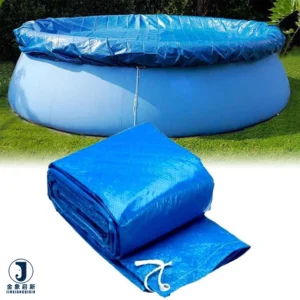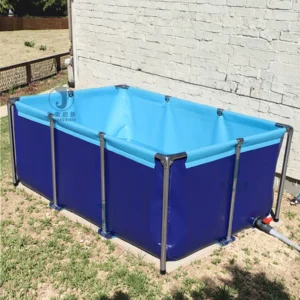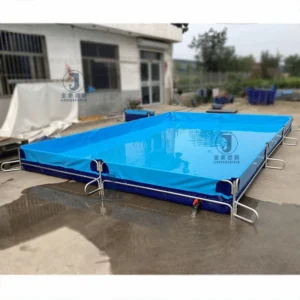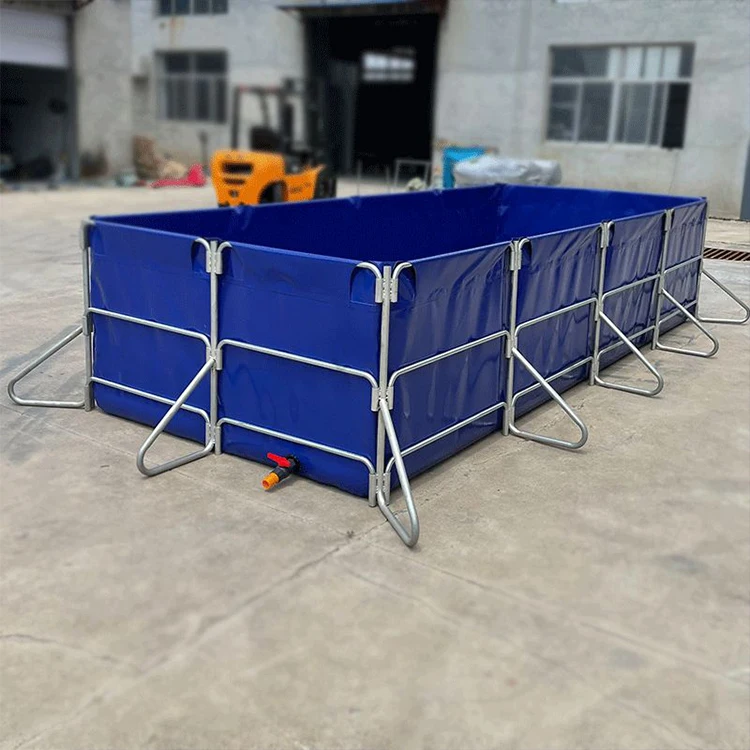
Consistent Roll Production — every PVC tarpaulin fish pond liner we ship is inspected against the quoted GSM before leaving the facility, eliminating the guesswork aquaculture operators face when unrolling material on site.
Technical Specifications
| Parameter | Value |
|---|---|
| Product Type | PVC Tarpaulin Fish Pond |
| Shape Options | Circular / Rectangular |
| Coating Material | PVC |
| Foldable Design | Yes |
| Application | Fish Tank / Fish Pond |
| UV Treatment | Available — confirm the grade required for your market |
| Flame Retardancy | Available in flame retardant grades — confirm the grade required for your market |
| Custom Sizing | Cut and welded to order |
Application Suitability
| Application | Exposure & Requirement |
|---|---|
| Aquaculture pond lining | Permanent water contact, soil chemistry interaction, puncture risk from substrate debris |
| Fish farming tanks | Constant water load pressure, flex stress at corners, daily abrasion from feeding and net handling |
| Portable fish breeding enclosures | Repeated folding and unfolding, transport vibration, rapid deployment and drainage requirements |
| Nursery pond conversion | Shallow water exposure, UV radiation in open-air settings, seasonal installation and removal |
Why PVC Tarpaulin Fish Pond Liner Failures Start at the Seam
Weld integrity under continuous water load determines whether a PVC tarpaulin fish pond liner survives a full grow-out cycle.
Aquaculture operators routinely report that pond liners fail first at the welded joints — not because the fabric itself is inadequate, but because the heat-weld parameters were not matched to the coating formulation or the stress profile of the pond geometry. In circular ponds, the hoop stress concentrates load evenly, but rectangular configurations place disproportionate tension at the corner welds where two planes meet. When the weld bead is under-fused or the overlap width is too narrow, the seam delaminates while the body fabric remains intact [NEED_CITE: tensile and tear test methods for coated fabrics per ISO 1421].
Seam Engineering for Water Containment Under Load
A PVC tarpaulin fish pond liner must hold welded seams that resist both hydrostatic pressure and the dynamic flexing caused by fish movement and water circulation. The heat-weld process we use controls temperature, dwell time, and pressure across each joint to ensure the PVC coating layers fuse into a continuous bond rather than a surface tack. This matters most at the drainage outlet penetrations and at the hem folds where the liner anchors to the pond frame, because those junctions experience cyclic loading every time water levels fluctuate during feeding or partial drainage.
Shape Selection and Structural Behavior in the Field
Circular pond liners distribute water pressure radially, which keeps stress relatively uniform across the entire welded circumference. Rectangular pond liners, by contrast, generate concentrated stress at the corners and along the long-axis seams where the water load pushes outward against flat panel sections. Choosing between circular and rectangular configurations is therefore not just a matter of site layout — it directly influences which weld lines carry the highest load and where reinforcement should be specified. Our fabrication team cuts and welds each PVC tarpaulin fish pond liner to the dimensions you provide, with seam placement planned to align with the structural logic of the chosen shape [NEED_CITE: hydrostatic pressure distribution in flexible pond liner geometries].
Reading the Specification Sheet Beyond the GSM Number
The stated GSM of a PVC tarpaulin tells you the total weight per square metre, but it does not reveal how that weight is distributed between the base fabric and the coating layers. A liner with a lighter base fabric and heavier coating may show the same GSM as one with a denser weave and thinner coat, yet the two will behave very differently under puncture stress and weld tension. The base fabric denier and weave density govern tear propagation resistance, while the coating thickness determines weld compatibility and surface durability. When evaluating material for pond lining, requesting the full specification sheet — including base fabric construction and coating weight breakdown — gives a more accurate picture than GSM alone. Surface finish also plays a role: glossy surfaces shed biofilm more readily during cleaning cycles, while matte surfaces reduce glare in open-air installations.
The Hidden Cost of Specification Mismatch on Site
When a PVC tarpaulin fish pond liner arrives lighter than the GSM stated on the quotation, the operator may not notice until the pond is filled and the seams begin to creep. By that point, the water is in, the stock has been transferred, and draining the pond to replace the liner means lost production days and stressed fish. Similarly, when anti-UV treatment is claimed without a supporting test report, the liner may chalk and embrittle within a single season in high-radiation climates, leading to micro-cracks that compromise waterproofing before the structural fabric is affected. These failures are preventable through documentation verification before shipment, but they require the buyer to specify exactly which properties must be tested and reported [NEED_CITE: coating adhesion failure modes in PVC tarpaulin under prolonged water immersion].
Why Aquaculture Operators Source PVC Tarpaulin Fish Pond Liners Here
Nearly thirty years of coated fabric production has given us process control over coating weight consistency — the same GSM you approve on the sample is the GSM that runs across your entire order, verified at every production stage. Three full production lines and 36 sets of equipment mean that custom-cut circular and rectangular pond liners move through fabrication without waiting for machine availability, keeping lead times predictable for seasonal aquaculture schedules. Our 10-person R&D team develops samples within days when you need a specific shape, drainage fitting layout, or reinforcement configuration confirmed before committing to the full production run. Dedicated QA/QC runs 100% pre-shipment inspection on every pond liner, checking weld integrity, dimensional tolerance, and surface condition before packing. The foldable design of our pond liners allows compact container loading, reducing freight cost per unit for operators stocking multiple sites or managing phased installation across a farming season.
Documentation & Verification
- Material specification sheet stating GSM, base fabric denier, and PVC coating weight for each pond liner order
- Pre-shipment inspection record covering weld seam strength, dimensional accuracy, and surface defect check
- UV and flame retardant test reports provided where treatment grades are specified on the purchase order
- ISO and CE certificates covering the production facility and quality management system
- Roll packing list with individual liner dimensions and weight for customs clearance and site receiving
Fabrication, Handling & Storage
- Heat-weld parameters matched to PVC coating formulation to prevent delamination at pond corner seams
- Reinforced hem folds at anchoring points to resist pull-through stress during pond filling
- Folded liners stored flat and dry to prevent crease marks from setting into the PVC coating
- Avoid dragging unfolded liners across abrasive substrate — lift and position to protect coating surface
- Field repairs using compatible PVC patch material and solvent cement matched to the coating grade
- Drainage outlet penetrations welded with reinforced flange rings to distribute load around the cut-out
What We Need to Quote Your PVC Tarpaulin Fish Pond Liner
To provide an accurate specification and lead time, please share the pond dimensions and whether you need circular or rectangular configurations, the water depth and intended fish species, and any drainage or inlet fitting positions you want fabricated into the liner. If your site is in a high-UV climate or requires flame retardant certification for regulatory compliance, let us know the specific grade or standard your market demands so we can include the correct treatment and test documentation with your order.
Frequently Asked Questions
Q: What GSM grade should I specify for my fish pond depth and stock type?
A: The appropriate GSM depends on water depth, substrate conditions, and whether the pond is permanent or seasonal. Deeper ponds and rougher substrates require heavier base fabric construction for puncture resistance. We recommend sharing your pond dimensions and site conditions so we can propose a material specification that matches the actual load profile rather than selecting by GSM alone.
Q: Can I order custom circular and rectangular sizes with drainage fittings?
A: Yes. Each PVC tarpaulin fish pond liner is cut and welded to your specified dimensions. Drainage outlets, inlet penetrations, and overflow openings can be fabricated with reinforced flange rings during production. Send us your pond layout drawing or dimension list and we will develop a sample for your approval before full production.
Q: How does PVC tarpaulin compare to HDPE for pond lining applications?
A: PVC tarpaulin offers flexibility and foldability that rigid HDPE sheets cannot match, making it suited for portable and seasonal installations. PVC also allows heat-welded seams that form continuous waterproof bonds on site. HDPE may offer different chemical resistance profiles. The choice depends on your installation method, expected service conditions, and whether the pond will be relocated between seasons.
Q: What UV protection is included and is a test report available?
A: Anti-UV treatment is available for outdoor pond installations in high-radiation environments. The specific grade and test basis depend on the treatment formulation selected for your order. Confirm the UV performance standard required by your market or project specification, and we will supply the corresponding test report with your shipment documentation.
Q: Can multiple pond liners ship consolidated in one container?
A: Yes. The foldable design allows multiple circular and rectangular pond liners to be packed compactly for container loading. Consolidating your order reduces freight cost per unit, which is particularly relevant for operators stocking several pond sites or managing phased installation across a farming operation. Share your quantity and dimension list so we can calculate the loading plan.