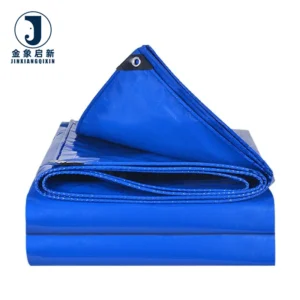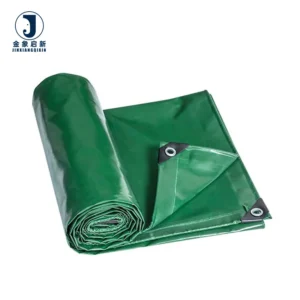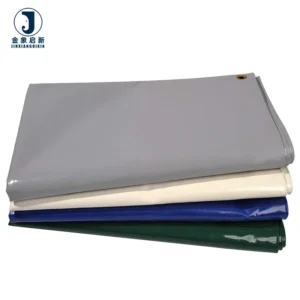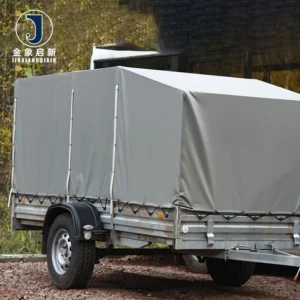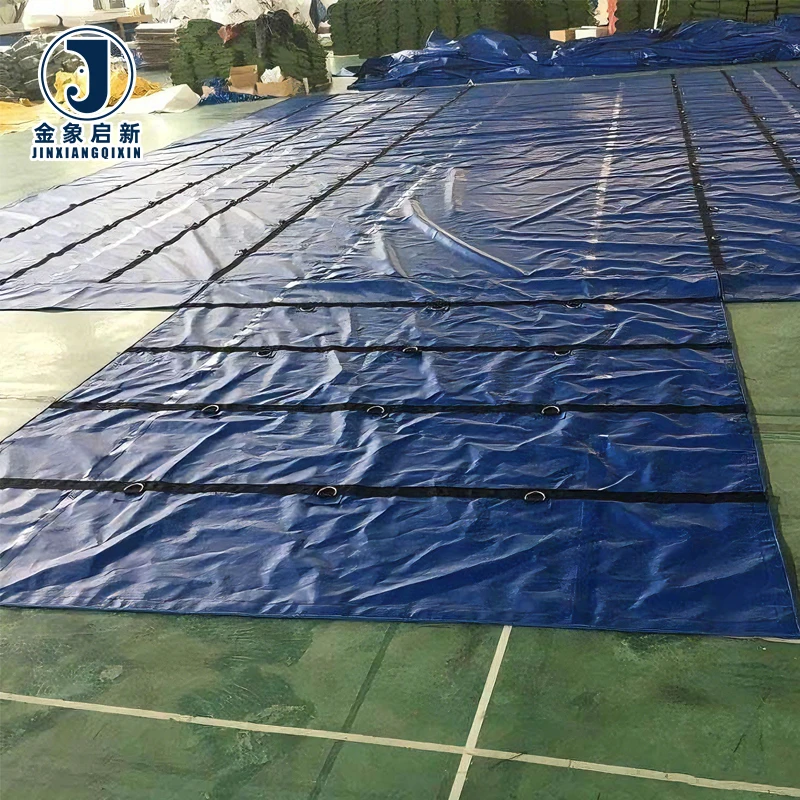
Model-Specific Fabrication — Covers are dimensioned to the exact truck or trailer model, eliminating the gap and billow problems that generic tarps create at highway speed.
Technical Specifications
| Parameter | Value |
|---|---|
| Product Type | PVC Coated Tarpaulin Truck Cover |
| Coating Material | PVC |
| Flame Retardant | Available (grade not stated in source) |
| Anti-Static | Available (standard not stated in source) |
| Anti-Cold | Available |
| Anti-Mildew | Available |
| Waterproof | Yes |
| Weather Resistance | 1–3 years outdoor life assurance (test basis not stated in source) |
| Customization | Size, colour, and printing available |
| Standards | ISO, CE |
Application Suitability
| Application | Exposure & Requirement |
|---|---|
| Flatbed trailer load covering | Continuous highway wind load, UV exposure, tie-down abrasion at edges |
| Curtain-side trailer fabric | Repeated flex cycles at roller tracks, road spray, lateral wind pressure |
| Construction equipment transit covers | Load shift stress, puncture from sharp edges, site dust and moisture |
| Fleet-standard cargo protection across mixed models | Consistent colour and weight across multiple vehicle types, regulatory compliance |
Why a "Universal Fit" Truck Cover Costs More Than a Custom One
A cover cut to your exact trailer model eliminates the cargo exposure and road-incident risk that generic sizing creates.
Fleet operators who order off-the-shelf truck tarps regularly discover that the stated dimensions do not account for mirror housings, tail-lamp clusters, or the specific curvature of a curtain-side rail. The result is fabric that pulls away from the chassis at speed, exposing the load to rain ingress and creating aerodynamic drag that increases fuel consumption. A PVC coated truck tarpaulin for transport built to the vehicle’s actual profile removes every one of these failure points. [NEED_CITE: aerodynamic drag increase from poorly fitted truck covers on long-haul routes]
Model-Matched Cutting and Welding for Every Trailer in the Fleet
Each PVC coated truck tarpaulin for transport is fabricated against the precise dimensions of the trailer it will cover. Flatbed operators supply the deck length, side-rail height, and tail-gate profile; curtain-side builders provide the roller-track spacing and header-rail profile. The cover is then cut and welded to match, so every hem, eyelet, and seam falls where the trailer’s hardware expects it. This eliminates the on-site trimming and re-punching that generic tarps demand, saving installation time at the depot.
Reinforcement Where Load Movement Concentrates Stress
The points where a cover flexes most — typically the front header seam, the rear corner hems, and the tie-down eyelet rows — receive additional layers of PVC-coated fabric welded over the primary panel. This localised reinforcement prevents the seam from peeling before the main fabric reaches its service life. On curtain-side applications, the vertical weld lines that run along the roller-track contact zone are double-welded to handle the constant friction cycle without delamination. [NEED_CITE: coated fabric seam peel strength test methods per ISO 1421]
Treatment Options Aligned to Route and Cargo Requirements
Long-haul routes that cross cold-climate corridors benefit from anti-cold treatment, which keeps the PVC coating flexible at low temperatures and prevents cracking when the cover is folded or tensioned in freezing conditions. Anti-mildew treatment is specified for humid-region routes where the cover remains damp for extended periods between loads. Flame retardant grades are available in flame retardant grades — confirm the grade required for your market before ordering. Anti-static treatment options exist for operators hauling sensitive electronic or combustible cargo where static discharge is a documented risk.
Coating Weight, Base Fabric, and the Relationship That Determines Real Strength
The tensile and tear performance of a PVC coated truck tarpaulin for transport depends on both the base fabric denier and the coating weight working together. A heavier coating alone does not guarantee higher tear resistance if the underlying yarn is a low-denier weave; conversely, a high-denier base fabric with insufficient coating will abrade quickly against tie-down straps and cargo edges. The PVC coating method — whether knife-over-roll, calendered, or laminated — also affects the bond between coating and yarn, which directly determines how well the fabric withstands repeated flexing without delamination. Knife-over-roll coating typically produces the strongest mechanical bond, while calendered coating offers a smoother surface finish suited to printed branding. Understanding this relationship lets buyers specify a cover that balances weight, flexibility, and durability for their particular load profile.
The Hidden Cost of Specifying on Price Per Square Metre Alone
Buyers who select a truck cover based solely on the lowest quoted price per square metre often discover that the delivered fabric is lighter than the GSM stated on the quotation. The coating weight is reduced to hit the price point, and the cover degrades under UV exposure and mechanical stress far sooner than expected. Welded seams on under-coated fabric tend to fail first, because the heat-activated bond has less material to grip. Colour variation between rolls in the same shipment becomes visible once the covers are installed side by side on adjacent trailers in the fleet. These issues force early replacement, negating any initial saving. [NEED_CITE: coating weight verification methods for PVC tarpaulin pre-shipment inspection]
Why Procurement Teams Source Custom Truck Covers Here
The ten-person R&D team develops cover samples within days, cutting and welding to the buyer’s exact trailer drawing so fitment can be confirmed before bulk production begins. Three full production lines and thirty-six sets of professional equipment support the volume needed for large fleet orders while maintaining on-time delivery schedules. Dedicated QA/QC runs at every production stage — from base fabric inspection through coating weight checks to final dimension verification — with one hundred percent inspection before dispatch. ISO and CE certification underpins the quality management system, and test reports for flame retardant or anti-static treatments are supplied where applicable so buyers can present documented evidence to their compliance teams.
Documentation & Verification
- Material specification sheet stating base fabric denier, coating weight, and confirmed GSM for each roll
- Pre-shipment inspection record verifying cover dimensions against the trailer model specification
- Flame retardant and anti-static test reports supplied with applicable grades
- Roll and cut-size packing list with individual cover identification
- Certificate of origin and customs documentation for international shipment
Fabrication, Handling & Storage
- Weld temperature and dwell time must match the specific PVC coating thickness to achieve full seam adhesion
- Eyelet spacing and hem reinforcement should align with the fleet’s tie-down strap configuration
- Store rolled covers upright on pallets to prevent permanent creasing of the PVC coating
- Allow covers to reach ambient temperature before unfolding in cold conditions to avoid coating crack
- Clean with mild detergent only; solvent-based cleaners may degrade the surface coating layer
- Field repair kits using compatible PVC adhesive and patch material extend cover service life
Before You Request a Quote
Provide the exact make, model, and year of each truck or trailer in the fleet so the cover dimensions can be matched to the vehicle profile. State whether flame retardant or anti-static treatment is required and which standard your market mandates. Indicate the quantity, colour preference, and whether printed fleet branding is needed on the covers.
Frequently Asked Questions
Q: How are truck cover dimensions matched to specific trailer models?
A: We request the trailer make, model, year, and any non-standard modifications such as extended mirrors or custom tail-lamp housings. The cover is then cut and welded to those exact dimensions, with eyelet positions aligned to the trailer’s tie-down points. A sample or dimensional drawing can be supplied for approval before full production begins.
Q: Can you provide test reports for flame retardant and anti-static claims?
A: Yes. Where flame retardant or anti-static treatment is specified, we supply the corresponding test report with the shipment. Buyers should confirm the grade or standard required by their local transport regulation at the inquiry stage so the correct treatment is applied and documented.
Q: How is actual coating weight verified on delivery?
A: Every roll or cut cover is inspected against the material specification sheet before dispatch. The pre-shipment inspection record confirms the base fabric denier, coating weight, and overall GSM so the delivered product matches what was quoted.
Q: How do you ensure colour consistency across multiple covers in a fleet order?
A: Production runs for a single fleet order use PVC compound from the same batch. In-process colour checks are conducted at the coating stage, and the pre-shipment inspection includes a side-by-side visual comparison of all covers in the shipment to flag any variation before packing.
Q: What is the typical lead time for custom-sized truck covers?
A: Lead time depends on order volume and whether special treatments or printed branding are required. Custom covers typically require multi-week production schedules. We provide a confirmed dispatch date at the quotation stage so fleet operators can plan around vehicle availability.