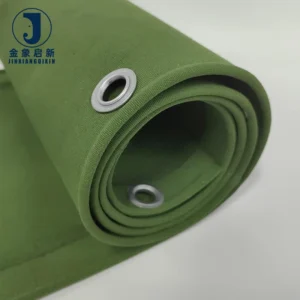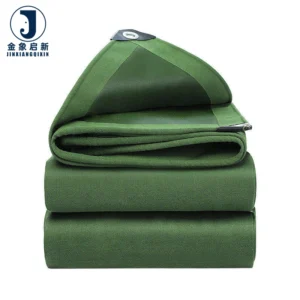
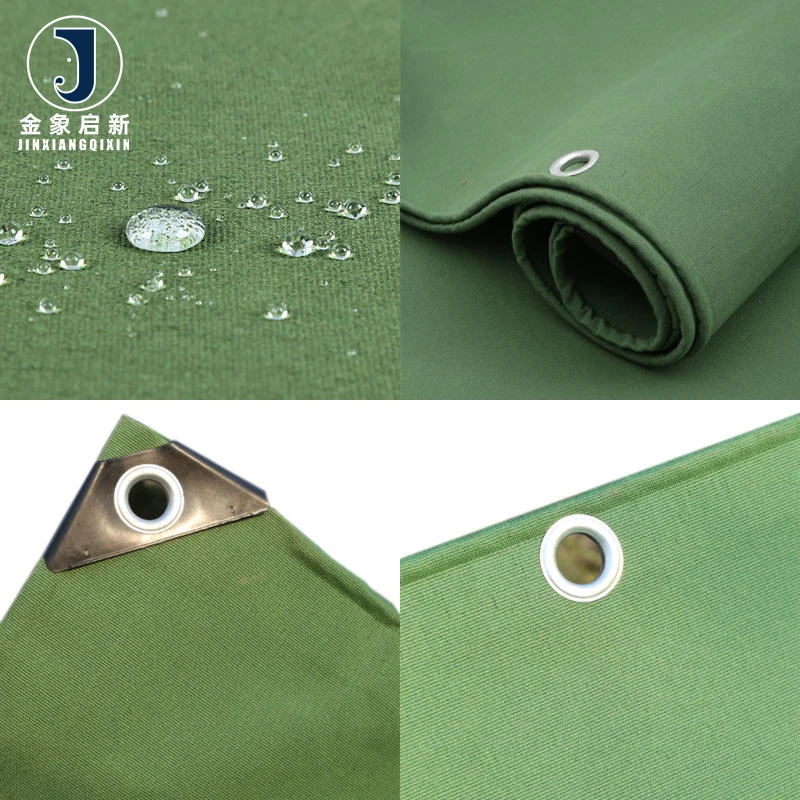
Deep process control over coating weight and adhesion — Every roll of heavy duty canvas tarpaulin for truck cover undergoes QA checks against the 600gsm specification before dispatch, ensuring the material you receive matches the quotation.
Technical Specifications
| Parameter | Value |
|---|---|
| Product Type | Canvas Tarpaulin |
| Base Material | Polyester cotton industrial textile, 8-12 strands of fine cotton yarn |
| Coating Material | Silicone |
| Weight | 600gsm |
| Total Thickness | 0.5mm / 0.6mm / 0.7mm |
| Roll Width | 2m |
| Roll Length | 100m |
| Color | Army Green Camouflage / Custom |
| Waterproof | Yes |
| UV Treatment | Test basis not stated — confirm requirement |
| Mildew Resistant | Yes |
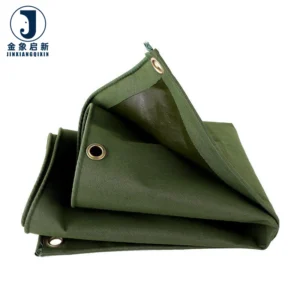
| Grommets | Rustproof aluminum grommets every 1 meter at corners and hem |
| Seam Construction | Folded and sewn with poly ropes |
| Service Life | 5-8 years (source value — verify against manufacturer catalog) |
| Standards | CE, ISO |
Application Suitability
| Application | Exposure & Requirement |
|---|---|
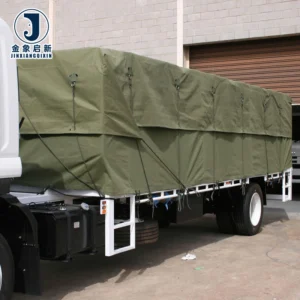
| Truck and trailer load cover | Constant road vibration, flex-point abrasion, weather exposure, secure tie-down at highway speed |
| Construction equipment cover during transit | Dust ingress, rain, UV exposure on site, repeated deployment and folding |
| Tent and canopy roof | Sustained sun and rain exposure, tension from frame structure, mildew risk in humid climates |
| Asphalt cover on transport | Heat retention, chemical contact with bitumen residues, mechanical abrasion from load shifting |
Why Generic-Size Covers Fail on Moving Loads
A Heavy Duty Canvas Tarpaulin for Truck Cover that is cut to a standard rectangle rarely matches the actual dimensions of a specific trailer deck, leaving gaps at the corners and excess fabric that flaps and abrades at speed. The result is a cover that shifts during transit, exposes part of the load to rain and road spray, and wears through at the tie-down points long before the main body of the fabric shows any damage. Fleet operators who specify cut-to-model sizing eliminate both the waste of oversized generic covers and the risk of under-sized covers that cannot be secured properly at the hem. [NEED_CITE: transport load cover fitment and failure analysis]
Silicone-Coated Polyester-Cotton Base for Breathable Load Protection
The polyester-cotton woven base, built from 8-12 strands of fine cotton yarn, provides a dense textile structure that holds the silicone coating evenly across the entire surface. Unlike fully sealed PVC constructions, silicone-coated canvas allows limited moisture vapour transmission while blocking liquid water, reducing condensation build-up under the cover during temperature swings on long-haul routes. This makes the heavy duty canvas tarpaulin for truck cover suited to loads that are sensitive to trapped humidity, such as packaged goods, timber and certain agricultural products.
Reinforced Hems and Grommet Spacing for Secure Tie-Down
Rustproof aluminum grommets are placed at 1-meter intervals along the hem and at every corner, distributing tie-down load across a wider section of the fabric edge rather than concentrating stress at isolated points. The hem itself is folded and sewn around poly ropes, adding a continuous reinforcement cord that prevents the grommet from pulling through the canvas when tension is applied by ratchet straps or bungee cords. [NEED_CITE: grommet pull-through test methods for coated fabrics] This construction addresses the common failure point where a cover tears at the eyelet before the main body shows any sign of wear.
Reading GSM, Thickness and Coating Weight Together
The 600gsm weight of this canvas tarpaulin reflects the combined mass of the polyester-cotton base fabric and the silicone coating, not the coating alone. A heavier GSM does not automatically mean higher tear strength — the weave density of the base yarns and the strand count determine how well the fabric resists tear propagation once a puncture occurs. The three available thickness options (0.5mm, 0.6mm, 0.7mm) correspond to different coating build-ups on the same base textile, allowing buyers to select the level of abrasion resistance and stiffness required for their specific load type. Thicker coatings add surface protection but also increase roll weight and reduce drape, which matters when a cover must be folded and deployed by a single operator on a loading dock.
The Cost of Overlooking Seam Construction at Flex Points
A cover that meets GSM and coating specifications on paper can still fail early if the seams are not engineered for repeated flexing under load movement. Standard single-row stitching creates needle holes that become tear initiation points, especially where the cover bends over sharp load edges or flaps in crosswind. Folded-and-sewn seams with poly rope reinforcement address this by spreading the mechanical load across the rope core rather than relying on the canvas alone. When a buyer specifies only GSM and ignores seam method, the result is a cover that delaminates or splits at the hem line within months of deployment, negating any advantage gained from selecting a heavier fabric grade. [NEED_CITE: seam failure modes in heavy-duty coated fabrics]
Production Capability Behind Every Roll
Three full production lines and 36 sets of professional equipment support consistent output of silicone-coated canvas in both roll stock and custom cut sizes. A 10-person R&D team handles material selection, custom sizing and sample development, with samples turned around within days for fleet-specific cover dimensions. Dedicated QA/QC runs at every production stage, with 100% pre-shipment inspection verifying that the 600gsm weight, grommet spacing and seam construction match the agreed specification before any roll leaves the facility. Nearly 30 years of focused coated fabric production provides the process control needed to maintain batch-to-batch consistency across multi-roll orders.
Documentation & Verification
- Material specification sheet confirming 600gsm weight, base fabric composition and silicone coating type for each roll
- Pre-shipment inspection record verifying grommet spacing and hem reinforcement against order requirements
- UV and mildew resistance test report provided where applicable — confirm the test basis required for your market
- Roll packing list detailing individual roll dimensions, weight and colour reference for shipment reconciliation
- CE and ISO certificates included with dispatch documentation
Fabrication, Handling & Storage
- Sew heavy-duty canvas tarpaulin using heavy-gauge needles suited to 600gsm material to avoid needle breakage at seams
- Allow 2m roll width plus hem allowance when calculating cut sizes to maintain grommet reinforcement integrity
- Store rolls upright on pallets to prevent flat-spot deformation of the silicone coating surface
- Deploy and fold covers above freezing to avoid stiffening of the polyester-cotton base in cold weather
- Clean with mild detergent and soft brush — avoid solvents that degrade the silicone coating finish
- Repair minor punctures with silicone-compatible adhesive patches matched to the 0.5mm–0.7mm thickness range
What We Need to Quote Your Cover
To provide an accurate specification and lead time, share the truck or trailer model dimensions, the type of load being covered and the typical road and weather conditions the cover will face. If your market requires specific UV or mildew resistance test documentation, state the standard or regulation so the correct test basis is applied. Let us know whether you need finished cut-to-size covers with grommets installed, or roll stock for your own fabrication line, and the estimated annual volume so we can plan production accordingly.
Frequently Asked Questions
Q: How is the 600gsm weight verified on delivery against the quoted specification?
A: Every roll undergoes a weight check during pre-shipment inspection, and the result is recorded on the inspection report that ships with your order. You can cross-reference the stated GSM against the physical roll weight upon arrival. If any discrepancy is found before dispatch, the roll is held for review rather than shipped.
Q: What seam construction method is used and how does it perform at load flex points?
A: Hems and seams are folded and sewn around poly ropes, creating a continuous reinforcement cord that distributes tie-down and flex stress across the rope rather than concentrating it on the canvas. This method reduces the risk of seam splitting at high-stress points where the cover bends over load edges or flaps during transit.
Q: Can the tarpaulin be cut to fit a specific truck or trailer model?
A: Yes, finished covers are produced in custom dimensions matched to vehicle specifications. You provide the model or exact measurements, and the cover is cut, hemmed and fitted with grommets to those dimensions, eliminating the gaps and excess fabric common with generic-size tarps.
Q: What is the test basis for UV and mildew resistance claims?
A: UV and mildew resistance performance depends on the specific test standard applied. Request the test report for your order and confirm which standard or regulation your market requires so the correct test basis is documented before production begins.
Q: What eyelet spacing and hem reinforcement options are available for tie-down loads?
A: Standard configuration uses rustproof aluminum grommets spaced every 1 meter along the hem and at each corner, with the hem folded and sewn around poly ropes. Custom spacing or additional reinforcement at specific stress points can be specified during the sampling stage.