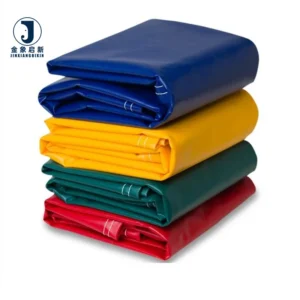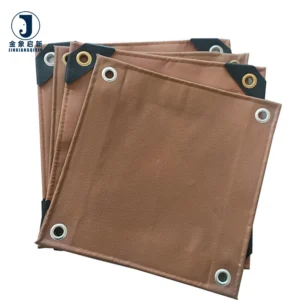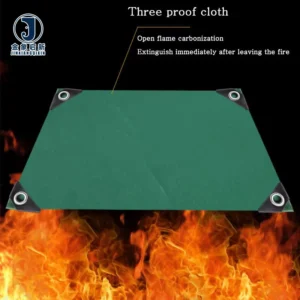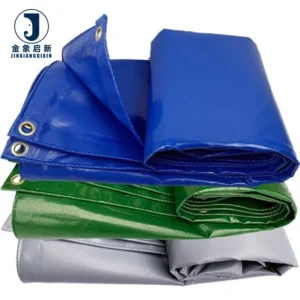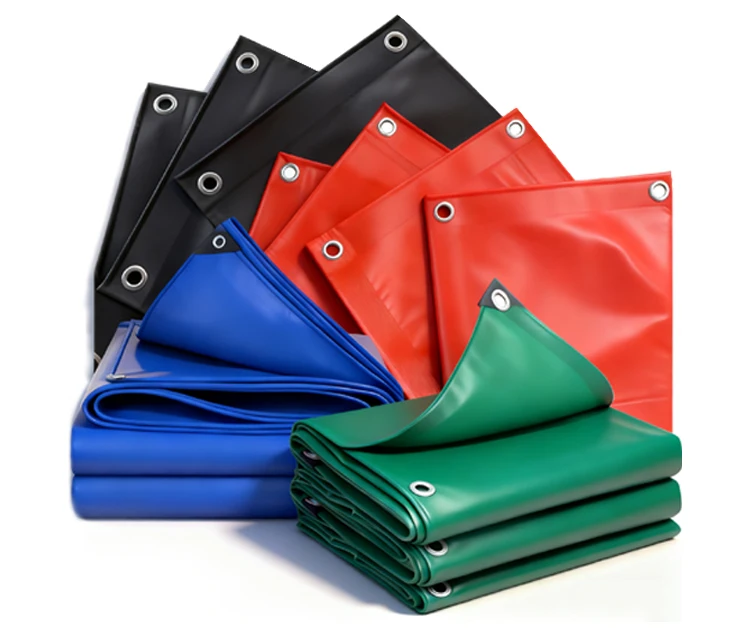
Three-Line Production Capacity — Jinxiang runs three full coating lines with 36 sets of professional equipment, supporting bulk roll output of PVC coated tarpaulin for truck and transport with consistent GSM control and on-time dispatch.
Technical Specifications
| Parameter | Value |
|---|---|
| Product Type | PVC Coated Tarpaulin |
| Base Fabric | 100% high tenacity polyester yarn |
| Yarn Denier Options | 500D / 1000D / 2000D |
| Coating Material | PVC |
| Coating Method | Lamination technology and hot melt coating technology |
| Weight Range | 400–500 g/m² (medium-duty) / 700–1000 g/m² (heavy-duty) / 1100–1500 g/m² (super heavy-duty) |
| Thickness Range | 0.35–0.45 mm / 0.70–1.0 mm / 1.2–1.5 mm |
| Tensile Strength (Warp/Weft) | 1500–2000 / 1200–1800 N/5cm (500D) · 2000–2500 / 1800–2200 N/5cm (1000D) · 2500–3000 / 2200–2800 N/5cm (2000D) |
| Treatment Options | Flame retardant (grade to be confirmed), anti-static (test basis to be confirmed), UV resistant, anti-mildew, cold-crack resistant |
| Waterproof | Fully waterproof coated construction |
| Standards | ISO, CE |
Application Suitability
| Application | Exposure & Requirement |
|---|---|
| Flatbed truck tarpaulin | Highway wind load, road spray, repeated tie-down tension at hems and eyelets |
| Trailer side curtain fabric | Constant flexing at load pivot points, abrasion against cargo edges, UV exposure |
| Full-size pickup load cover | Daily deployment and folding, weather protection for palletised freight |
| Transport equipment OEM build | Cut-to-fit side curtain panels, welded seam integrity under dynamic load movement |
| Logistics fleet weather cover | Seasonal temperature swings, cold-crack resistance, batch colour match across vehicles |
Why the Right PVC Coated Tarpaulin for Truck and Transport Demands More Than a GSM Number
A truck cover lives or dies at the weld seam, not in the middle of the fabric panel.
Fleet operators often specify a GSM figure and assume the cover will hold. In practice, the failure point is almost always where the fabric flexes most — at the welded hem, the eyelet reinforcement zone, or the tie-down strap contact area. The base fabric denier, the coating adhesion method, and the weld technique together determine whether the tarp survives repeated load movement on the highway. A PVC coated tarpaulin for truck and transport that is correctly specified at the seam will outlast a heavier fabric with poor weld integrity [NEED_CITE: tensile and tear test methods for coated fabrics per ISO 1421].
Cut to the Trailer, Not to a Generic Rectangle
A generic-size cover that does not match the trailer model creates excess fabric that flaps in highway wind, accelerates abrasion at contact points, and puts uneven tension on welded seams. Our PVC coated tarpaulin for truck and transport is cut to the specific trailer dimensions you provide, so the fabric sits flush against the load profile without billowing or dragging.
Weld Integrity at the Flex Zone
The seam is where most truck tarpaulin failures originate. Hot melt coating technology creates a strong bond between the PVC layers and the polyester base, and this adhesion carries through to the welded seam. When the load flexes during transit, the weld must absorb the same dynamic forces as the body fabric. We reinforce hems and high-stress tie-down points to handle the repeated stress cycles that a moving load generates [NEED_CITE: hot melt versus lamination coating adhesion comparison for welded seam performance].
Reading the Specification Sheet Beyond GSM
Weight in grams per square metre tells you how much coating is on the fabric, but it does not tell you how tightly the base yarn is woven or how well the coating adheres. A 500D base fabric with a dense weave and strong hot melt bond can outperform a loosely woven heavier fabric when it comes to tear propagation resistance. The denier of the yarn determines individual thread strength, while the weave density controls how a tear spreads once initiated. Coating thickness adds puncture resistance and weather protection but contributes less to structural tear strength than the base fabric construction. For truck and transport use, specifying denier, weave density, and coating method together gives a far more accurate picture of field performance than GSM alone.
What Happens When the Specification Is Wrong
Ordering a truck cover in a lighter GSM than the route demands leads to premature coating wear at abrasion points, especially where the tarp contacts sharp cargo edges or tie-down hardware. Specifying flame retardant treatment without confirming the grade required for your market can result in a load arriving at a site that rejects the cover on compliance grounds. Batch colour inconsistency across rolls in the same fleet order becomes visible once the covers are deployed side by side on adjacent vehicles, forcing a full replacement rather than a panel swap [NEED_CITE: fleet livery colour consistency standards for transport tarpaulins].
Why Source Your Truck Tarpaulin Fabric Here
Three full production lines with 36 sets of professional equipment give us the capacity to handle bulk roll orders for fleet-scale deployment without splitting your order across multiple production runs, which protects batch consistency.
A dedicated 10-person R&D team reviews your trailer model dimensions and recommends the denier and coating weight combination that matches the actual load profile and route conditions.
Every roll undergoes 100% inspection before shipment, with QA checkpoints at coating, curing, and winding stages so that GSM and colour are verified before the fabric leaves the line.
Samples for custom widths, colours, and treatment options are developed within days, letting you confirm the material against your trailer hardware and tie-down system before committing to a production run.
Documentation & Verification
- Material specification sheet stating base fabric denier, coating method, and colour reference for each roll
- GSM verification record confirming actual coating weight per roll against the quoted value
- Test report for flame retardant and UV treatment grades where applicable to your market
- Pre-shipment inspection record documenting seam integrity and surface condition
- Roll packing list with individual roll dimensions and weight for container loading planning
- Certificate of origin and customs documentation for cross-border shipment
Fabrication, Handling & Storage
- Hot melt coated fabric accepts heat welding — set temperature and dwell time to match the coating thickness grade selected
- Reinforce eyelet zones with additional PVC patches before punching to distribute tie-down load across the base fabric
- Store rolls upright on pallets in a shaded area to prevent flat-spotting and surface creasing on the coating
- Allow cold-stored rolls to reach ambient temperature before unrolling to avoid coating crack at the fold line
- Use mild detergent and soft brush for cleaning — avoid solvent-based cleaners that can degrade the PVC coating surface
- When cutting panels for custom trailer fitment, orient the warp direction along the longest span to maximise tensile resistance
Request a Specification Recommendation
Tell us the trailer model, the cargo type, and the typical route conditions your fleet operates in. Specify any fire-retardant or anti-static compliance requirements for the markets your vehicles enter, along with the colour and any branding or fleet livery requirements. We will recommend the denier, coating weight, and treatment package, and produce a sample roll for your approval before production.
Frequently Asked Questions
Q: How do you ensure the truck cover fits my specific trailer model?
A: We work from the exact trailer model dimensions you provide, including side curtain rail positions, tie-down point locations, and door clearance gaps. The PVC coated tarpaulin is cut and welded to those measurements rather than a generic rectangle, so the cover fits flush against the load profile without excess fabric that could flap or abrade during transit.
Q: What reinforcement options are available at tie-down and flex points?
A: We apply additional PVC patches at eyelet zones and high-flex areas where the tarp bends around cargo edges or tie-down hardware. The hot melt coating bond carries through to these reinforced zones, ensuring the weld and the base fabric share the load evenly under repeated highway tension cycles.
Q: How is batch colour consistency maintained across multiple rolls for fleet livery?
A: Each production run uses a single batch of compounded PVC colourant, and rolls are inspected under controlled lighting at the winding stage. We recommend approving a sample roll before bulk production so that the colour reference is locked for the entire fleet order.
Q: What documentation is provided to verify GSM and coating weight on arrival?
A: Every shipment includes a weight verification record per roll, a material specification sheet stating the base fabric denier and coating method, and a pre-shipment inspection record. Flame retardant and UV test reports are included where those treatments have been specified for your market.