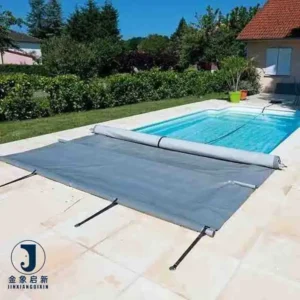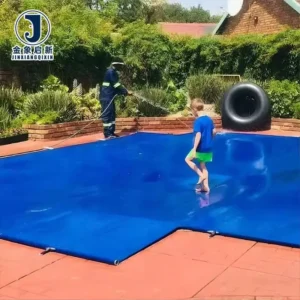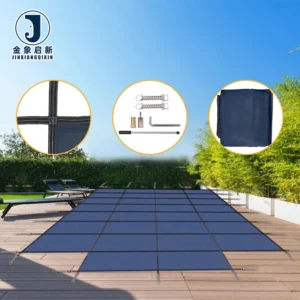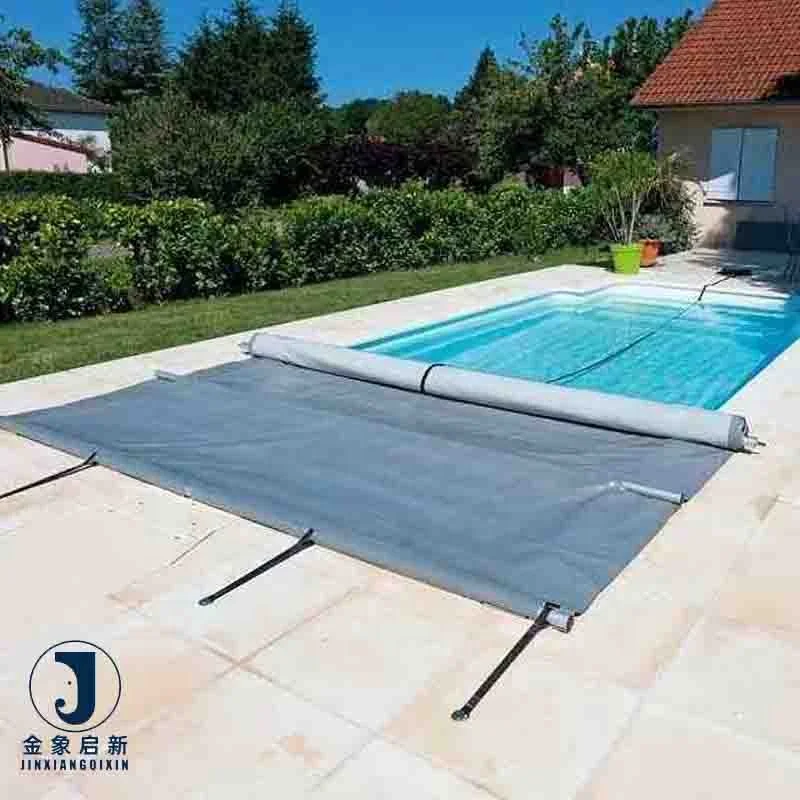
Consistent Coating Control — Every roll of PVC tarpaulin pool cover material is knife-coated on dedicated lines with 100% pre-shipment inspection, ensuring uniform waterproof and UV-resistant performance across your entire order.
Technical Specifications
| Parameter | Value |
|---|---|
| Product Type | PVC Tarpaulin Pool Cover |
| Material | PVC Knife Coated Fabric |
| Coating Method | Knife Coated |
| Waterproof Rating | 100% Waterproof |
| UV Treatment | Anti-UV (test basis not stated — request documentation) |
| Anti-Mildew | Yes |
| Weather Resistance | Rain, wind, snow, extreme temperatures |
| Tear Resistance | High strength and tear resistant |
| Color | Custom color available |
| Size | Custom size available |
Application Suitability
| Application | Exposure & Requirement |
|---|---|
| Residential swimming pools | Continuous sun and rain exposure, debris accumulation, seasonal temperature swings requiring flexible yet dimensionally stable cover material |
| Hotel and resort pools | High-frequency installation and removal cycles, demand for consistent color and finish across large cover spans |
| Outdoor commercial pools | Wind uplift at exposed edges, prolonged UV exposure, chemical-laden pool atmosphere requiring material that resists degradation |
| Construction site water features | Dust and sediment ingress prevention, heavy debris load, rough handling during placement and storage |
Why a Pool Cover That Fits Exactly Matters More Than You Think
Generic-sized covers leave exposed edges that invite wind lift, debris ingress, and accelerated wear at stress points.
When a PVC Pool Cover Tarpaulin for transport and outdoor pool protection is cut to an approximate dimension rather than a measured fit, the consequences compound quickly. Edges that flap in the wind abrade against the pool coping, creating micro-tears that expand under tension. Debris that slips under an ill-fitting cover settles into the water, defeating the primary purpose of covering the pool in the first place. Fleet operators and facility managers who manage on-site water features or settling pools encounter this repeatedly — a cover that looked adequate on paper fails to seal properly on site. [NEED_CITE: wind uplift failure points on tensioned membrane covers]
Custom Dimensions Eliminate the Fitment Gap
Every pool has unique geometry — coping profiles, step-downs, equipment cutouts, and perimeter drains all affect how a cover sits. A PVC pool cover tarpaulin cut to exact measured dimensions accounts for these variables. Overlap allowances are calculated based on the specific tie-down method, whether rope through eyelets, bungee cords, or weighted perimeter systems. This eliminates the guesswork that leads to either excessive material bunching or dangerous short-falls at the edges.
Knife Coated Construction for Extended Outdoor Service
The knife coating process applies PVC compound directly onto the base fabric under controlled pressure, forcing the coating into the weave interstices. This produces a PVC pool cover tarpaulin with a continuous waterproof barrier that does not delaminate under repeated wet-dry cycling. Unlike laminated alternatives, knife-coated fabric maintains coating adhesion at the fold lines and stress points where pool covers are most vulnerable during installation and removal. [NEED_CITE: coating adhesion test methods for PVC coated fabrics]
Understanding What the Specification Sheet Actually Tells You
The specification sheet for a pool cover fabric communicates several interdependent properties. Waterproof performance depends on coating continuity — a knife-coated PVC construction ensures the compound penetrates the base fabric fully, closing the weave gaps that allow water migration. Anti-mildew treatment addresses the underside environment where condensation accumulates between the cover and the water surface, a zone where biological growth initiates rapidly in warm climates. Tear resistance is a function of both the base fabric construction and the coating bond strength; the coating must transfer load across yarn intersections rather than peeling away under point stress. Custom color capability allows the cover to match site aesthetics while the PVC compound itself provides the functional weather barrier against rain, snow, and temperature extremes.
The Hidden Cost of Specifying on Price Alone
When pool cover material is sourced primarily on unit cost, the first compromise is typically coating weight. A thinner coating reduces the waterproof barrier’s durability and accelerates UV degradation of the base fabric beneath. Anti-mildew additives may be reduced or omitted entirely, leading to discoloration and odor that appears weeks after installation. Color consistency between production batches degrades when pigment dosing is not controlled to tight tolerances, creating visible variation when multiple covers are installed at the same facility. These failures do not appear immediately — they surface after the first full weather cycle, when replacement costs have already multiplied. [NEED_CITE: coating weight verification methods per ISO standards]
Why Source Pool Cover Fabric Through This Channel
Production runs are supported by three full coating lines and 36 sets of professional equipment, providing capacity for both single custom covers and multi-unit fleet orders without schedule conflict. A dedicated 10-person R&D team develops samples within days when custom dimensions, colors, or treatments are specified, allowing physical approval before production commitment. Every roll undergoes 100% inspection before dispatch, checking coating continuity, dimensional accuracy, and color consistency against the order specification. Knife coating process control ensures uniform coating weight across the full width and length of each roll, eliminating the thin spots that become failure origins. Material specification sheets accompany every shipment, documenting the coating method, base fabric type, and treatment claims for your records.
Documentation & Verification
- Material specification sheet stating knife coating method, base fabric construction, and anti-mildew treatment
- Pre-shipment inspection record confirming custom dimensions, color match, and seam integrity
- UV resistance test report provided where applicable — request the test basis for your market requirements
- Roll packing list detailing quantity, dimensions, and weight per unit for receiving verification
- Certificate of origin and customs documentation included for international pool cover shipments
Fabrication, Handling & Storage
- Weld seams on knife-coated PVC pool cover material using hot air at manufacturer-recommended temperature to maintain coating bond
- Specify overlap allowance when providing custom dimensions to account for hem folding and eyelet placement zones
- Store rolls on flat pallets in covered areas to prevent creasing that creates permanent coating stress marks
- Clean anti-mildew treated surfaces with mild detergent only — harsh solvents degrade the PVC compound
- Unroll custom-sized covers on clean flat surfaces before installation to identify any transit damage early
What We Need to Quote Your Pool Cover Accurately
Provide the exact pool dimensions including coping width, step profiles, and any equipment cutouts that affect the cover footprint. Specify the tie-down method you intend to use so overlap and reinforcement can be designed accordingly. Indicate your color requirement with a RAL or Pantone reference if available, and confirm whether you need the material supplied as finished covers or as roll stock for your own fabrication.
Frequently Asked Questions
Q: How is custom pool cover sizing measured and confirmed before production?
A: You provide the pool’s internal water dimensions plus coping width and any offset requirements. We calculate the overlap allowance based on your specified tie-down system and confirm the finished dimensions with you before production begins. A sample panel can be developed for physical approval if the order volume warrants it.
Q: What UV treatment test basis supports the anti-UV claim on this pool cover fabric?
A: Anti-UV treatment is applied during the PVC compounding stage. The specific test basis varies by product grade — request the test report with your inquiry so you can verify the treatment level meets your local climate requirements and any applicable standards for your market.
Q: How are welded seams reinforced at high-stress points around pool edges?
A: On knife-coated PVC fabric, seams are hot-air welded to create a bond that matches the base material strength. At perimeter zones where tie-down loads concentrate, additional reinforcement patches can be applied during fabrication to distribute stress across a wider area of the cover.
Q: How is batch color consistency maintained across multiple pool cover orders?
A: Pigment dosing is controlled per batch formulation against the approved color reference. Pre-shipment inspection includes color comparison across rolls in the same production run. For multi-phase projects, we retain the color standard on file to match subsequent orders.