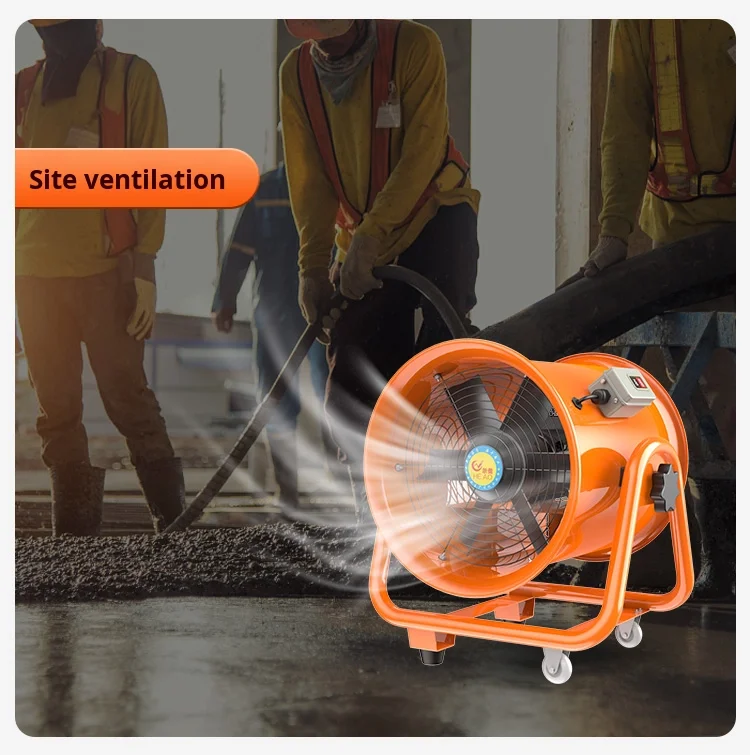
Proven Ventilation Equipment Supply — three full production lines and 36 sets of professional equipment ensure on-time delivery of portable axial flow fans and flexible duct hoses to transport and construction sites.
Technical Specifications
| Parameter | Value |
|---|---|
| Product Type | Portable Axial Flow Fan with Flexible Duct Hose |
| Size Options | 200mm / 250mm / 300mm / 350mm / 400mm / 450mm / 550mm / 650mm / 750mm / 850mm / 900mm |
| Power Range | 250W – 5500W (varies by size) |
| Air Volume Range | 1300 m³/h – 28000 m³/h (varies by size) |
| Total Pressure Range | 140 Pa – 320 Pa (varies by size) |
| Voltage | 220V / 380V |
| Noise Level | 57 – 88 dB(A) (varies by size) |
| Configuration | Handheld with flexible duct hose |
| Certifications | ISO, CE (company-level) |
Application Suitability
| Application | Exposure & Requirement |
|---|---|
| Enclosed truck and trailer loading bays | Diesel exhaust accumulation, confined airflow routing, continuous operation during loading cycles |
| Vehicle workshop and maintenance pits | Solvent fumes, welding particulates, low-clearance duct routing beneath chassis |
| Construction site temporary ventilation near transport routes | Dust ingress, equipment vibration, rapid deployment and relocation demands |
| Tunnel and trench work adjacent to logistics corridors | Moisture exposure, limited power supply options, extended duct runs |
Why Specifying the Right Air Volume Matters More Than Fan Size Alone
Matching a portable axial flow fan with flexible duct hose to the actual contaminant load and enclosure volume prevents dangerous under-ventilation on site.
Fleet operators and transport contractors frequently select ventilation equipment based on physical dimensions or a single airflow figure, only to find exhaust fumes still accumulating in enclosed loading bays or maintenance pits. The relationship between fan diameter, air volume, and duct resistance is not linear — longer duct runs, bends, and filters all reduce delivered airflow at the point of extraction. A unit rated at a given free-air volume may deliver substantially less once connected to the flexible duct hose routed around vehicle frames or through scaffolding [NEED_CITE: industrial ventilation design principles for confined spaces]. Without calculating total system resistance and required air changes per hour for the specific enclosure, the investment fails its primary safety function.
Sizing the Fan to the Enclosure and Contaminant Source
Selecting the correct portable axial flow fan with flexible duct hose starts with understanding the workspace volume and the rate at which contaminants are generated. A vehicle maintenance pit holding a single idling diesel truck requires different air exchange rates than a multi-bay loading dock where several engines run intermittently. The 11 available diameter options from 200mm to 900mm correspond to air volumes spanning 1300 m³/h to 28000 m³/h, covering scenarios from spot extraction at a single welding station to full-bay exhaust for heavy transport vehicles.
Routing Airflow Through Confined and Obstructed Spaces
The flexible duct hose paired with each fan allows directional airflow control around obstacles commonly found in transport workshops and loading areas — support columns, overhead crane rails, stacked cargo, and vehicle chassis. Duct routing introduces static pressure losses that reduce effective air delivery. Total pressure ratings ranging from 140 Pa to 320 Pa across the size options indicate how well each model can push or pull air through extended or convoluted duct paths [NEED_CITE: duct friction loss calculation methods for temporary ventilation systems]. Transport operators deploying these units in low-clearance maintenance pits or narrow loading corridors must account for these losses when selecting fan size.
Understanding the Power and Pressure Relationship
Each fan size within the 200mm to 900mm range carries a specific motor power rating from 250W to 5500W, directly influencing both air volume and total pressure capability. Higher-wattage models sustain airflow against greater duct resistance, which matters when hose runs extend beyond 10 metres or include multiple directional bends. The dual voltage support — 220V for single-phase site supplies and 380V for three-phase industrial power — means transport depots with standard workshop electrics can deploy smaller units immediately, while larger infrastructure projects with dedicated three-phase connections can run the high-capacity models without voltage conversion equipment.
How Noise Levels Affect Deployment Decisions in Occupied Zones
Noise output spans 57 to 88 dB(A) depending on fan size, a critical consideration when ventilation equipment operates in occupied transport workshops or near residential boundaries at logistics parks. Smaller diameter fans generating lower air volumes produce less noise, making them suitable for enclosed vehicle cabs or inspection areas where workers remain present throughout the shift. The larger 750mm to 900mm units delivering maximum airflow generate correspondingly higher sound levels, requiring hearing protection protocols or remote placement with extended duct runs to keep noise exposure within occupational limits [NEED_CITE: workplace noise exposure standards for industrial ventilation equipment].
What Happens When Ventilation Capacity Falls Short on Transport Sites
Under-specced portable axial flow fans on transport and construction sites lead to visible consequences within hours rather than weeks. Diesel particulates accumulate visibly in enclosed loading bays, welding fumes linger in maintenance pits beyond safe re-entry times, and workers begin removing personal protective equipment prematurely because heat and humidity build up faster than the extraction system can manage. These are not theoretical risks — transport fleet operators managing multiple depot locations frequently encounter compliance failures during safety audits when ventilation equipment does not match the documented air quality management plan. The mismatch typically traces back to selecting a unit based on available physical space rather than calculated airflow requirements [NEED_CITE: occupational exposure limits for diesel exhaust and welding fumes in confined spaces].
Why Procurement Verification Matters for Mobile Ventilation
Each procurement decision for portable axial flow fans carries specific verification requirements that transport and construction buyers should address before equipment arrives on site. Confirming voltage compatibility with the electrical infrastructure at each deployment location prevents costly project delays. Requesting test documentation for any fire-retardant or anti-static claims on the flexible duct hose ensures compliance with site safety regulations, particularly in environments where flammable vapours or combustible dusts are present. Verifying noise specifications against local occupational exposure standards protects both workers and the contracting company from regulatory action.
What Supports Reliable Supply for Transport Ventilation Projects
Three full production lines and 36 sets of professional equipment maintain production schedules for ventilation orders alongside the core coated fabric output, preventing the extended lead times that commonly delay transport site mobilisation. The 10-person R&D team handles specification matching between fan size, duct hose diameter, and site-specific airflow requirements rather than simply shipping standard catalogue items. Dedicated QA/QC inspection at every production stage with 100% pre-shipment checks catches dimensional deviations and motor performance issues before equipment leaves the facility. Samples and specification confirmations are developed within days when custom duct lengths or connection configurations are needed. Nearly 30 years of industrial manufacturing experience informs how ventilation equipment integrates with the broader site safety infrastructure.
Documentation & Verification
- Product specification sheet listing fan size, motor power, air volume, and total pressure ratings per unit
- Voltage configuration confirmation matching 220V or 380V site supply before dispatch
- Noise level test data per model size for occupational health compliance records
- Flexible duct hose material composition statement for fire safety plan documentation
- ISO and CE certificates confirming manufacturing system compliance for export markets
- Pre-shipment inspection record covering motor function, impeller balance, and duct connection integrity
Fabrication, Handling & Storage
- Position flexible duct hose connections to avoid sharp bends that restrict airflow below rated capacity
- Store fan units upright on pallets to prevent impeller shaft misalignment during transport depot staging
- Verify 220V or 380V supply matches motor nameplate before first energisation to prevent winding damage
- Route flexible duct hose away from vehicle exhaust paths and hot workshop equipment to prevent material degradation
- Secure duct hose joints with appropriate clamps rated for the selected fan’s total pressure output
- Clean fan impellers with compressed air rather than solvents to preserve motor bearing seals
What Information to Prepare Before Enquiry
Transport fleet operators and construction ventilation buyers should provide the enclosure dimensions, contaminant type and generation rate, available voltage supply, and required duct run length including any directional bends. Specify whether the flexible duct hose must meet fire-retardant or anti-static requirements for your site safety plan. Indicate the number of units needed and whether they will deploy across a single site or multiple transport depot locations to support logistics planning.
Frequently Asked Questions
Q: How do I determine the correct air volume for an enclosed truck loading bay?
A: Calculate the bay volume in cubic metres, then determine required air changes per hour based on the number and type of vehicles operating simultaneously and the contaminants generated. Cross-reference this figure against the air volume range of 1300 to 28000 m³/h available across our fan sizes, factoring in duct resistance losses for the specific hose length and routing layout planned.
Q: Are the flexible duct hoses certified for fire-retardant or anti-static use on construction sites?
A: Fire-retardant grades and anti-static properties are available in specific configurations, but the exact certification level must be confirmed against your site safety requirements before ordering. Request test reports and material composition statements during the enquiry stage to ensure the flexible duct hose supplied matches the compliance documentation your project safety plan demands.
Q: Can multiple portable axial flow fans be connected in series for longer duct runs?
A: Series connection is possible to overcome static pressure losses in extended flexible duct hose runs, but the combined system must be evaluated for airflow balance and motor load. The total pressure ratings from 140 Pa to 320 Pa across different fan sizes indicate how each model handles resistance, and our technical team can advise on series configurations suited to your specific duct routing.
Q: What voltage options are available for international transport depot deployments?
A: Dual voltage support covering 220V single-phase and 380V three-phase allows deployment across varied site electrical infrastructure. Confirm the available supply at each transport depot or construction location before ordering, as the motor winding configuration must match the site voltage to deliver rated air volume and prevent equipment damage.
Q: How do noise levels vary across different fan sizes for occupied workshop environments?
A: Noise output ranges from 57 dB(A) on smaller models to 88 dB(A) on the largest units, with the specific level determined by fan diameter and motor power. For occupied transport maintenance workshops where workers remain present during operation, select a size that delivers adequate airflow while keeping noise exposure within your site’s occupational health limits, or position larger units remotely with extended duct routing.