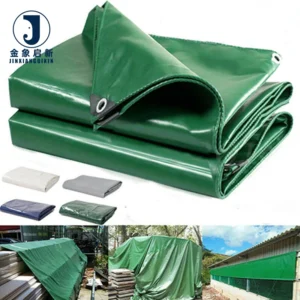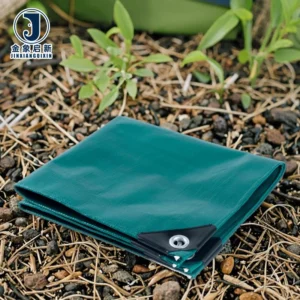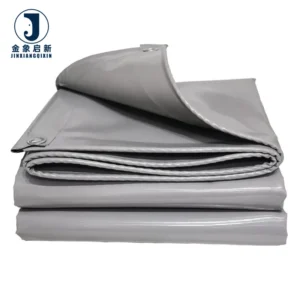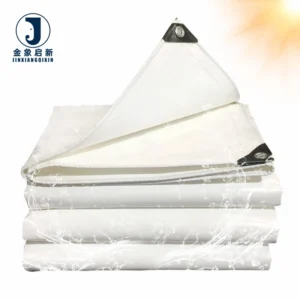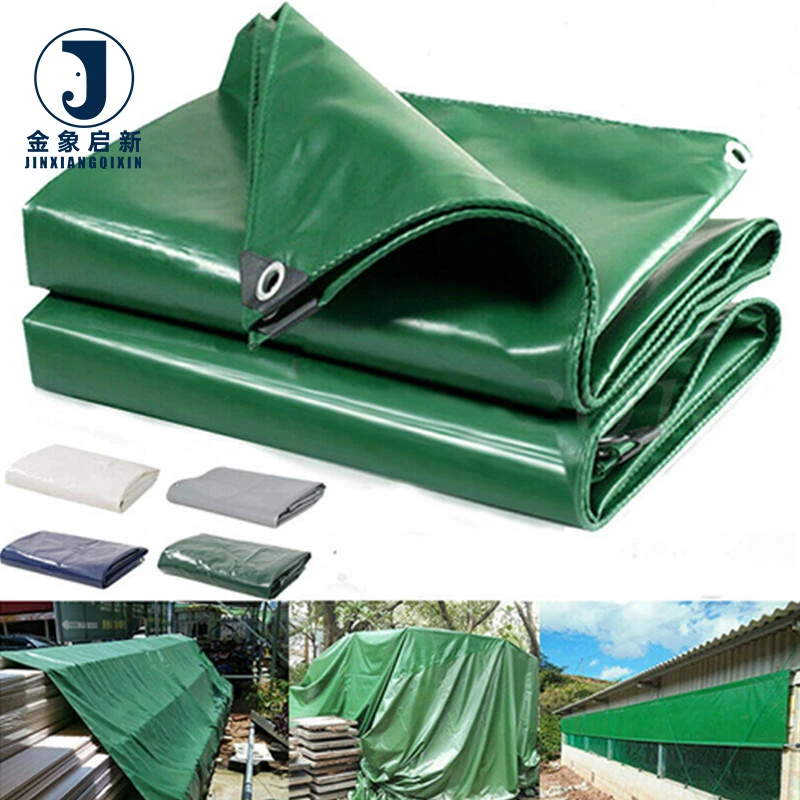
Coated Fabric Expertise — Three production lines and 36 sets of professional equipment handle bulk roll orders for truck and transport covers with verified GSM and reliable dispatch schedules.
Technical Specifications
| Parameter | Value |
|---|---|
| Product Type | PVC Coated Tarpaulin / Membrane Structure Fabric |
| Base Fabric Denier (medium-duty) | 500D |
| Base Fabric Denier (heavy-duty) | 1000D |
| Base Fabric Denier (super heavy) | 500D-2000D |
| Total Thickness (medium-duty) | 0.35-0.45 mm |
| Total Thickness (heavy-duty) | 0.70-1.0 mm |
| Total Thickness (super heavy) | 1.2-1.5 mm |
| Weight (medium-duty) | 400-500 g/m² |
| Weight (heavy-duty) | 700-1000 g/m² |
| Weight (super heavy) | 1100-1500 g/m² |
| Tensile Strength (medium-duty) | Longitude 1500-2000 / Latitude 1200-1800 N/5cm (test basis not stated in source) |
| Tensile Strength (heavy-duty) | Meridian 2000-2500 / Latitude 1800-2200 N/5cm (test basis not stated in source) |
| Tensile Strength (super heavy) | 2500-3000 warp / 2200-2800 weft N/5cm (test basis not stated in source) |
| Waterproof | Yes |
| UV Treatment | Available (test basis not stated in source) |
| Anti-Mildew | Yes |
| Roll Width Options | 6ft, 8ft, 10ft, 12ft / 2m, 4m, 6m |
| Roll Length Options | 100 yards, 100 meters, or custom |
| Eyelet & Hem Options | PP rope reinforced hem, galvanized eyelets every 3ft or 1m, reinforced plastic corners |
| Color Options | Blue, Blue/Orange, Green, Grey, Black, Clear, Grey/Green, Orange, or custom |
| Custom Printing | Available |
| Standards | ISO, CE |
Application Suitability
| Application | Exposure & Requirement |
|---|---|
| Truck and trailer side curtains | Constant flexing at load points, road abrasion, wind lift on highways, UV exposure |
| Fleet top covers and load wraps | Weather impact during transit, tie-down strap pressure, repeated folding and unfolding |
| Transport equipment OEM fitment | Model-specific cutting accuracy, batch colour consistency across production runs |
| Construction and agricultural fleet covers | Mud and debris abrasion, chemical exposure from cargo, prolonged outdoor parking |
| Large trailer and bulk material covers | Heavy wind load, extended sun exposure, mechanical stress from load shifting |
Why a Generic Truck Cover Size Fails at the Flex Points
A truck cover cut to a generic size that does not fit the specific trailer model leads to flapping, abrasion, and premature failure at flex points — our cut-to-model approach eliminates this.
Fit-to-model cutting removes the excess fabric that causes highway-speed flapping and concentrated wear.
When a PVC Coated Tarpaulin for Truck and Transport is ordered in a standard rectangle, the excess material billows at speed. That billowing concentrates stress at the tie-down points and along the welded seams. The result is not a slow wear pattern — it is a sudden split, often at the hem or the first eyelet, within the initial months of service. [NEED_CITE: wind-induced fabric fatigue on heavy transport covers] Fleet operators replacing covers multiple times per year often trace the failure back to fit, not fabric quality.
Covering a Moving Load: Where the Fabric Meets the Road
Truck and trailer covers operate in one of the harshest environments for coated fabric. The material must handle sustained wind pressure at highway speeds while flexing with every suspension movement and cargo shift. Our PVC Coated Tarpaulin for Truck and Transport is graded across three denier tiers — 500D for medium-duty curtain use, 1000D for heavy-duty top covers, and up to 2000D for super-heavy membrane applications — so fleet specifiers can match the fabric to the actual load profile and route exposure rather than defaulting to a single grade for all vehicles.
Tie-Down Security and Edge Integrity Under Highway Stress
The edge of a truck cover carries disproportionate load. Every strap passes through an eyelet, and every corner turns a radius under tension. We reinforce hems with PP rope and space galvanized eyelets at 3ft or 1m intervals to distribute tie-down force across a broader fabric area. Reinforced plastic corners add an extra layer at the highest-stress points. [NEED_CITE: tie-down load distribution on reinforced tarpaulin hems] For fleet operators running mixed trailer types, the eyelet spacing and hem construction can be adjusted to match the specific tie-down configuration of each vehicle model in the fleet.
Reading the Specification Sheet Beyond the GSM Number
Weight in g/m² is the most quoted figure in coated fabric procurement, but it tells only part of the story. A 700 g/m² PVC coated fabric with a 1000D base and tight weave will outperform a 700 g/m² fabric built on a lighter 500D base with heavier coating to reach the same weight. The coating adds mass but not tensile contribution — the base fabric denier and weave density determine how the material handles tear propagation and load flex. This is why our specification sheets list base fabric denier, coating weight, and total GSM separately, giving buyers the full picture of what they are receiving. The tensile strength values across warp and weft further clarify how the fabric will behave under directional loads typical of side curtain and top cover applications.
The Cost of Ordering Without a Model Number
When a transport company orders truck covers by generic dimensions, the covers arrive and appear to fit. The problems surface on the road. Loose fabric flaps at speed, wearing through at the contact points with the trailer frame. Tight fabric strains at the eyelets, pulling the hem away from the body of the cover. Both failure modes happen well before the fabric itself reaches end of life. [NEED_CITE: premature tarpaulin replacement due to incorrect sizing] The replacement cost is not just the new cover — it includes the downtime for the vehicle, the labour to remove and refit, and the cargo exposure risk during the gap. Specifying covers by trailer model number eliminates these variables before the material enters production.
Why Transport Fleets Source This Fabric Here
Three full production lines with 36 sets of professional equipment support the volume and consistency requirements of fleet-scale orders, whether the requirement is a single model run or a mixed fleet rollout.
The 10-person R&D team develops cut patterns and samples for specific truck and trailer models within days, allowing fleet operators to verify fit before committing to full production.
Dedicated QA/QC at every production stage, with 100% pre-shipment inspection, ensures that the GSM, colour, and hem construction match the approved specification before the rolls or finished covers leave the facility.
Roll-to-roll colour consistency is controlled and verified before dispatch, so covers installed across a fleet match when parked side by side at the depot.
Custom width and length options — from 2m to 6m widths and rolls of 100 yards or 100 meters — give transport equipment builders the flexibility to optimise cutting layouts and reduce waste in OEM fitment operations.
Documentation & Verification
- Material specification sheet stating exact GSM, base fabric denier, and coating weight for each roll in the order
- Pre-shipment inspection record covering visual defects, dimensional checks, and hem integrity
- UV treatment test report supplied where applicable — confirm the test standard required for your market
- Roll packing list with individual roll weights and dimensions for receiving verification
- Certificate of origin and customs documentation for cross-border fleet procurement
Fabrication, Handling & Storage
- High-frequency welding recommended for seams on 700-1000 g/m² heavy-duty grades to maintain bond strength at flex points
- PP rope hem reinforcement distributes tie-down load across the full edge of the truck cover
- Store rolls vertically on pallets to prevent flat-spot creases that weaken the PVC coating over time
- Allow cold-stored rolls to reach ambient temperature before unrolling to avoid coating crack at low temperature
- Clean with mild detergent only — solvent-based cleaners degrade the PVC surface and reduce UV treatment effectiveness
- Plan cutting layouts around available 2m, 4m, or 6m roll widths to minimise welded seams on large trailer covers
Starting Your Specification
To specify the right PVC Coated Tarpaulin for Truck and Transport for your fleet or production line, share the trailer model numbers, the operating environment including typical route climate, and any fire-retardant or UV treatment grades your market requires. Indicate whether you need roll stock for in-house fabrication or finished covers cut and hemmed to model-specific dimensions. If colour consistency across the fleet is critical, provide your RAL or Pantone reference so we can develop a sample for approval before production begins.
Frequently Asked Questions
Q: How do you verify GSM on arrival matches the quotation?
A: Every roll is weighed and documented against the material specification sheet before dispatch. The pre-shipment inspection record includes individual roll weights, so you can cross-check the received material against the stated GSM. We provide the specification sheet with base fabric denier and coating weight broken out separately, not just the total GSM figure.
Q: Can truck covers be cut to fit specific trailer models rather than generic sizes?
A: Yes. Our R&D team develops cut patterns based on the specific trailer model number, accounting for tie-down points, access panels, and flex zones. We produce samples within days for fit verification before full production, eliminating the flapping and premature wear caused by generic-size covers.
Q: What eyelet spacing and hem reinforcement options are available for highway tie-down loads?
A: Standard configuration uses galvanized eyelets spaced every 3ft or 1m with PP rope reinforced hems and reinforced plastic corners. Spacing and corner reinforcement can be adjusted to match your fleet’s tie-down system. Specify your strap configuration and trailer model so we can align the reinforcement to your actual load points.
Q: How is colour consistency controlled across rolls in the same fleet order?
A: All rolls in a single order are produced in the same batch run. Colour is verified against the approved reference before dispatch, and the pre-shipment inspection record confirms consistency. This ensures covers across your fleet match when installed side by side.
Q: What UV treatment test basis is provided for long-term road and weather exposure?
A: UV treatment is available for our PVC coated tarpaulin range. The specific test basis depends on the grade selected. Request the UV test report for your target market’s compliance requirements when placing your inquiry, and we will confirm the applicable test standard and results for your grade.