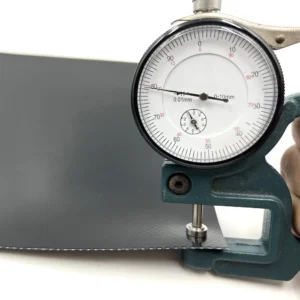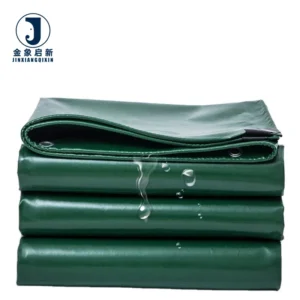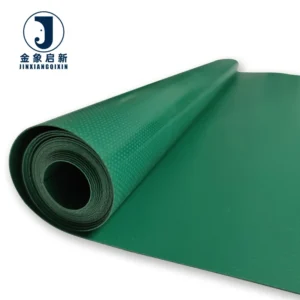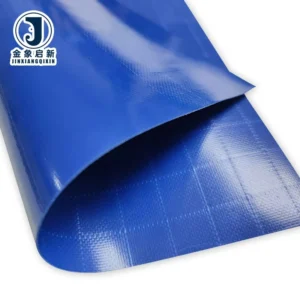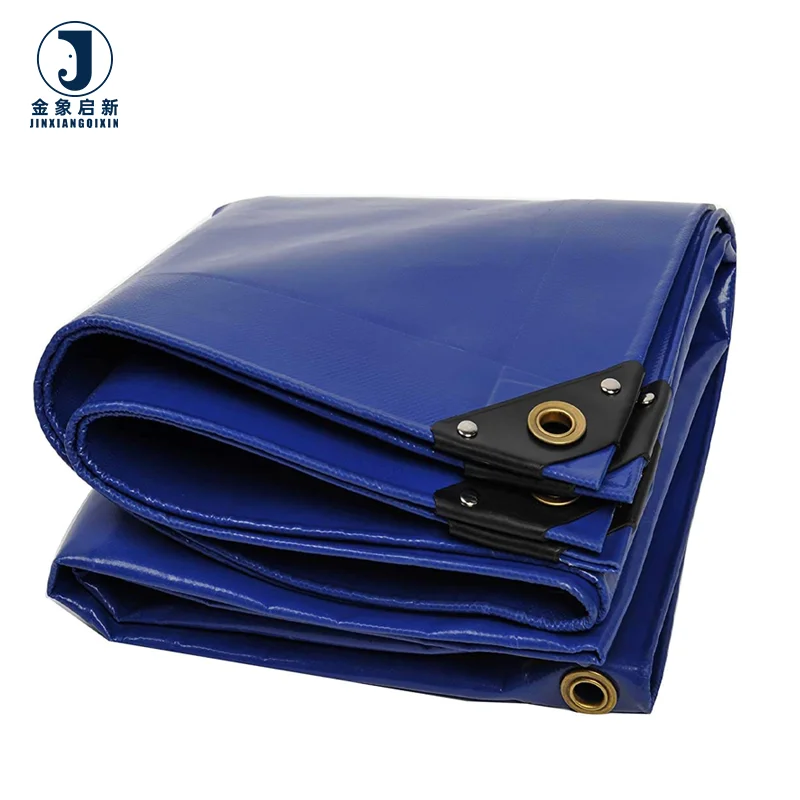
Near-three-decade coating focus — Jinxiang controls PVC coating weight and adhesion at every stage, ensuring the GSM on your truck cover roll matches the quotation before it leaves the factory.
Technical Specifications
| Parameter | Value |
|---|---|
| Product Type | PVC Coated Tarpaulin Roll |
| Coating Material | HDPE weaving with LDPE lamination on both sides (verify against PVC requirement) |
| Weight (GSM) | 50gr/m2 ~ 220gr/m2 available (range covers product family — confirm grade) |
| Total Thickness | 0.2-0.4mm / 8 mil-16 mil / Custom |
| Mesh Count Options | 6×6, 6×7, 7×7, 7×8, 8×8, 9×9, 8×10, 10×10, 12×12, 14×14, 14×16 weave |
| Width Options | 6ft, 8ft, 10ft, 12ft, 2m, 4m, 6m |
| Roll Length | 100 yards, 100 meters, or custom |
| Color Options | Blue, Blue/Orange, Green, Grey, Black, Clear, Grey/Green, Orange, or custom color |
| UV Treatment | Available (test basis not stated in source — confirm standard for your market) |
| Anti-Static | Claimed (standard not stated in source — verify certification required) |
| Waterproof | Yes |
| Mildew Proof | Yes |
| Anti-aging | Yes |
| Hem & Eyelet Options | PP rope reinforced on all four edges; galvanized eyelets every 3ft or 1m; reinforced plastic corners |
| Standards | ISO, CE |
Application Suitability
| Application | Exposure & Requirement |
|---|---|
| Truck and trailer load covering | Road abrasion, wind flexing at tie-down points, UV exposure during transit and yard storage |
| Fleet side curtain systems | Constant folding and unfolding, tension at roller mechanisms, weather sealing at edges |
| Transport equipment manufacturing | Roll-to-roll colour consistency for multi-unit builds, weld seam integrity at structural joints |
| Construction site equipment covers | Puncture from sharp edges, standing water, UV during long-term outdoor staging |
| Agricultural crop and timber covers | Moisture ingress, mildew in humid stacking conditions, UV degradation over seasons |
Why the Quoted GSM Does Not Guarantee the Tarpaulin You Receive
A stated weight on paper means nothing if the coating line runs light and nobody checks before dispatch.
Fleet operators who buy PVC tarpaulin roll for truck and transport covering frequently face a quiet problem: the roll feels thinner on the loading dock than the sample did. The coating weight was reduced somewhere between the quotation and the production run, and by the time the cover fails at a flex point, the material is already installed on a trailer hundreds of kilometres from the supplier. [NEED_CITE: GSM variance in coated fabrics and its effect on tensile performance per ISO 1421]
This is not a rare occurrence. It happens because some suppliers treat GSM as a nominal target rather than a controlled parameter, and pre-shipment inspection is either skipped or done on a single sample roll rather than across the full batch.
How Roll-to-Roll Consistency Protects Your Fleet Build Schedule
When you order multiple rolls of PVC tarpaulin roll for truck and transport applications, even slight colour drift between rolls becomes visible once installed side by side on a trailer fleet. A batch with inconsistent coating weight also means some covers will age faster than others, creating uneven replacement cycles across your vehicles. Jinxiang runs dedicated QA checks at every production stage so that the colour reference and weight tolerance hold across the entire order, not just the first roll off the line.
Matching Mesh Density to the Real Loads Your Covers Will See
A 6×6 weave handles light temporary covering where the material sees minimal tension. A 14×16 mesh count, by contrast, places more yarn per square centimetre and distributes tie-down forces across a tighter grid, reducing the chance that a single broken yarn starts a tear that propagates across the panel. Choosing the correct density for your trailer model and load type prevents overspecifying on lighter-duty covers and underspecifying on heavy highway exposure. [NEED_CITE: weave density and tear propagation in coated fabrics]
What Coating Weight and Weave Density Actually Control
The GSM figure alone does not tell the full story. A 220gr/m2 fabric with a loose 6×6 weave concentrates the coating mass over fewer yarns, which can mean good water resistance but lower tear strength at the yarn junctions. A tighter 12×12 or 14×16 weave at the same weight spreads the coating more evenly and gives each yarn intersection more support from its neighbours. Thickness — here available from 0.2mm to 0.4mm — also influences how the material handles at the fabricator’s welding table: thinner rolls conform to tight folds and complex shapes more easily, while thicker grades resist puncture from cargo edges. The combination of mesh count, GSM, and thickness determines whether a cover survives a season of highway use or needs replacing after the first load shift.
The Hidden Cost of Getting the Specification Wrong
Order a roll that is too light for the exposure and the first sign of trouble is usually not the fabric itself — it is the welded seam splitting where the material flexes most around a trailer corner. A cover specified without UV treatment for a truck that sits in a southern European yard will become brittle at the fold lines within a single summer, long before the body of the fabric shows wear. [NEED_CITE: UV degradation patterns in coated tarpaulins under continuous outdoor exposure] Colour inconsistency across a multi-roll order means the fabricator either rejects the batch and delays the build, or ships mismatched covers and absorbs the customer complaint. Each of these outcomes costs more than specifying correctly at the inquiry stage.
Why Transport Buyers Source This PVC Tarpaulin Roll from Jinxiang
Three full production lines and 36 sets of professional equipment give the capacity to fill container orders on schedule without splitting your batch across multiple runs. The 10-person R&D team develops samples within days when you need a custom width or colour match for a specific trailer model. A hundred percent pre-shipment inspection means every roll is checked for weight and visual consistency before packing, not just a random sample. Deep process control over coating weight and adhesion, built over nearly 30 years of coated fabric production, is what keeps the GSM on the delivery note matching the GSM on your test cut. Custom widths and lengths are handled as standard production runs, not treated as exceptions with inflated minimums.
Documentation & Verification
- Material specification sheet stating confirmed GSM, HDPE base weave, LDPE lamination, and colour reference
- UV test report provided when UV treatment grade is specified and confirmed for target market
- Pre-shipment inspection record with per-roll weight check against quoted GSM
- Roll packing list with roll count, individual roll weight, and CBM for container loading calculation
- Certificate of origin and customs documentation for cross-border shipment
Fabrication, Handling & Storage
- Heat-weld seams using temperature and dwell settings matched to the LDPE lamination layer; test on a scrap piece of the same roll first
- PP rope in the hem distributes tie-down load — space galvanized eyelets at 3ft intervals for standard loads, closer for heavy highway use
- Store rolls upright on the hard paper tube to prevent flat-spot creases that weaken the coating at the fold line
- Unroll in temperatures above freezing; cold LDPE lamination can crack if forced open in sub-zero conditions
- Clean with mild detergent and soft brush; avoid solvent-based cleaners that attack the LDPE surface
- Cut panels with a hot knife to seal edges and prevent weave fraying before hemming
Before You Send the Inquiry
Tell us the trailer models you are covering and the typical load profile — flatbed steel, palletised goods, or bulk agricultural — so we can recommend the right mesh count and GSM range. If your market requires UV treatment or anti-static certification, state the standard your end customer demands. Specify whether you need rolls in stock widths or custom cut widths, and whether finished eyelet-and-hem panels or raw roll stock suits your fabrication setup.
Frequently Asked Questions
Q: How do I verify the GSM matches the quotation when the rolls arrive?
A: Cut a measured sample from each roll, weigh it on a calibrated scale, and compare against the stated GSM on the material specification sheet. Jinxiang ships a pre-shipment inspection record with per-roll weight data so you can cross-reference before cutting. If any roll falls outside tolerance, flag it before fabrication begins.
Q: How do I choose the right roll width and length for container loading?
A: Wider rolls reduce the number of welded seams on large covers but increase CBM per roll. Standard widths run from 2m to 6m, and roll lengths of 100 yards or 100 meters are typical. Share your container type and we will calculate the roll count and weight that fills the space without exceeding weight limits.
Q: How is colour consistency maintained when I order multiple rolls?
A: Each production batch is mixed from a single colour reference and checked against the standard under controlled lighting. Rolls from the same order are inspected side by side before packing. If your project requires rolls from the same dye lot, state this at the inquiry stage so it is built into the production schedule.
Q: What eyelet spacing and hem reinforcement should I specify for truck tie-downs?
A: Galvanized eyelets at 3ft or 1m intervals work for standard flatbed loads.*he full edge rather than concentrating it at each eyelet. For heavier loads or higher wind exposure, request closer eyelet spacing and confirm the reinforced plastic corner patches are included at high-stress points.
Q: What documentation ships with my roll order?
A: You receive a material specification sheet with the confirmed GSM and colour reference, a roll packing list with individual roll weights and dimensions, the pre-shipment inspection record, and a certificate of origin. UV or anti-static test reports are included when those treatments are specified and confirmed for your target market standard.