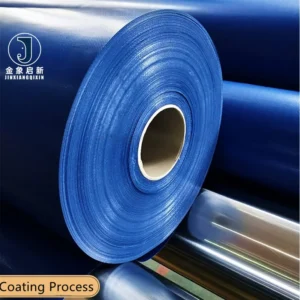
Deep process control over coating weight — verified at every production stage for PVC coated tarpaulin rolls destined for transport and load-covering service.
Technical Specifications
| Parameter | Value |
|---|---|
| Product Type | PVC Coated Tarpaulin Roll |
| Material | PVC Coated Fabric |
| Weight (GSM) | 50 g/m² ~ 220 g/m² available |
| Thickness | 0.2–0.4 mm / 8–16 mil (customizable) |
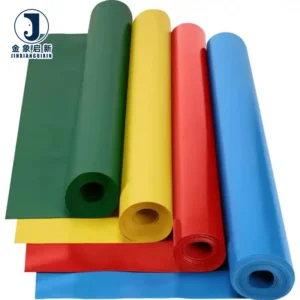
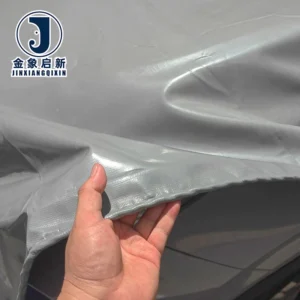
| Color Options | Blue, Green, Grey, Black, Clear, Orange (customizable) |
| Waterproof | Yes |
| UV Treatment | Available (test basis not stated) |
| Mildew Proof | Yes |
| Anti-aging | Yes |
| Tear Resistant | Yes |
| Key Features | Waterproof, mildew proof, anti-aging, tear resistant, UV treatment available |
| Standards | ISO 9001, ISO 14001, ISO 45001, CE |
Application Suitability
| Application | Exposure & Requirement |
|---|---|
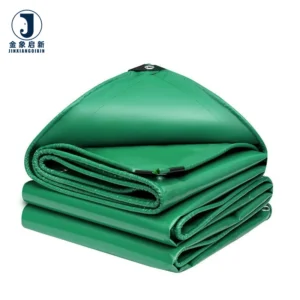
| Flatbed and trailer load cover | Road vibration, weather, wind uplift, repeated tie-down tensioning |
| Truck side curtain fabric | Constant flexing at roller tracks, road spray abrasion, daily UV exposure |
| Construction site equipment cover | Outdoor weathering, dust, mechanical contact with sharp edges |
| Agricultural stock and pond cover | Permanent water contact, soil chemistry, puncture from debris |
| Transport-adjacent ground protection | Tyre traffic, aggregate abrasion, fuel and oil spill resistance |
Why Roll-to-Roll Consistency Matters More Than Quoted GSM for PVC Tarpaulin for Truck and Transport Cover
A specification sheet that looks identical across three rolls means nothing if the coating weight drifts between them.
Fleet operators and tarpaulin fabricators routinely receive shipments where one roll measures lighter than the next, even though the invoice states a single GSM figure. When those rolls are cut and welded into side curtains or load covers, the lighter panels flex differently under road vibration and wear through at stress points well before the heavier ones. [NEED_CITE: coating weight variation and its effect on tensile uniformity across rolls per ISO 1421] The result is a cover that fails in sections rather than as a system, forcing partial replacement and downtime the operator never budgeted for. PVC Tarpaulin for Truck and Transport Cover supplied with documented per-roll weight verification eliminates this mismatch before the fabric ever reaches the cutting table.
Matching Fabric Weight to the Load Profile of Moving Cargo
Transport covers face a specific damage sequence: wind-driven flutter initiates micro-tears at the hem, road grit abrades the coating at contact points, and tie-down straps concentrate load at anchor positions. Selecting a GSM grade that aligns with the trailer type and route conditions determines whether the PVC coated tarpaulin roll absorbs these forces or transmits them into structural failure. Lighter grades serve short-haul and urban delivery where the cover is tensioned and released daily, while heavier grades hold up under long-haul motorway conditions with sustained wind load and higher UV exposure.
Tensioning Hardware and Edge Reinforcement at Flex Points
The fabric itself is only half the equation for a transport cover that survives repeated deployment. Brass anchors, triangular hooks and ratchet systems distribute tension across multiple points, preventing the localized stress that tears unreinforced hems. Aluminium poles provide mid-span support on wider loads, reducing sag and the ponding that accelerates mildew on the underside. When these hardware elements are paired with heat-welded seams at the anchor zones, the PVC coated tarpaulin roll performs as an integrated system rather than a sheet of material held together by thread alone. [NEED_CITE: seam strength testing methods for coated fabrics under cyclic loading]
How Coating Method and Base Fabric Define On-Road Performance
The interaction between the PVC coating and the base fabric determines how the material behaves when a load shifts or the cover flexes in crosswinds. Coating weight governs waterproofing and surface durability, while the base fabric’s weave density controls tear propagation — a dense weave stops a puncture from spreading into a split, even when the coating layer is thin. Thickness, measured at 0.2–0.4 mm across the available range, correlates with both abrasion resistance at contact points and flexibility at low temperatures, where stiffer material is more prone to cracking during deployment in cold weather. UV treatment, when specified, protects the coating surface from embrittlement that leads to chalking and micro-cracking. For transport covers, the balance between flexibility and abrasion resistance typically favours mid-to-heavy GSM grades with confirmed UV stabilisation for the target climate zone.
The Hidden Cost of Underspecified Fabric for Fleet Covers
Specifying a PVC coated tarpaulin roll purely on price-per-metre invites failures that surface after the cover is in service, not in the warehouse. A lighter-than-required GSM leads to coating abrasion at tie-down points within the first season of use. Skipping UV treatment on covers that run exposed routes results in surface embrittlement and colour fade that fleet operators associate with poor quality, regardless of the base fabric’s actual strength. [NEED_CITE: field failure analysis of PVC tarpaulin at anchor and hem stress points] Batch colour inconsistency across rolls forces fabricators to reject panels mid-production, inflating waste and delaying delivery to the fleet operator who is already running without cover.
Why Fabricators and Fleet Buyers Source PVC Coated Tarpaulin Roll Here
Three full production lines and 36 sets of professional equipment support bulk roll output with controlled coating weight, so the GSM on the quotation matches what arrives at the dock.
A dedicated 10-person R&D team develops samples within days for custom width, colour and GSM requests, letting you validate fabric behaviour before committing to a container order.
QA inspection at every production stage — not just at the end of the line — catches coating weight drift, colour shift and weave defects before the roll is wound.
Full pre-shipment inspection with documented per-roll verification gives fleet procurement teams the traceability needed to approve incoming goods without re-testing.
Custom sizing to specific trailer dimensions replaces the generic cut sizes that leave excess material flapping or come up short at the anchor rail.
Documentation & Verification
- Material spec sheet stating GSM, base fabric type, coating method and colour reference per roll
- UV treatment test report supplied when the grade is specified at order stage
- Pre-shipment inspection record confirming weight, width and visual quality roll by roll
- Roll packing list with batch traceability for cross-border fleet procurement
- Certificate of origin and full customs documentation for international transport orders
Fabrication, Handling & Storage
- Heat-weld seams at anchor points using parameters matched to the 0.2–0.4 mm thickness range
- Reinforce tie-down zones with additional PVC patches before installing brass anchors or hooks
- Store rolls upright on hard paper tubes to prevent flat-spot creasing across the coating surface
- Allow rolls to acclimate to ambient temperature before unrolling in cold conditions to avoid cracking
- Cut panels with allowance for thermal expansion when welding multi-piece transport covers
- Clean with mild detergent only to preserve the mildew-proof and anti-aging treatment on the PVC coating
Specifying Your PVC Tarpaulin for Truck and Transport Cover Order
To match the right PVC coated tarpaulin roll to your fleet or fabrication requirement, provide the trailer model or cover dimensions, the GSM range you have been using, and the UV exposure conditions on your primary routes. Let us know if you need roll stock only or finished panels cut and welded to size, along with your preferred colour reference and any hardware configuration such as ratchet systems or aluminium pole supports. A sample cut from production stock can be dispatched for your own tensile and weld testing before you commit to the full order.
Frequently Asked Questions
Q: How do I verify that the GSM of each roll matches the quotation on delivery?
A: Every roll undergoes weight verification during our 100% pre-shipment inspection. You receive an inspection record showing measured GSM per roll alongside the quoted figure, so any deviation is flagged before dispatch. You can cross-check with a simple scale test on arrival against the documented values.
Q: Can the rolls be cut to fit my specific trailer model rather than a generic size?
A: Yes. Provide your trailer make, model and the exact cover dimensions including hem and eyelet positions. Our R&D team develops a cut-and-weld pattern tailored to those measurements, and a sample is produced for fitment approval before the full batch runs.
Q: Will UV treatment be documented with a test report?
A: UV treatment is available across the PVC coated tarpaulin roll range. When you specify UV-stabilised fabric at the inquiry stage, a test report is included with your shipment documentation. Confirm the test standard required for your market so we align the treatment grade accordingly.
Q: How consistent is colour across multiple rolls in one shipment?
A: Colour is controlled across the full batch run, with in-process QA checks at the coating stage to catch drift before the roll is wound. The pre-shipment inspection record confirms visual colour consistency roll by roll, reducing the risk of mismatched panels when installed side by side.
Q: Do you supply finished transport covers or only PVC coated tarpaulin roll stock?
A: Both. Fleet operators can order finished covers cut and welded to trailer dimensions with hardware installed, while fabricators and distributors order roll stock by container for their own production. Specify your requirement at inquiry so we quote the correct format and lead time.