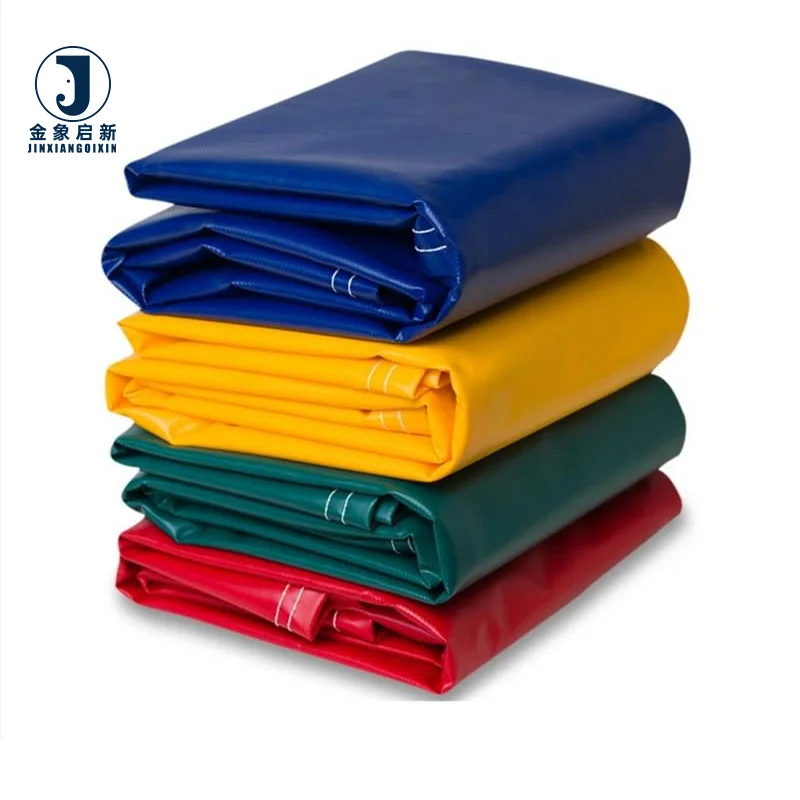
Proven adhesion control — Hot-melt coating technology bonds PVC to high-tenacity polyester mesh under controlled heat and pressure, ensuring the coating does not delaminate at flex points on a moving load.
Technical Specifications
| Parameter | Value |
|---|---|
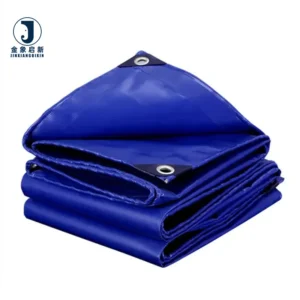
| Product Type | PVC Knife-Coated Tarpaulin for Truck Cover |
| Material | PVC + High-strength polyester mesh fabric |
| Coating Method | Laminated technology & Hot-melt Coating technology |
| Weight (GSM) | 350gsm / 420gsm / 500gsm / 550gsm / 600gsm / 750gsm |
| Total Thickness | 0.32mm / 0.35mm / 0.4mm / 0.45mm / 0.5mm / 0.65mm |
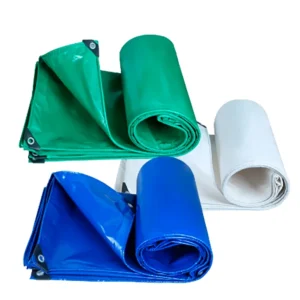
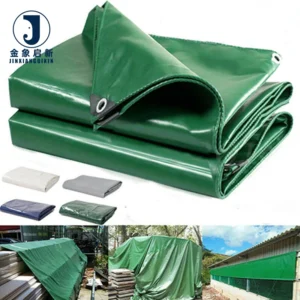
| Color Options | Blue / Red / Yellow / Light Blue / Grey (Customized) |
| Roll Size | 2m width × 75m length / 2.1m width × 50m length |
| Finished Product Size | Custom items as per customer’s needs or sold by inventory |
| Flame Retardant | Available in flame retardant grades — confirm the grade required for your market |
| Anti-Static | Available in anti-static treatment — surface resistance or standard to be confirmed |
| Anti-UV | UV treatment available — test basis to be confirmed per order |
| Service Life | 3-7 years under normal circumstances |
| Key Features | Cold crack resistance, anti-mildew, waterproof, sunproof, best color fastness |
| Standards | ISO, CE |
Application Suitability
| Application | Exposure & Requirement |
|---|---|
| Flatbed and curtain-side trailer covers | Continuous highway flexing, wind load, abrasion at tie-down contact points |
| Refrigerated trailer top covers | Temperature cycling from sub-zero to ambient, condensation, UV exposure |
| Transport equipment new builds | High-frequency welding of side curtain fabric to trailer aluminium rail |
| Fleet cover replacement | Matching colour to existing fleet livery, reinforced hem at buckle and strap zones |
| Cargo ship deck covers | Salt spray exposure, heavy weather, prolonged sun, abrasion from shifting loads |
Why Seam Failure Happens Before the Fabric Does
Coating adhesion strength determines whether the weld line or the fabric gives way first under load flex.
Fleet operators frequently report that truck covers split at the welded seam long before the fabric itself shows wear. The failure typically starts at the point where the load flexes most during transit — near the tie-down straps and at the trailer corners. When the PVC coating does not bond fully to the base fabric, the heat from high-frequency welding melts the surface but the coating-to-fabric interface separates under repeated bending. This is why a PVC coated truck tarpaulin cover must be specified on adhesion strength, not just GSM alone. [NEED_CITE: peel adhesion test methods for PVC coated fabrics]
Cut to Trailer Model, Not Generic Roll Widths
A PVC coated truck tarpaulin cover cut to a generic dimension leaves gaps at the trailer edges or excess fabric that flaps in the slipstream, accelerating wear at the hem. Covers are cut to the exact dimensions of each trailer model — flatbed, curtain-side or refrigerated — so the fabric sits flush against the load without tension points that pull at welded seams.
Reinforcement Where the Load Flexes
The areas around tie-down straps, corner buckles and the bottom hem absorb the highest stress during transit. Hem reinforcement and eyelet spacing are configured for the specific trailer model so that the load-bearing points distribute force across a wider fabric area. This prevents the common failure where a standard grommet tears through the coating at the first hard braking event.
Understanding GSM in Context with Coating Adhesion
GSM indicates the total weight per square metre — base fabric plus coating combined — but two rolls at the same GSM can perform very differently depending on how that weight is distributed. A heavier coating on a lighter base fabric may deliver surface thickness but lack the tensile strength needed for long-haul highway flexing. Conversely, a tighter polyester mesh with a thinner coating bond provides tear resistance but may not protect against UV degradation over extended outdoor exposure. The hot-melt coating and laminated technology used here ensures consistent PVC-to-polyester adhesion across the full roll width, which directly supports reliable high-frequency welding during fabrication. [NEED_CITE: tensile and tear test methods for coated fabrics per ISO 1421]
The Cost of Specifying on Price Per Kilogram Alone
When procurement decisions are driven by cost per kilogram rather than verified GSM and adhesion performance, the consequences surface after the first season on the road. Covers that arrive lighter than quoted wear through at the flex zones within months. Batch colour variation across rolls in a single order becomes visible once installed side by side on a fleet, forcing selective replacement. Welded seams that fail prematurely require the entire panel to be removed and re-fabricated, costing more in downtime than the original material saving. [NEED_CITE: field failure analysis of PVC tarpaulin seams under cyclic load]
Production Capability Aligned to Fleet Requirements
Three full production lines and 36 sets of professional equipment support bulk output without sacrificing the coating consistency that fleet operators require across multiple trailer models. The 10-person R&D team handles pattern printing, custom sizing and sample development so that a new fleet livery or a one-off trailer shape can be prototyped and approved before the full production run. A dedicated QA/QC process inspects every roll before shipment, verifying that GSM, colour and dimensions match the order specification. Nearly 30 years of focused coated fabric production underpins this process control.
Documentation & Verification
- Material specification sheet stating GSM, base fabric and coating type per roll
- Pre-shipment inspection record confirming cover dimensions against trailer model drawings
- Colour consistency verified across all rolls within the same dispatch batch
- UV and flame retardant test reports supplied where treatment grades are specified
- Certificate of origin and customs documentation for cross-border fleet deliveries
Fabrication, Handling & Storage
- High-frequency welding parameters must be set to match the coating thickness — 0.32mm and 0.65mm grades require different power and dwell settings
- Reinforced hem sections at tie-down points should be double-layer*olyester mesh
- Store rolls vertically on a flat pallet in a shaded area to prevent compression marks on the PVC surface
- Allow rolls to acclimatise to workshop temperature before unrolling in cold weather — cold crack resistance is rated but stiff fabric may crease during handling
- Clean with mild soap and water; avoid solvent-based cleaners that can soften the PVC coating at eyelet edges
- Cut patterns should be nested to maximise material yield from the 2m or 2.1m roll width and reduce weld seam count
What to Include in Your Enquiry
To specify a PVC coated truck tarpaulin cover accurately, provide the trailer make and model or the exact cover dimensions required, the GSM grade preferred, and the route conditions the fleet typically operates under — long-haul highway, urban multi-drop, or cold-chain refrigerated. If your market requires a specific flame retardant or anti-static certification, state the standard so the correct treatment grade can be included in the sample.
Frequently Asked Questions
Q: How do you ensure the GSM on arrival matches what was quoted?
A: Every roll undergoes a pre-shipment inspection where the actual weight per square metre is measured and recorded. The material specification sheet included with your shipment lists the verified GSM alongside the base fabric denier and coating weight. This gives your receiving team a documented baseline to check against on arrival.
Q: Can you cut covers to fit my specific trailer model rather than generic sizes?
A: Yes. Provide the trailer make, model and year, or supply dimensioned drawings of the cover panels. Covers are cut to those exact dimensions with hem reinforcement and eyelet placement configured for the tie-down system on that specific trailer, eliminating gaps and excess fabric that cause wind damage.
Q: What reinforcement do you apply at the weld and flex points?
A: Hem sections at tie-down zones are double-layered before high-frequency welding, and eyelet spacing is set to match the strap positions on the trailer. This distributes the load across a wider area of the polyester mesh base, reducing the risk of the grommet tearing through the coating during transit.
Q: How do you guarantee colour consistency across multiple rolls in one order?
A: All rolls within a single order are produced from the same coating batch. A colour consistency check is carried out during pre-shipment inspection, and the results are documented so you can verify that every roll matches the approved sample when installed side by side on the fleet.
Q: Which fire-retardant or anti-static certifications come with the shipment?
A: Where flame retardant or anti-static treatment is specified, the relevant test reports are included with the shipment documentation. Confirm the standard required for your market — such as a specific building materials classification or a transport industry fire safety requirement — so the correct treatment grade is applied during production.