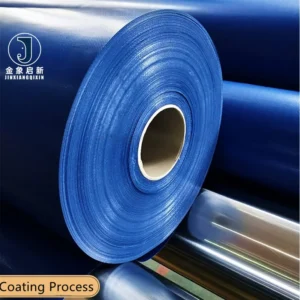
Deep Coating Adhesion Control — our 30-year focus on knife coated fabric means peel strength at the weld line is managed through coating weight and formulation, not left to chance when the trailer flexes under load.
Technical Specifications
| Parameter | Value |
|---|---|
| Product Type | PVC Coated Tarpaulin |
| Coating Method | Knife coated |
| Coating Material | PVC |
| Flame Retardant | Available in flame retardant grades — confirm the grade required for your market |
| UV Treatment | Available with UV stabilisation — request test report for your exposure zone |
| Anti-Mildew | Mildew proof formulation |
| Antibacterial | Yes |
| Chemical Resistance | Oil, stain, acid and alkali resistant |
| Temperature Performance | High temperature and cold resistance, anti-oxidation |
| Weather Resistance | Weather resistant, highly flexible and crack resistant |
| Surface Property | Self-cleaning |
| Welding Compatibility | HF welding, hot air welding, sewing |
Application Suitability
| Application | Exposure & Requirement |
|---|---|
| Truck side curtains | Constant flexing at roller tracks, road abrasion, UV and rain exposure, repeated folding at tie-down points |
| Flatbed trailer covers | Wind load stress at edges, cargo abrasion, long-haul weather cycling across climate zones |
| Outdoor event tents | Crowd-safe flame retardant requirement, seasonal UV exposure, fold-and-store mildew risk |
| Airport hangar doors | Large-panel wind load, fire classification compliance, daily flex cycles from opening and closing |
| Tensile membrane structures | Sustained tension loading, UV degradation over service life, welded seam integrity under structural stress |
| Portable storage enclosures | Forklift and equipment contact, chemical splash from stored goods, weather seal at zip and overlap joints |
Why "Flame Retardant" on a Quotation Is Not Enough for Transport Compliance
Flame retardant without a named grade leaves your fleet exposed at the compliance checkpoint.
When a logistics operator orders truck cover fabric labelled simply as "fire retardant," the material may pass a basic ignition test but fail the specific standard your regional transport authority enforces. I have seen curtain-side trailers pulled from service during roadside inspection because the cover documentation listed no test standard — only a marketing claim. The cost is not just the replacement fabric; it is the days of downtime while the new cover is fabricated and fitted [NEED_CITE: fire classification standards for commercial vehicle covers and transport textiles].
This PVC knife coated tarpaulin for truck and transport is available in multiple flame retardant grades. The grade you need depends on whether your market requires NFPA 701, DIN 4102 B1, M2, or a local equivalent. Specify the standard at the inquiry stage so the correct additive package is compounded into the coating formulation and the matching test report ships with your rolls.
Seam Integrity Where the Load Flexes Most
Truck side curtains fail at the weld line long before the fabric itself wears through. Road vibration, wind buffeting and the daily cycle of rolling and unrolling concentrate stress at every HF or hot air joint. This PVC knife coated tarpaulin for truck and transport is formulated for high peel resistance, meaning the bond between coating and base fabric holds through repeated flex cycles at the seam edge. Fabricators can choose HF welding for fast production throughput or hot air welding for field repairs and on-site modifications.
Chemical Exposure on Industrial Transport Routes
Flatbed and curtain-side loads are not always clean. Agricultural machinery leaks hydraulic fluid, chemical pallets drip during transit, and construction materials leave alkaline dust that settles on the cover surface. The oil, stain, acid and alkali resistance built into this fabric means the coating surface does not degrade or soften when exposed to these common transit contaminants. For fleet operators running mixed-cargo routes, this reduces the frequency of cover replacement driven by chemical staining or coating breakdown rather than mechanical wear [NEED_CITE: chemical resistance testing methods for PVC coated industrial fabrics].
How Coating Method, Welding Compatibility and Surface Treatment Interact in the Field
Knife coating applies the PVC layer as a controlled liquid film directly onto the base fabric, building coating weight in a single pass that locks the polymer into the yarn interstices. This produces higher peel strength than lamination, which is why HF and hot air welding both achieve strong seam bonds without delamination risk at the joint. The self-cleaning surface treatment reduces dirt adhesion during transit, so rain washes away road grime rather than leaving a film that dulls fleet branding over time. Anti-mildew and antibacterial additives are compounded into the coating itself, which matters for trucks running humid coastal or tropical routes where rolled-up curtains stored in damp compartments would otherwise develop fungal growth. The high temperature and cold resistance formulation keeps the fabric flexible across seasonal temperature swings, preventing the stiffening and micro-cracking that lets moisture reach the base fabric in freezing conditions. Crack resistance under repeated folding is a function of both the plasticiser system and the base fabric construction — a stiff base yarn will crack a flexible coating from the inside out, so both layers must be matched to the flex demands of curtain-side operation [NEED_CITE: tensile and tear test methods for coated fabrics per ISO 1421].
What Happens When Colour Varies Across Rolls in a Fleet Order
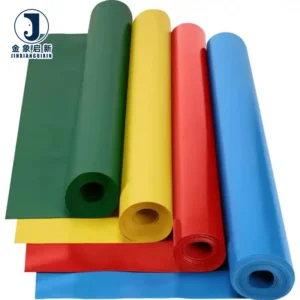
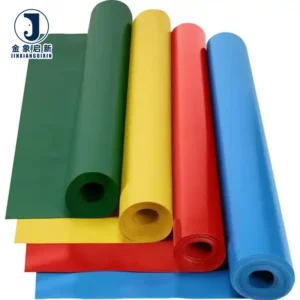
A transport company ordering covers for twenty trailers expects every truck in the yard to look identical. When colour shifts between rolls in the same shipment, the mismatch becomes visible the moment two adjacent panels are installed on a curtain-side trailer. The fleet operator is then forced to either accept an inconsistent appearance or reject partial rolls, delaying vehicle delivery and creating waste. This is a production discipline problem — pigment dosing, mixing time and coating temperature must be held constant from the first roll to the last [NEED_CITE: colour measurement and batch consistency standards for coated textiles]. Our QA process checks colour consistency across every roll in a single order before dispatch, so the fleet covers you receive match from first to final panel.
Why Procurement Teams Consolidate Coated Fabric Supply Here
Nearly thirty years of production focused exclusively on coated fabric gives our process engineers deep familiarity with how PVC formulation changes affect weld behaviour, flex life and surface finish — knowledge that shows up in fewer fabrication surprises for your team. Three full production lines and thirty-six sets of professional equipment mean your fleet-scale order runs on dedicated capacity rather than being slotted between unrelated products. The ten-person R&D team handles material selection and sample development in-house, so when you need a specific colour matched to fleet livery or a custom width to reduce offcut waste on a particular trailer model, the sample is developed and shipped within days rather than weeks. Every roll undergoes inspection at each production stage, with a final 100% check before dispatch covering weight, colour and surface quality.
Documentation & Verification
- Material specification sheet stating base fabric denier, coating weight and confirmed GSM for your order
- UV and flame retardant test reports matched to the specific production batch you receive
- Pre-shipment inspection record documenting roll-by-roll weight verification against quoted GSM
- ISO and CE certificates included with every shipment for your compliance file
- Roll packing list with individual roll IDs for traceability through your fabrication process
Fabrication, Handling & Storage
- HF welding recommended for production seams on this knife coated PVC; adjust dwell time to coating weight for full peel strength
- Hot air welding suited to field repairs and on-site curtain modifications where HF equipment is unavailable
- Store rolls upright on pallets in a dry, shaded area to prevent surface compression marks on the self-cleaning coating
- Allow cold-stored rolls to reach ambient temperature before unrolling to avoid stress cracking in the PVC layer
- Use mild detergent only for cleaning; solvent-based products may attack the plasticiser system and reduce flex life
- Plan cutting layouts to minimise transverse welds across the curtain width, concentrating seams at lower-stress zones
What to Include in Your Inquiry
To help us recommend the correct formulation and grade, share the trailer models you are covering, the welding method your fabrication team uses, and any flame retardant standard your regional transport authority requires. If you need the PVC knife coated tarpaulin for truck and transport supplied in a specific fleet colour, provide a RAL or Pantone reference so we can develop a matched sample. Let us know whether you need full rolls for your own cutting operation or pre-cut panels sized to your trailer dimensions.
Frequently Asked Questions
Q: How is GSM verified on arrival to match the quotation?
A: Every roll is weighed during pre-shipment inspection and recorded on the inspection report that ships with your order. You can cross-check the documented weight against the quoted GSM on arrival. If any roll falls outside tolerance, it is held before dispatch and replaced.
Q: What flame retardant grade can be supplied and does it meet my transport safety standard?
A: We supply this fabric in multiple flame retardant grades. Tell us which standard your market requires — NFPA 701, DIN 4102 B1, M2 or another — and we will compound the correct additive package and provide the matching test report with your shipment.
Q: How is colour consistency controlled across rolls in a fleet-scale order?
A: Pigment dosing, mixing parameters and coating temperature are locked for the full production run. Our QA team checks colour across every roll before dispatch using consistent lighting conditions, so panels cut from different rolls install without visible variation on adjacent trailers.
Q: Which welding method gives the strongest seam for side curtain applications?
A: HF welding typically produces the highest peel strength for production-scale side curtain seams on this knife coated PVC. Hot air welding is a strong alternative for field repairs or smaller fabrication shops without HF equipment. Sewing is an option for non-structural panels.
Q: Can the fabric be cut to my specific trailer model dimensions and what is the lead time?
A: Yes, we cut panels to exact trailer model dimensions. Provide the make, model and year of each trailer in your fleet, along with any custom eyelet or reinforcement requirements. Lead time depends on order volume and customisation level, which we confirm at the quotation stage.