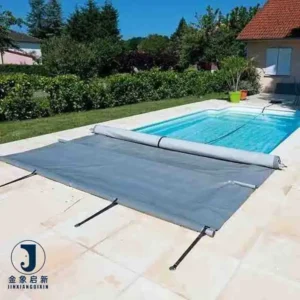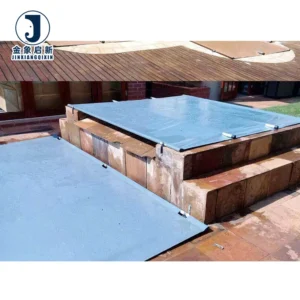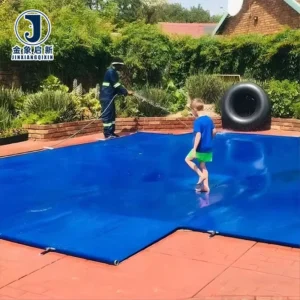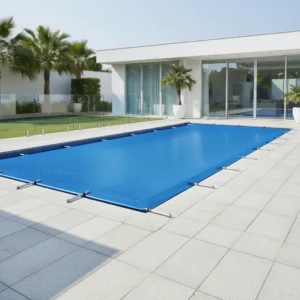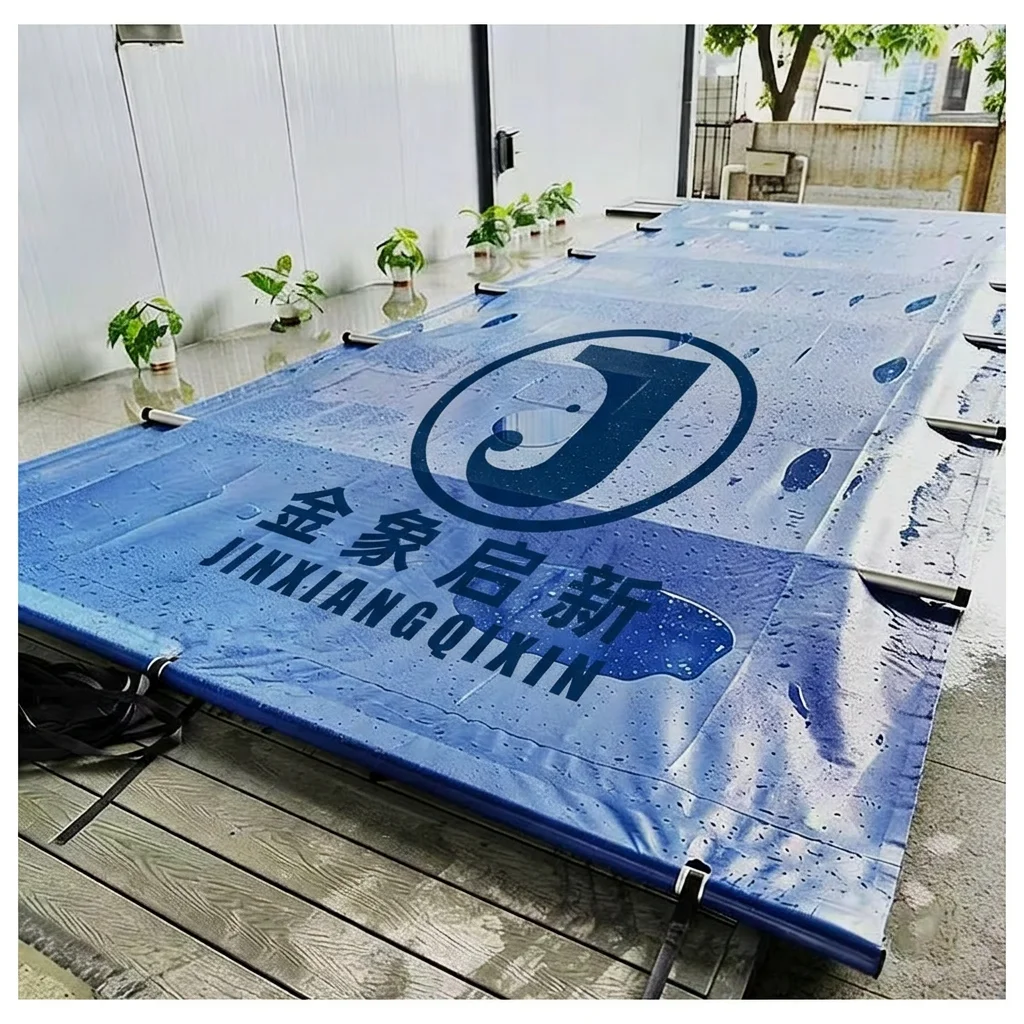
Precision Fitment Engineering — every cover is cut to the exact pool footprint and finished with reinforced anchor points at the six load-bearing connections, eliminating the dangerous edge gaps that generic tarps leave behind.
Technical Specifications
| Parameter | Value |
|---|---|
| Product Type | PVC Tarpaulin Cover Material |
| Coating Material | PVC (Knife Coated) |
| Weight Range | 50gr/m² ~ 220gr/m² |
| Thickness | 0.2–0.4 mm / 8–16 mil |
| Color Options | Blue, Blue/Orange, Green, Grey, Black, Clear, Grey/Green, Orange, Custom |
| Surface Treatment | UV Treatment Available (test basis not stated) |
| Waterproof | Yes |
| Mildew Resistant | Yes |
| Tear Resistant | Yes |
| Hardware Components | Brass Anchor, Triangular Hook, Ratchet System, Aluminium Poles |
| Attachment Method | Self-sinking stainless steel connections at six points |
| Operation Compatibility | Manual or motorized winders |
| Assembly State | Custom cut-to-size with hardware kit |
| Certifications | ISO 9001, ISO 14001, ISO 45001, CE |
Application Suitability
| Application | Exposure & Requirement |
|---|---|
| Residential swimming pool solid covers | Year-round outdoor weather, UV exposure, child safety tensioning, deck-anchor load transfer |
| Commercial pool facilities (hotels, resorts, fitness centres) | High-frequency deployment and removal, seasonal closure cycles, motorized winder compatibility |
| Pool construction and renovation contractors | Integration with new deck builds, embedded brass anchor placement, specification compliance at handover |
| Transport fleet load coverage | Road abrasion, wind uplift, flex-point stress at tie-downs, weather and debris exposure during transit |
Why a Generic Tarp Fails as a Pool Cover — and What PVC Pool Cover Material Aftermarket Supplier Specification Actually Solves
A pool cover is only as safe as its weakest anchor point, not its fabric weight.
I have walked residential pool sites where a generic tarp was strapped over a pool with bungee cords and deck screws, leaving gaps wide enough for a small child to slip through at the corners. The cover looked adequate from a distance, but the edge seal was nonexistent, and the attachment hardware was pulling through unreinforced fabric within one season. [NEED_CITE: pool safety cover anchoring standards for residential installations]
The PVC pool cover material aftermarket supplier approach replaces that improvisation with a system: knife-coated PVC fabric cut to the exact pool perimeter, brass anchors set into the deck, and a ratchet tensioning network that pulls the cover flat across the surface through six self-sinking stainless steel connection points. When the hardware and the fabric are specified together rather than sourced separately, the failure mode shifts from the attachment tearing through the material to a controlled, inspectable connection.
Deck-Embedded Anchoring and the Six-Point Connection Architecture
The brass anchors are drilled into the pool deck perimeter at calculated intervals, each receiving a triangular hook that links to the cover edge. The ratchet system then distributes tension evenly across the cover surface rather than concentrating stress at two or three tie-down points. This matters because a PVC pool cover for truck and transport or pool application must resist wind uplift uniformly — a single slack zone becomes a collection point for rainwater and debris, adding dead load that accelerates wear at adjacent anchor points.
The six self-sinking stainless steel connections sit flush with the deck surface when disengaged, preventing trip hazards and preserving the pool surround aesthetics during the swimming season when the cover is stored.
Wind Load, Water Shedding, and the Role of Tension Geometry
A flat cover that sheds water relies entirely on correct tension to maintain its pitch. When the ratchet system is engaged to specification, the cover forms a slight crown that directs rainfall toward the pool edge rather than allowing ponding at the centre. The aluminium poles provide intermediate support across wider pool spans where fabric alone would deflect under accumulated water weight. [NEED_CITE: wind uplift calculation methods for tensioned membrane covers]
The PVC pool cover fabric custom manufacturer must account for the specific pool dimensions when placing the aluminium pole supports and determining the ratchet interval — a system designed for a 6-metre span will not transfer directly to a 12-metre commercial pool without structural recalculation.
Knife Coating, Base Fabric, and Why Weight Alone Misleads Buyers
The knife-coating process applies a controlled layer of PVC compound directly onto the woven base fabric, producing a consistent coating weight across the full roll width. This consistency matters for pool covers because uneven coating creates thin spots that become the first points of UV degradation and water ingress. The weight range of 50gr/m² to 220gr/m² covers different span and load requirements — lighter grades serve residential pools with shorter unsupported spans, while heavier grades are specified for commercial facilities with wider spans and higher wind exposure.
The base fabric weave density determines how the load transfers from the coating to the yarn structure. A tighter weave resists tear propagation better at the anchor connection points, where the brass hook concentrates force into a small fabric area. Mildew resistance and tear resistance are inherent properties of the coated construction rather than added treatments, meaning they persist through repeated deployment cycles without reapplication. Colour options extend beyond standard blue and green to custom references, which matters when the cover must integrate with a specific landscape or architectural palette. The UV treatment is available, though the specific test basis should be confirmed against your market’s exposure classification requirements before specification.
The Cost of Specifying Hardware Separately from Fabric
When the cover fabric and the anchoring hardware are sourced from different suppliers, the connection points become the failure boundary. I have reviewed projects where the PVC fabric met specification but the grommets pulled through under ratchet tension because the reinforcement patch was sized for a different anchor geometry. The result was a cover that had to be removed, returned, and re-fabricated mid-season — a delay that left the pool exposed during a period when the client needed it covered. [NEED_CITE: hardware compatibility testing for coated fabric anchor systems]
Batch colour variation between rolls in the same order is another sourcing failure that becomes visible only after installation, when two adjacent panels are installed side by side and the difference is obvious in direct sunlight. Specifying the cover as a complete system — fabric, hardware, and finishing — from a single source shifts the compatibility responsibility to the supplier and makes the pre-shipment inspection meaningful rather than cosmetic.
What the Production Process Delivers for This Product
The three full production lines and 36 sets of professional equipment support the volume required for commercial pool contractors who need multiple cover systems for seasonal deployment across a portfolio of sites. The 10-person R&D team handles the custom sizing and hardware fitment development, producing samples within days so that the anchor placement and ratchet geometry can be validated on-site before full production runs.
Dedicated QA/QC at every production stage with 100% inspection before shipment means that each cover is checked against the specific pool dimensions and hardware specification before dispatch — not just inspected for visual defects on a sample basis. This matters when a cover cut to a generic size will not fit the specific pool footprint, leaving dangerous gaps that compromise the safety function of the installation.
Documentation & Verification
- Material specification sheet stating GSM, base fabric type, coating method, and colour reference for each cover produced
- Pre-shipment inspection record confirming cover dimensions match the specified pool footprint before dispatch
- ISO and CE certificates included with shipment documentation for project compliance files
- UV treatment test documentation available — confirm the grade required for your market exposure classification
- Hardware component list cross-referenced to the cover anchor point layout drawing
Fabrication, Handling & Storage
- Heat-weld seams at reinforced attachment zones using temperature settings matched to the specific PVC coating weight
- Brass anchors must be drilled into cured concrete or stone deck — soft timber surrounds require alternative fixing specification
- Store rolled covers on aluminium poles in a dry, shaded area to prevent coating adhesion loss from prolonged compression
- Deploy the cover with the ratchet system at minimum tension first, then increase gradually to avoid shock-loading individual anchors
- Clean with mild detergent and soft brush — avoid solvent-based cleaners that can degrade the knife-coated PVC surface
- Cut-to-size fabrication should allow for thermal expansion tolerance across the stated temperature range of the installed environment
Requesting a Specification for Your Pool Cover Project
Provide the pool dimensions including perimeter shape, deck construction material, and the span between opposite anchor points so the aluminium pole count and ratchet interval can be calculated. Confirm whether the cover will be deployed and removed manually or requires motorized winder integration, and specify the colour reference or custom colour requirement for the project.
Frequently Asked Questions
Q: How is the PVC pool cover sized to fit a specific pool shape and dimension?
A: The cover is cut to the exact pool perimeter measurement provided at inquiry stage, with reinforced anchor points placed at calculated intervals matching the deck-embedded brass anchor layout. The PVC pool cover for truck and transport or pool application is produced as a custom unit, not adapted from a generic roll size, ensuring the edge seal is complete with no gaps at corners or curves.
Q: What hardware is included and how are the anchors installed into the pool deck?
A: Each cover system ships with brass anchors, triangular hooks, a ratchet tensioning system, and aluminium support poles. The brass anchors are drilled into the pool deck perimeter at positions specified on the layout drawing provided with the cover. Self-sinking stainless steel connections sit flush with the deck surface when the cover is removed for the swimming season.
Q: How does the ratchet tensioning system work for cover removal and re-installation?
A: The ratchet system connects the triangular hooks at each brass anchor point to the cover edge, allowing controlled tension adjustment across the full cover surface. Deployment requires engaging each ratchet to minimum tension first, then increasing gradually in a cross-pattern sequence to distribute load evenly. Removal reverses the process and the cover folds onto the aluminium poles for storage.
Q: Is the UV-resistant treatment backed by a test report, and what is the expected outdoor service life?
A: UV treatment is available on the knife-coated PVC fabric, though the specific test basis should be confirmed against your market’s requirements at inquiry stage. Request the applicable test documentation when specifying the cover for high-exposure environments. Service life depends on installation tension, local climate, and deployment frequency rather than a fixed year count.
Q: Can the cover be supplied with motorized winders for large commercial pools?
A: The cover system is compatible with both manual and motorized winder configurations. For commercial pools with wider spans and heavier cover weight, motorized winders reduce deployment time and labour requirements. Specify the winder type at inquiry stage so the cover edge reinforcement and aluminium pole spacing are configured for the winding mechanism load profile.